
Almeria fire
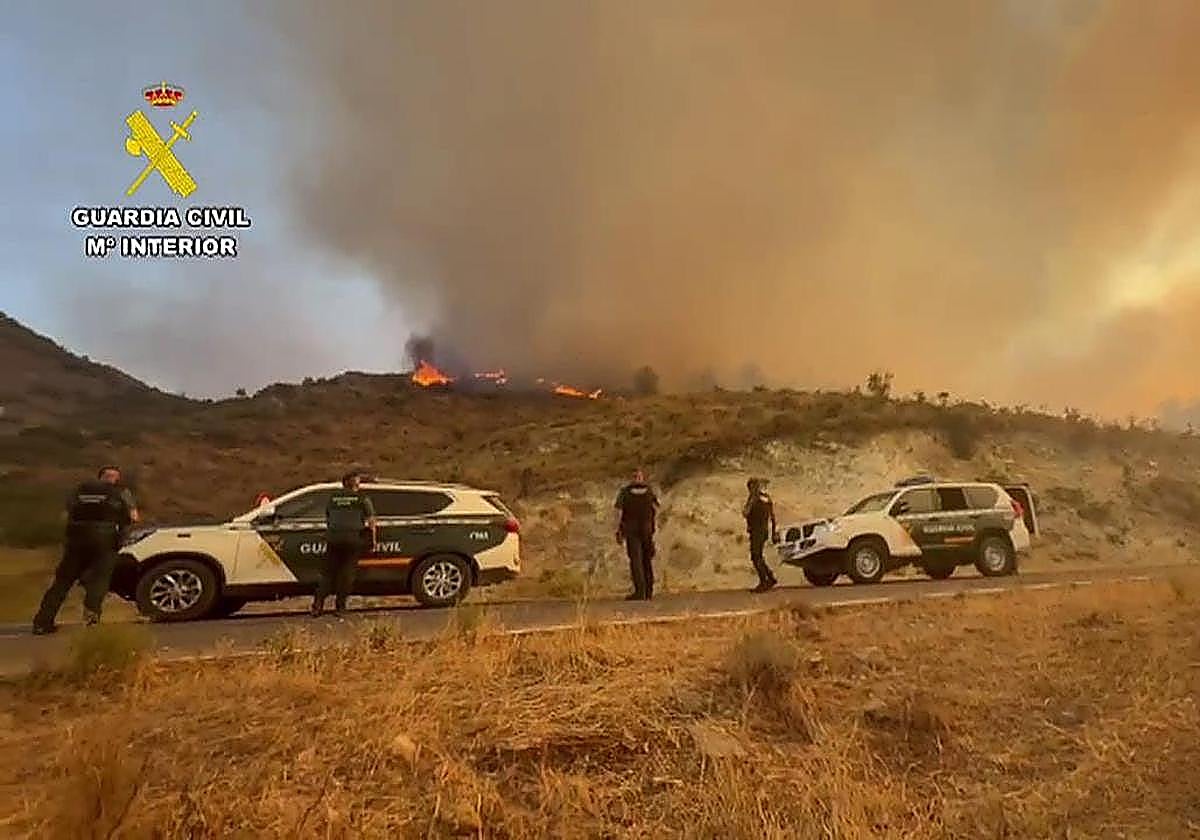
Guardia Civil search for possible victims among the burnt-out vehicles
The deployment of 500 ground troops and around twenty aircraft has shifted from defence to a direct attack, thanks to a lull in the wind and the humidity
Miguel Cárceles
Members of the Guardia Civil responding to the forest fire in Almería, which has claimed twelve lives, are continuing to carry out intensive search and ... prevention operations in the area between Los Gallardos and Vera. Officers are conducting searches to locate anyone who may be in the affected area, including inside vehicles, while continuing to take measures to control and secure the perimeter of the fire.
The Guardia Civil continue to deploy their security measures, access controls and evacuation support, ensuring compliance with the measures adopted to guarantee the safety of the general public.
At the same time, the regional minister for health and emergencies, Antonio Sanz, stated on Saturday that the “brief window of good weather” had been utilised “to the full” and expressed hope that there would be no further fatalities, apart from the twelve victims already confirmed.
Meanwhile, the change in weather conditions has led to a radical shift in strategy in the fight against the devastating wildfire ravaging the region of Andalucía. Following days of extreme difficulty characterised by the fire’s erratic behaviour, Antonio Sanz announced a shift from a purely defensive tactic to a direct offensive against the flames.
This strategic shift comes at a critical moment, just as the provisional assessment of the affected area puts the total area burnt at 6,600 hectares. The intense hotspots and active fire fronts recorded over the last few hours have forced the firefighting teams to redouble their efforts, significantly expanding a perimeter that has the entire district on tenterhooks.
The key to this cautious optimism lies in a respite from the weather, which the regional government’s experts have described as an "extraordinary window of opportunity". For the first time since the disaster struck, the wind has been very light, recording a speed of just two kilometres per hour, whilst relative humidity has stood at around 50 per cent.
These circumstances stand in stark contrast to the hostile conditions of the previous days, when strong gusts of wind and extreme dryness had restricted the Infoca Plan’s operations to containing the fire’s rear and protecting its flanks. Today, with the fire fronts less active, operations commanders have been able to plan a direct assault on the hottest spots.
Large-scale deployment
On the ground, the operation is on a massive scale. A total of 500 ground personnel are working in a coordinated manner to extinguish the fires. This team comprises 200 professionals from the Infoca service, closely supported by a further 200 military personnel from the Military Emergency Unit (UME), members of the Forest Fire Reinforcement Brigades (BRIF) from the Ministry for Ecological Transition, and members of the Levante Fire Service.
In the air, reinforcements have been arriving steadily since early this morning. Initially, four aircraft - two helicopters and two cargo planes on the ground - set off at eight o’clock this morning, with two further helicopters joining them an hour later. The operation maintains a fleet of 22 aircraft ready to be deployed in stages according to the needs of the operations committee.
One of the key achievements of the last few hours has taken place on the A7 motorway. Specialists from Infoca’s technical fire unit - one of the new operational initiatives in this year’s campaign - carried out controlled tactical burning in the early hours of the morning, creating an artificial firebreak and successfully preventing the flames from spreading to the road.
Thanks to the effectiveness of these ‘fire-against-fire’ manoeuvres, the Andalusian authorities were able to reopen the A7 motorway to traffic in the early hours of the morning, restoring some normality to transport links in the area and facilitating the safe passage of emergency vehicles.
The regional government’s optimism has also been bolstered by the stabilisation of the other major fire that was simultaneously threatening the municipality of Benahavís. This has made it possible to free up resources and focus attention on the major blaze that is keeping the region on tenterhooks.
Nevertheless, caution continues to prevail at the forward command post. Although the outlook is considerably better than it was on Friday, the regional government points out that the fire remains on a large scale and that the coming hours will be crucial in bringing it under definitive control.
![[]](http://static.vocstatic.com/voc26/latest/assets/images/favicon/surinenglish/apple-touch-icon-57x57.png)