
Spain corruption
Supreme Court sentences former minister Ábalos to 24 years and adviser to 19 in the first corruption trial of the Sánchez era
The court, which has sentenced businessman De Aldama to four and a half years but suspended his prison sentence, considers that the former minister and those around him caused a “serious erosion of public trust”
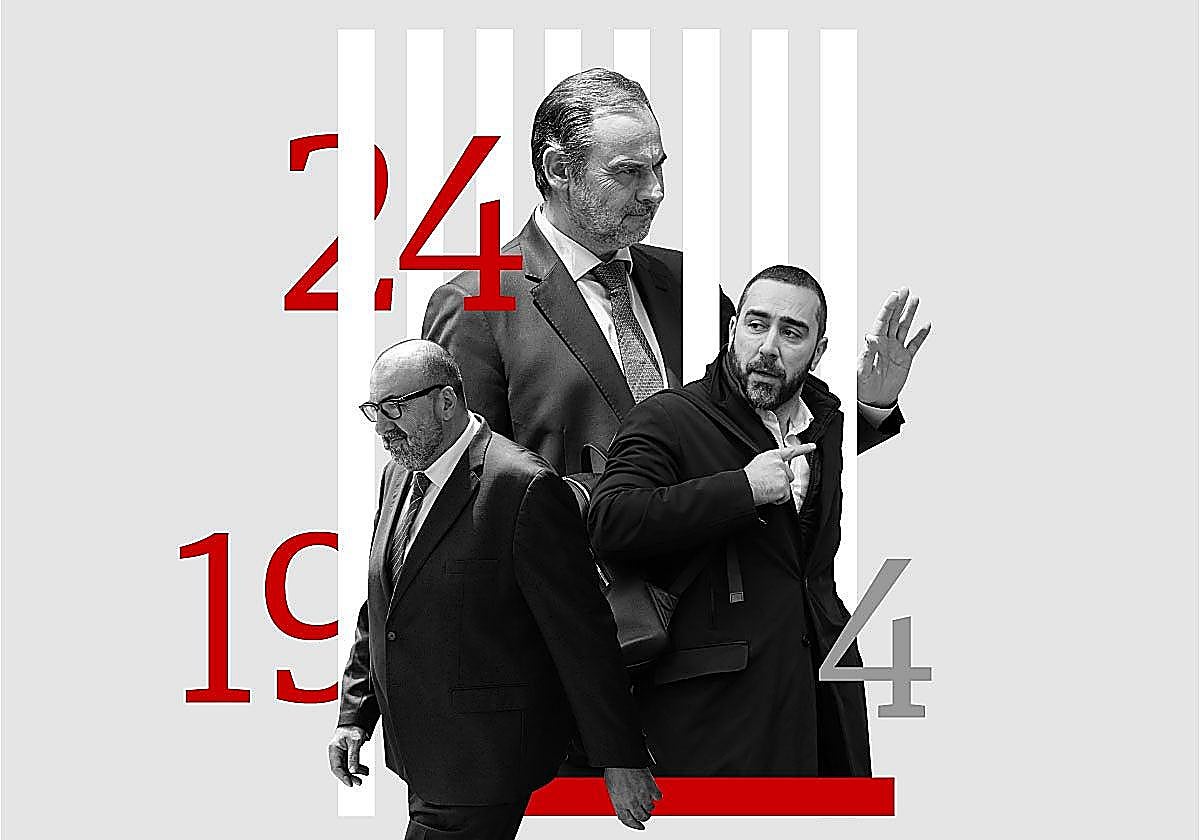

The first conviction for corruption in Pedro Sánchez’s government comes with the maximum possible sentence for José Luis Ábalos in the 'Koldo' corruption case. ... The Supreme Court has sentenced the former Minister of Transport to 24 years and three months in prison. His former adviser, Koldo García, has been handed 19 years, eight months and one day for offences of criminal organisation, bribery, embezzlement and influence-peddling.
The ruling , comprising 224 pages and adopted unanimously by the court presided over by Andrés Martínez-Arrieta, states that the offences committed by the former minister and his associates while "exercising public and political power" possess "destabilising potential" and "undermine the democratic architecture" of the State.
Alongside the sentence handed down to Ábalos, Sánchez’s former right-hand man in the PSOE and the government – and his all-round collaborator – the High Court has sentenced the businessman Víctor de Aldama to four and a half years in prison.
Related story
-

M. Balín / M. Sáiz-Pardo
However, in another significant decision, it has agreed to suspend this sentence for five years in recognition of the cooperation with the courts shown by the self-confessed ringleader of the corruption scheme. This suspension is conditional upon him not reoffending, appearing before the court every six months to report on his work, commercial or business activities, and carrying out one year of community service.
Ábalos’s sentence exceeds by three months the 24 years sought by the anti-corruption prosecutor’s office; Koldo’s sentence also exceeds the 19 and a half years requested by the public prosecutor’s office; and Aldama’s sentence falls short of the seven years sought by the public prosecutor’s office.
The judges have found it proven that the three convicted men were part of a criminal organisation intended to be long-lasting. Within it, each played his own role. Ábalos provided political leadership, ministerial influence and authority over the transport ministry.
Koldo, according to the judgement, was "more of an assistant than an adviser" and went on to become the former minister’s "right-hand man". Aldama, a businessman and fixer, identified business opportunities and paid to keep the door to the ministry open.
This is not just another conviction, even given the long list of convictions that Spanish democracy has accumulated: in fact, it is the most severe sentence handed down to any of the other ministers convicted previously. Ábalos served as the PSOE’s secretary for organisation between 18 June 2017 and 12 July 2021; minister for public works and later for transport; he was Sánchez’s right-hand man in the internal battle that restored the current prime minister to the Socialist Party’s general secretary post; and the voice of the Socialists in the motion of no confidence that brought their leader to La Moncloa. The ruling highlights precisely this dual role: minister and secretary of organisation of the party that led the government.
The court puts it bluntly: Ábalos wielded "considerable influence" by virtue of his ministerial status and his position within the PSOE. And, using Koldo, he took steps to favour companies linked to Aldama, in return for which he received commissions in cash and in kind. The court’s account traces the origins of this scheme to the trip to Mexico in February 2019, when the three convicted men saw “an opportunity to obtain a shared financial benefit”.
The court puts it bluntly: Ábalos had "considerable influence" by virtue of his role as a minister and his position within the PSOE
The first thread was the monthly payments. The judgement finds it proven that the three agreed on a monthly payment of 10,000 euros to cover Ábalos’s "fixed expenses". Aldama paid this from October 2019 to June 2022, first to Koldo and then to his brother Joseba. The court has ordered the seizure of 430,298 euros in proceeds from the bribery: €340,000 for those monthly payments, €82,295 for the rent on a flat in Plaza de España where Jésica Rodríguez lived, and €8,000 for a villa in Marbella.
The crux of the judgement lies in the face masks. In the midst of the pandemic, the three defendants, "by mutual agreement" and in "coordinated action", used their influence to ensure that Soluciones de Gestión, the company linked to Aldama, was awarded two supply contracts with Puertos del Estado and Adif. This involved 13 million face masks supplied to two bodies under the ministry of transport itself.
The court sees neither a coincidence nor a poorly managed emergency. It sees a prior agreement. Even before those in charge of the contracting authority were aware of the operation, the judgement states, the successful bidder already knew that there would be a ministerial order, that the purchase would be centralised through Puertos, that the volume would be eight million face masks and that it would be the chosen bidder. The Adif contract, according to the court, followed the same pattern. The ministerial order came afterwards. The successful bidder was, in practice, already standing by.
De Aldama’s presence at the Ministry of Transport is documented in several testimonies. Second Lieutenant José Luis Rodríguez stated that the businessman had permanent, unrestricted access to the minister’s private area. Álvaro Sánchez Manzanares, former secretary-general of ports, was even more direct: “Aldama was part of the ministry.” And Ricardo Mar Ruipérez, chief of staff, added that Koldo took orders only from Ábalos and that whatever the adviser said “was always the minister’s word”.
The judgement also convicts Jésica Rodríguez at Ineco and Claudia Montes at Logirail, Ábalos’s former lover and friend. In the case of the former, the Supreme Court asserts that, with the former minister’s knowledge and consent, she did not carry out "any work or function whatsoever" during the entire time she was employed by the public company. It also notes that she travelled with Ábalos on at least 13 occasions without any record of her having requested permission or leave from her employers.
Another company affected by the ruling is Air Europa . The Supreme Court has found it proven that Ábalos and Koldo took steps regarding a press release concerning the airline’s bailout and that, in return for this action, De Aldama arranged for them to stay free of charge at Villa Parra, a villa in Marbella where the former minister and his family spent a few days in August 2020. “This is on the house to make up for the inconvenience caused,” Koldo wrote to Ábalos when discussing the property.
The Supreme Court has acquitted the three of various offences of perverting the course of justice, forgery and insider dealing, but has upheld the core criminal charges in the case: criminal organisation, bribery, embezzlement and influence peddling
The third major property gift was in La Alcaidesa, La Línea de la Concepción, Cádiz, linked to negotiations regarding a hydrocarbons licence for Villafuel. The court concludes that Ábalos enjoyed free use of this villa for months and notes a ‘pattern of behaviour’ similar to that in Marbella: Koldo would look for a house that met the former minister’s requirements, inform De Aldama of this, and De Aldama would then enlist people in his circle to secure possession or ownership of the property. A conversation included in the judgement sums it up bluntly: "It was a case of finding a house and he just pressed the little button."
Not all the charges brought by the prosecution have been upheld. The Supreme Court has acquitted the three of several offences of abuse of office, forgery and insider dealing. However, it upheld the core criminal charges in the case: criminal organisation, bribery, embezzlement and influence peddling. Ábalos and Koldo must also pay compensation to Ineco and Tragsatec of 34,450 and 9,500.54 euros respectively.
The trial took place at the Supreme Court from 7 April to 6 May 2026, over 14 gruelling days of morning and afternoon sessions. The judgement does not bring the ‘Koldo case’ to a close. It establishes the facts. The first major figure has now been sentenced. And Sánchez’s former right-hand man has been unanimously identified as the central figure in an organisation that used public power to enrich itself.
The former minister’s son announces an appeal: ‘My father is going to die in prison’
“Now things are really going to kick off. Aldama is getting off scot-free and my father is going to die in prison.” Víctor Ábalos, the former minister’s eldest son, who is suspected of acting as his father’s front man and who tried to save him in his testimony before the Supreme Court, yesterday criticised the heavy sentence imposed by the high court on his father and the parallel reduction in sentence granted to Víctor de Aldama for cooperating with the authorities. Ábalos’s son, who made these remarks on the Cuatro television channel, indicated an intention to seek the annulment of the case and to lodge possible appeals against the verdict before the Spanish Constitutional Court and the European courts; to do so, Ábalos would need to argue that his fundamental rights were potentially violated throughout his prosecution. “There are many people in my family crying right now,” his son stated.
![[]](http://static.vocstatic.com/voc26/latest/assets/images/favicon/surinenglish/apple-touch-icon-57x57.png)