
Rail infrastructure
Spain's rail infrastructure company kept Urda section open in 2023 despite warnings of 'derailment' risk
A report by Adif warned of a "serious risk to rail services" due to the deterioration of the track, but the operator attempted a series of unsuccessful stopgap measures before ordering the replacement of 76,500 sleepers
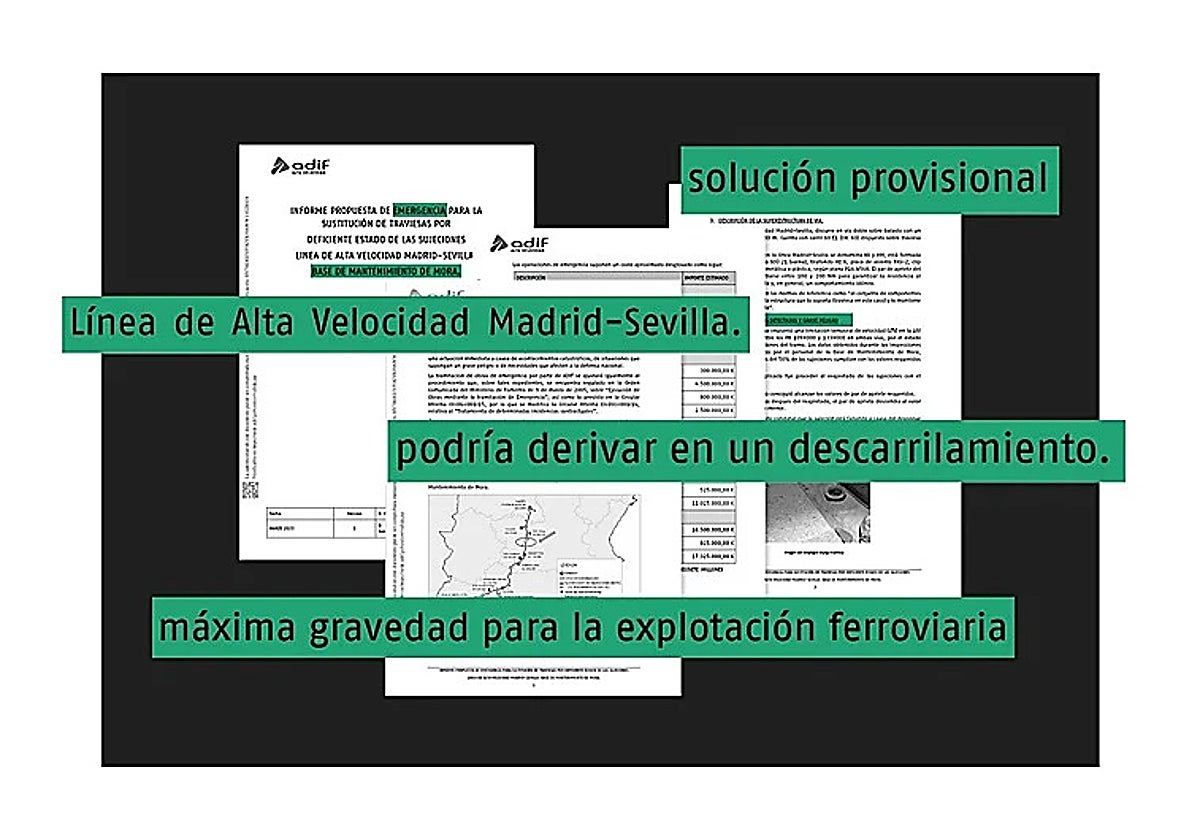

The Urda (Toledo province) tragedy could have occurred three years earlier and in exactly the same place, albeit for different reasons.
The lack of modernisation and the deterioration of the infrastructure were always the underlying factors. Not only was the LZB protection system that failed at Urda outdated, but it also led to the manual control prior to the tragedy. Rail infrastructure company Adif also knew, according to its own documents and records, that the section where the accident occurred on 28 October was already suffering from critical deterioration due to ageing, posing a risk of an accident.
Even so, at no point did Adif suspend services on this section, perhaps one of the most heavily used on this line, which has been in service for over 30 years. It merely reduced the speed of the trains.
What is more, Adif's own documents reveal that, before implementing a permanent solution to eliminate the risk of an accident, it spent four months unsuccessfully trialling various low-cost stopgap measures before finally deciding, this time for good, to replace the obsolete infrastructure.
The manager even warned in 2023, on the eve of Iryo and then Ouigo launching perations, which would cause the wear and tear on that infrastructure to skyrocket. that defects in the track fastenings could "lead to a derailment". The documentation reveals that Adif had attempted to rectify the problems with temporary repairs (unsuccessful retightening and a trial of replacing one in every three sleepers).
These "fixes" were to no avail and the track continued deteriorating. Surprisingly, traffic was not suspended at that point either. Instead, Adif proposed to increase the speed limit to 160 kilometres per hour.
The key document that reveals the entire operation says: "The fastening is a safety component, the widespread failure of which could have extremely serious consequences for railway operations. There is a tendency for the track gauge to widen on the affected sections, which in turn could lead to a derailment."
Cheap options
By then, the railway authority, far from suspending services and replacing all the sleepers, had been trialling other, cheaper alternatives, at least between December 2022 and March 2023, while hundreds of thousands of passengers continued to travel through Urda.
The then chair of Adif Alta Velocidad, María Luisa Domínguez, signed off on the change on 28 March 2023: exactly three years and seven months before the accident. The Minister for Transport at the time was Raquel Sánchez, Óscar Puente's predecessor in the post.
The emergency measure was approved just three days before Iryo began commercial services to Seville, Cordoba and Malaga on 31 March 2023. Ouigo joined the network of services to Andalucía in January 2025. The liberalisation added new services to Renfe's offering on the same corridor through Urda.
The expansion of services entailed more intensive use of infrastructure which Adif had previously recognised as being in need of renewal.
"Due to the situation described above, which poses a serious risk to rail traffic, it is not possible to wait for an urgent procurement procedure to be processed," the report states.
The problems on that section were so serious that they forced the introduction of a temporary speed limit in December 2022. Inspections by staff at the Mora maintenance depot revealed that fewer than half of the fastenings met the required torque to keep the rails properly secured.
The document states that "under 50 per cent of the fastenings met the required tightening torque values".
The first course of action was to try tightening them again. The document describes the result: "Retightening failed to achieve the required tightening torque values." A few weeks after the intervention, the fastenings had returned to their previous values or had even dropped to lower levels.
The situation got worse
"A few weeks after retightening, the torque value had dropped back to its previous level or even lower," the report notes. The situation was even worse than before, but trains continued running.
The report lists these measures as the background to the emergency measures approved in March, although it does not specify the dates on which they were carried out. It does, however, date a technical note from February 2023 which proposed increasing the speed limit to 160 kilometres per hour, subject to thorough monitoring of the track geometry and fastening.
The fault affected the anchoring of the fastenings within the sleepers. The sleeves were coming away from the surrounding concrete and the bolts were no longer exerting the necessary pressure on the components that secure the rail. This deterioration was causing the gap between the rails to widen.
Even before the signing in March, trials had been carried out to replace one in every three sleepers. The report explains that removing one sleeper meant having to move the adjacent ones and tamper with their damaged fixings, with the risk of rendering them permanently unusable. This partial intervention slowed down the work, and the engineers ruled it out due to insufficient safety guarantees.
"This is a temporary solution that does not guarantee the security of the system," the report acknowledges quite openly.
For the emergency works in the Urda area, a total of 17,325,000 euros (excluding IVA) was finally authorised: 6.3 million for the supply of sleepers to Prefabricaciones y Contratas and over eleven million for the works carried out by Comsa. The civil engineering contract stipulated a timeframe of eleven months from the start date, which was to be formalised by means of a minutes of meeting or a written order.
Access the broad Spain national news archive
