
Pope's visit to Spain
Sagrada Familia's tallest tower blessed by Pope Leo XIV
Papal blessing of the Tower of Jesus on the centenary of Gaudí's death crowns the architect's elevation as the Sagrada Familia nears completion
Iva Anguera
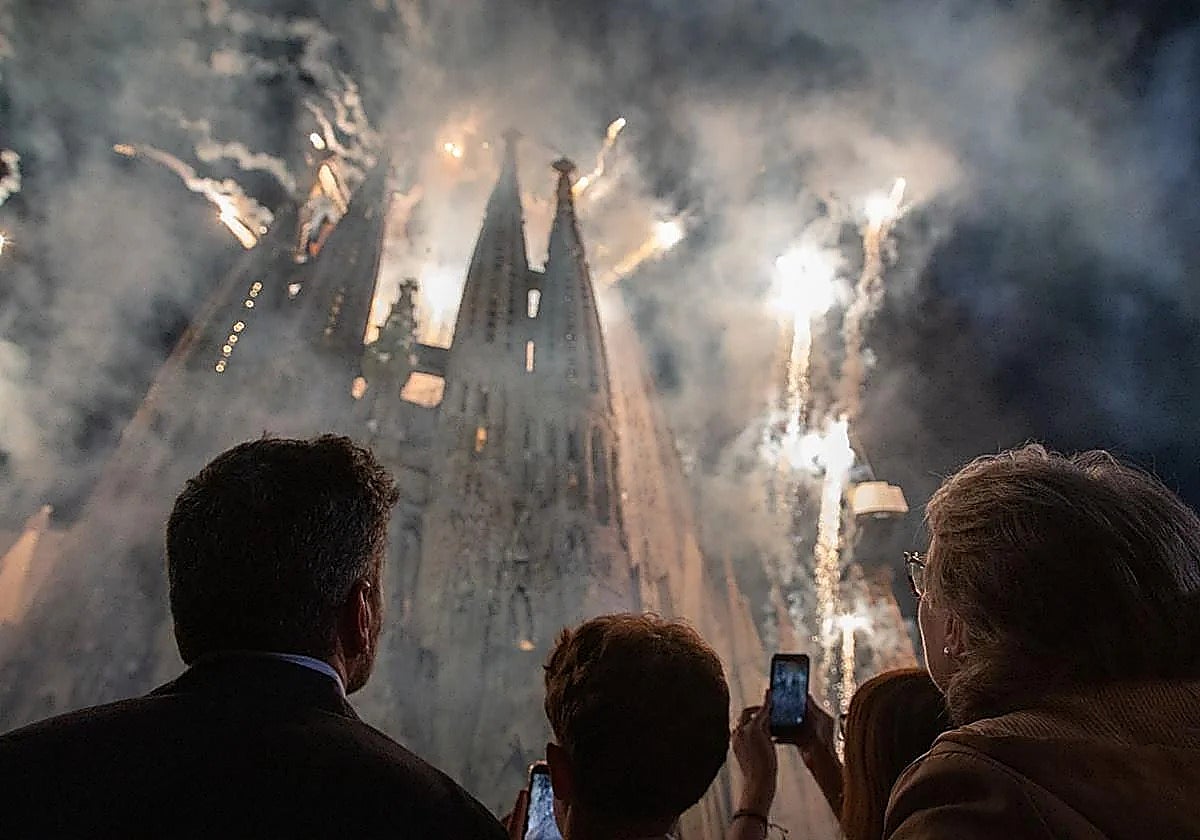
Pope Leo XIV and a spectacular display of light and fireworks crowned the Sagrada Familia on Wednesday as Barcelona's definitive landmark, the highest point on the city skyline thanks to the 172.5-metre Tower of Jesus and the most recognisable feature of its cityscape.
The tower is topped by Gaudí's illuminated cross, through which "God protects the city of Barcelona and embraces" its people, as Valentina, a blind girl who described the Tower of Jesus to the Pope, King Felipe VI and Queen Letizia as they arrived at the basilica, said.
The ceremony confirmed that Barcelona has finally embraced what the Pontiff called the "venerable Architect of God".
Related story
-
Pope's visit in Spain
Minor Dario
It was not always so. In the 1970s and 1980s, debate centred on whether construction should continue at all. Some of the most prominent figures of Barcelona's architectural 'gauche divine' movement including Óscar Tusquets and Oriol Bohigas, argued that Antoni Gaudí's masterpiece should be demolished.
At that time, the cathedral survived thanks to donations from parishioners in the dioceses of Barcelona and Sant Feliu. The Sagrada Familia also held annual fundraising collections, much like the Church's World Mission Sunday appeal or cancer charities.
For that reason, Pope John Paul II remarked during his 1982 visit that the temple conceived by Gaudí was "the work of the will of a people", as president of the Sagrada Familia foundation Esteve Camps said.
Back then there were no crowds of tourists and no multimillion-euro revenues. That came later, following the Barcelona Olympics and, above all, after Pope Benedict XVI consecrated the church as a basilica in 2010.
Compared with the crowds Leo XIV drew in Madrid and Barcelona this week, Benedict's visit generated far less public enthusiasm. Nor did it attract requests from international leaders to attend. The only senior civil authority present alongside King Juan Carlos and Queen Sofía was Catalan regional president José Montilla.
On Wednesday, however, Prime Minister Pedro Sánchez led a sizeable government delegation that included members from coalition partner Sumar, among them Yolanda Díaz and Ernest Urtasun. Representatives from several European governments also attended the ceremony inside the basilica, alongside around 200 bishops from across the Mediterranean and the entire Spanish Catholic hierarchy.
Unforgettable international exposure
The basilica's consecration nevertheless had a major international impact thanks to global television coverage. The ceremony reached audiences around the world and visits to the Sagrada Familia rose by 40 per cent afterwards. Revenue also climbed steadily, reaching 134 million euros in 2025, when almost five million people visited.
"It's Barcelona's icon," Camps proudly said, reflecting on the work carried out over recent decades. He noted, for example, that organisers of the World Congress of Architects chose Barcelona as their host city during the Gaudí centenary year and requested that the awards ceremony take place inside the Sagrada Familia.
"Japanese tourists don't realise it, but they're expiating their sins when they visit us," the basilica's parish priest, Josep Maria Turull, joked.
In reality, today's visitors are not so different from the audience Gaudí originally had in mind. He designed the church to explain scripture to people who do not attend Mass regularly.
That is why the life of Jesus unfolds on the exterior of the building through its three façades: the Nativity, the Passion and the Glory facade, the latter still awaiting decoration and the planned pedestrian bridge over Carrer de Mallorca.
Gaudí's dream reaches its culmination with the Tower of Jesus
The Sagrada Familia is also a building that "invites spirituality through its 18 towers, which rise towards the sky and lift the gaze upwards", current chief architect Jordi Faulí said.
Gaudí inherited the project launched on St Joseph's Day in 1882 by architect Francesc del Villar and transformed it into "a far more monumental temple".
By 1906, the man now known as the "Architect of God" had already conceived the full monumental ensemble of the Sagrada Familia, centred on its 18 towers.
These include the towers of the Twelve Apostles, the four Evangelists represented by the tetramorphs of John, Matthew, Luke and Mark, the Tower of the Virgin Mary and the Tower of Jesus, which now stands crowned, although its interior will not open to visitors until 2028.
In his writings, Gaudí described "a tower resting upon four columns". At its summit, he envisioned an illuminated cross projecting its arms across Barcelona, fulfilling Christ's words: "I am the light of the world."
![[]](http://static.vocstatic.com/voc26/latest/assets/images/favicon/surinenglish/apple-touch-icon-57x57.png)