
Archaeology
Ancient bronze chariot discovered at Tartessian site of Turuñuelo
A 6th-century BC vessel featuring the Greek god Achelous has been unearthed in Spain alongside luxury ivory and Egyptian imports during the eighth excavation campaign in Extremadura.
-RbBi4qykYd9p9uDIx9cEydO-1200x840@diario_abc-kCHD-U101072592324x1-1200x840@Diario%20Sur.jpg)

Mónica Arrizabalaga
Every excavation campaign at Casas del Turuñuelo in Guareña, Badajoz, holds a surprise for archaeologists.
"There’s always something unique, an extraordinary find, and ... this year has been no exception," revealed Sebastián Celestino, co-director of the Construyendo Tarteso team.
The Extremaduran site is fundamentally altering our understanding of the legendary Tartessos civilisation. Beneath a mound in the Vegas del Guadiana - where the mass sacrifice of some 50 horses inside a monumental building was previously documented - archaeologists have unearthed treasures as impressive as those attributed to the semi-mythical King Argantonio.
Related story
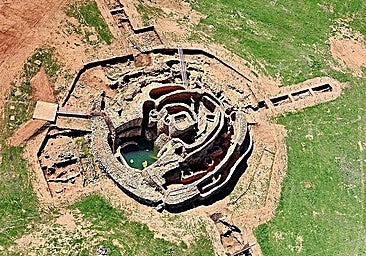
Following the 2023 discovery of the first sculpted faces of this civilisation, a slate warrior tablet, and a columnar altar from the Turkish island of Marmara, the team has now uncovered a 6th-century BC bronze votive chariot.
"It is extremely rare for something like this to turn up; we are studying it but so far we have no parallels," says Celestino.
The small chariot would have carried aromatic resins, such as myrrh or incense, during religious ceremonies, prompting researchers to describe it as a "rolling botafumeiro" - a reference to the famous giant censer of Santiago de Compostela cathedral. Co-director Esther Rodríguez suggests it played a central role in ritual banquets held toward the end of the monumental building’s life.
A protective deity and Etruscan links
The chariot was found broken in half but is otherwise beautifully preserved and richly decorated. Its sides feature griffins - mythological creatures with the bodies of eagles and lions - while the front bears the image of Achelous.
-U83150431824ypD-758x530@diario_abc-kCHD--609x426@Diario%20Sur.jpg)
"He is the god of the waters who has bull’s horns and the face of a Gorgon, like Medusa, but with her tongue sticking out," describes Celestino, noting this is the first depiction of the deity ever found on the Iberian Peninsula. On either side of the deity, two bearded, loincloth-clad male figures act as Atlantean supports.
The 60-centimetre-long artefact was unearthed in April and immediately transferred to the conservation laboratory at the Autonomous University of Madrid. While isotope analyses are pending to determine the origin of the bronze, researchers believe the lost-wax casting technique points toward Etruria in modern-day Italy.
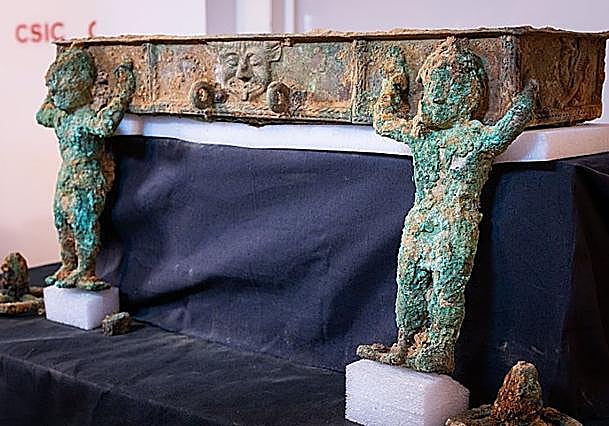
The vehicle was intentionally split in two before the inhabitants abandoned the site. Following a massive animal sacrifice and a final feast, the community systematically smashed their household items and sculptures. However, archaeologists note the chariot was treated less ruthlessly than other items, likely out of fear of the protective deity depicted on it.
The 'year of imports'
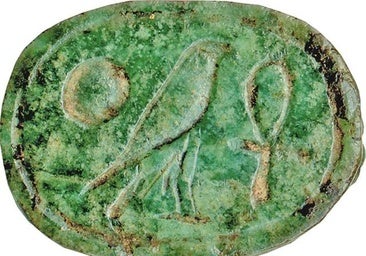
The object was discovered on the upper floor of the complex, next to a newly identified "banquet hall." This southern residential zone has yielded such a high volume of foreign luxury goods that the team has dubbed this season "the year of imports".
Related story
-
Arachaeology
Dilip Kuner
The architectural layout of the site is also becoming clearer. The recent excavations, which concluded at the end of May, confirm a strict division of space within the monumental building. The upper floor served as a high-status residential area filled with luxury goods, while the lower courtyard was an open, public area where ritual remains were deposited.
The team chose to shorten this year's field campaign to focus on post-excavation analysis. With unique artefacts emerging every season, processing the sheer volume of Mediterranean history preserved in the Extremaduran mud has become the archaeologists' primary challenge.
![[]](http://static.vocstatic.com/voc26/latest/assets/images/favicon/surinenglish/apple-touch-icon-57x57.png)