
Ceuta migration crisis
Spanish police say 125,000 people entered Ceuta in July, compared to the 72,000 government estimate
The national immigration and border control centre's latest report describes a mobilisation consisting almost exclusively of Moroccan citizens from across the country, who entered Ceuta in a perfectly coordinated manner
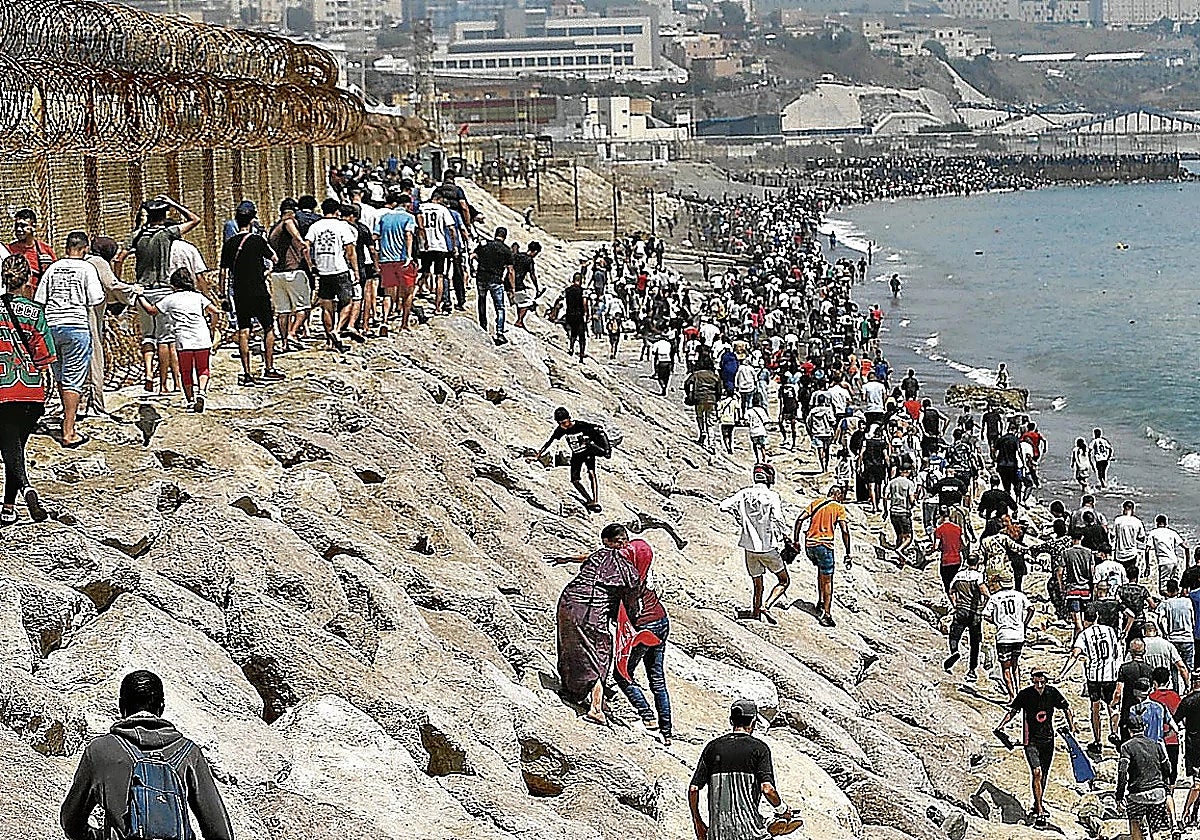

The National Police have revised the number of people who entered Ceuta during the mass influx on 30 and 31 July upwards to 125,000, ... which is 53,000 more than the government's estimate (72,000).
The confusion over the figures persists to such an extent that Spain still does not know how many people actually crossed the border, how many returned to Morocco, how many remain on Spanish territory and what the exact death toll was.
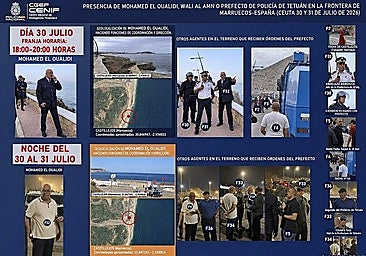
The new estimate appears in the latest report Cenif (the national centre for immigration and borders) submitted to judge María Tardón. Cenif is the police body that has investigated the influx most thoroughly.
Related story
The investigators estimate the number of arrivals at between 100,000 and 125,000 people, "almost exclusively Moroccans", coming from "virtually all parts" of the Northern African country.
According to the latest police analysis, it was a sort of perfectly coordinated human crossing in which, unlike the mass crossings of recent years, there were hardly any sub-Saharan migrants.
The scale of the influx in the latest police report is difficult to take in. Ceuta has a population of around 83,600. At the upper end of the police estimate, the number of arrivals would be equivalent to one and a half times the entire population of the Spanish territory, all arriving in the space of just two days.
Yet the new figures are still only estimates. Cenif has acknowledged that the number remains "undetermined". The report does not provide a breakdown that would make it possible to establish how many different people were involved in the crossings.
The back-and-forth over the figures began almost as soon as the influx happened. Interior Minister Fernando Grande-Marlaska corroborates the 72,000 estimate, although he admitted it was impossible to carry out an accurate count. The government stated that more than 70,000 people had left Ceuta in the first few days.
Cenif initially raised the estimate to a range of between 75,000 and 85,000 people.
Inconsistent statistics
The discrepancies also extend to the number of people who have returned to Morocco. In a report from 27 October, the Guardia Civil said that "approximately 88,146 people may have returned to Morocco". That is, 16,146 more than the number the Ministry of the Interior had recorded.
The armed forces' estimate is also provisional and covers a longer period, during which further movements and repeated crossings may have taken place. However, it highlights the enormous difficulties in reconciling the statistics from the various bodies responsible for managing the crisis.
The deputy director of operations of the National Police expressly acknowledged that they "have no official data on this matter". He stated that the entries had taken place via the breakwater and the fence at El Tarajal, which are under the custody of the Guardia Civil.
The government's latest update does not clear up all the uncertainties either. Moncloa (the government's headquarters) has recorded 16,475 returns and deportations. Of these, 15,692 are voluntary returns, as well as 305 deportations and 478 refusals of entry since the crisis began.
These statistics use different time periods and categories to those of the Guardia Civil. They also do not allow us to reconstruct the spontaneous returns that took place in the early days, when the government stated that more than 90 per cent of those who had entered Ceuta had left.
Minister of Territorial Policy Ángel Víctor Torres said on 8 September that it was "impossible for any institution to give an exact figure", because it was not possible to determine the exact number of people entering and leaving either.
Cenif vs CNI
The numerical uncertainty adds to the unresolved questions regarding who was behind the influx. While the CNI (national intelligence centre) holds it has found no evidence to attribute the planning of the operation to the Moroccan authorities, the Cenif continues to gather evidence of an organised operation, now also through the analysis of the large-scale supply of flotation devices used at the border.
The police force believes that the gathering of tens of thousands of people who had travelled from different parts of Morocco, the timing of the calls to action and the choice of a single border crossing suggest that this was not a spontaneous event and give rise to suspicions of prior planning.
There is also no definitive picture of those who remain in Ceuta. The government's figures from 17 November show 5,037 state-funded places occupied by adults and 3,767 by minors within the city's protection system. These are welfare figures that do not allow us to identify all the people who remain following that mass influx.
On 18 November, the judge again contacted the Tarifa maritime rescue coordination centre for precise details of exactly how many people they rescued on 30 and 31 July, during which time periods, where they were located and which units were involved in each rescue.
The discrepancy in figures also extends to the death toll. The government delegation put the figure at 72; the city of Ceuta at 88; and the Guardia Civil now estimate the number of deaths on Spanish soil at 90. Sánchez spoke of 141 victims. Morocco initially acknowledged eleven deaths and its national human rights council later raised the figure to 14. There is still no definitive number.
