
Ceuta crisis 2026
Spanish police and CNI intelligence service clash over Moroccan responsibility for Ceuta border surge
National Police investigators name 18 Moroccan officials in coordinated 'avalanche', while spy agency exonerates Rabat and Guardia Civil slams 'insufficient' warnings

A three-way battle inside Spain’s security apparatus threatens to trigger an institutional crisis following July's mass border crossings into Ceuta.
The National ... Police and the National Intelligence Centre (CNI) are openly at loggerheads over whether Morocco bore direct responsibility for the stampede, while the Guardia Civil has entered the fray by accusing the spy agency of providing "insufficient" informal warnings - even though Rabat had received an official, detailed alert about a potential human surge on 30 and 31 July.
National High Court (Audiencia Nacional) investigating judge María Tardón, who is leading the judicial inquiry into the events of 30 and 31 July, has been inundated in recent days with conflicting submissions.
Three reports - drawn up by the National Police, the CNI and the Guardia Civil, to which SUR has had access - offer sharply divergent accounts of how thousands of people breached the Spanish border.
The fiercest dispute pits the National Police’s National Immigration and Borders Centre (CENIF) against the Ministry of Defence’s intelligence service. While police investigators have identified 18 Moroccan suspects by name and rank, uncovering signs of a coordinated operation and shared instructions across different security corps, the CNI insists it lacks evidence to blame Rabat for orchestrating the surge.
In the most damning dossier against Morocco, CENIF officers interviewed 81 migrants, recorded 13 formal statements and cross-referenced testimonies, photographs, videos and police files to identify 18 individuals linked to Moroccan state actions during the crossings.
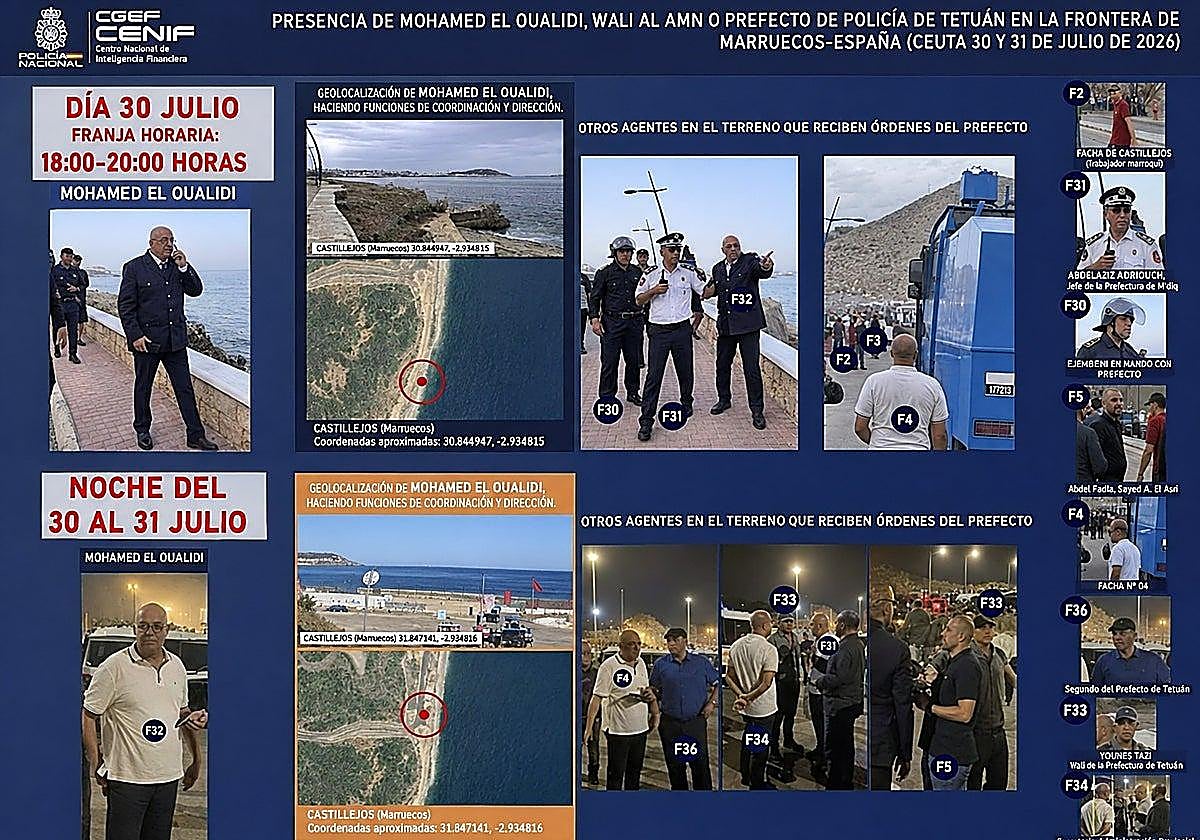
Among those named in full are Younes Tazi, governor of Tangier-Tetouan-Al Hoceima; Mohamed El Oualidi, police prefect of Tetouan; Youssef El Hajji, the highest-ranking civilian official in Castillejos; and Muhammad Al-Sassi, commander of a Moroccan riot police unit. Photographs, identification profiles and geolocations of several of these officials - spotted on the ground issuing orders as crowds advanced towards the Tarajal breakwater - fill much of the 42-page report.
'Compatible items'
CENIF identifies "clear evidence consistent with the existence of a higher-level, cross-organisational coordination structure", highlighting how police officers, gendarmes, auxiliary forces and civil authorities allegedly guided migrants towards the sea to reach Spanish territory.
Investigators conclude that this synchronised conduct "points to a planned and organised operation" driven by instructions shared across separate chains of command, and are examining ties between regional commanders, local officials and operational leaders to map out who gave the orders.
Mohamed El Oualidi features prominently, having been photographed between 6pm and 8pm on 30 July briefing other commanders and observed later that night in meetings with authorities as people continued heading towards Ceuta. While these documented actions remain under investigation and do not yet prove who ordered the operation or whether the Moroccan government was directly involved, police treat them as key evidentiary leads.
CNI rules out state-sponsored operation
The CNI’s nine-page report, submitted to Judge Tardón in November, is unequivocal: "to date, no evidence has been found to suggest" that the crossings were "instigated, planned or coordinated by the Moroccan authorities".
Although intelligence analysts acknowledge that a migration surge of this scale could theoretically be deployed as a hybrid warfare tactic - and identify Morocco's DGED and DGST secret services, police and Armed Forces as capable of executing one - they rule out having found proof of such state interference. Instead, the CNI attributes the influx to multiple online calls to action spread in a "decentralised, multifaceted, self-organised and collaborative" manner, fuelled by socio-economic discontent and hopes of entering Spain.
Crucially, the spy agency stresses that "no links have been established between the individuals named in the CENIF report". The rift even extends to suspect identification: after receiving a two-terabyte hard drive of police photos, videos and files on 14 October, the CNI ran facial recognition searches against its own databases and reported "no positive matches", concluding it lacked sufficient data to compile the individual profiles requested by Judge Tardón - a stark contrast to police identifications gathered via witness testimony and field work.
Throne Day security priorities
The CNI nevertheless concedes that Morocco was aware of the gatherings and that its operational decisions facilitated the entries. According to the intelligence service, Moroccan authorities prioritised security around Throne Day celebrations attended by King Mohammed VI at the nearby royal palace in Rincón, leaving Auxiliary Forces overwhelmed on the morning of 30 July.
While acknowledging a "passive attitude" by Moroccan forces that enabled thousands to cross irregularly, the CNI attributes this to operational priorities, a lack of containment and a delayed response rather than a deliberate state decision to target Spain. In a telling comparison, the agency maintains that the May 2021 Ceuta surge was "a direct and deliberate state operation decided upon by the Moroccan authorities" to pressure Madrid during the diplomatic crisis over the hospitalisation of Polisario Front leader Brahim Ghali.
Guardia Civil turns on the CNI
A third front has opened with the Guardia Civil’s Intelligence Directorate, whose 11 November report devotes several pages to challenging the CNI’s claim that informal contacts with its officers on 29 July constituted an advance warning.
Guardia Civil commanders argue that those WhatsApp and phone exchanges lacked the formality, risk assessment and seniority required for a major security threat - pointing out a glaring contradiction: the CNI did send an official early-warning notice to Moroccan intelligence.
"A note of this nature, both in terms of its formality and official status and its content, was not forwarded to this Headquarters," the report states, adding that "the choice of the telephone as a channel of communication was not dictated by any need for speed or urgency".
Had the CNI anticipated a crisis of this magnitude, the Guardia Civil argues, it should have escalated the intelligence to senior command and political levels rather than leaving it to analyst-to-analyst chats, especially as the messages failed to identify specific groups or allow their credibility to be verified.
In an embarrassing admission quoted in the report, a CNI source later acknowledged the agency "had not been able to gauge the scale" of the social media calls passed on 29 July. For its part, the Guardia Civil also admits its own assessment drawn up the day before had deemed a mass fence-storming attempt unlikely, even while warning of rising migratory pressure and gatherings on Moroccan soil.
