
Ceuta migrant crisis
Spanish police uncover major operation involving Moroccan undercover agents orchestrating Ceuta incident
A dossier, three confessions and five videos reveal, in great detail, the involvement of "organisers" from Rabat in the mass influx of migrants in July
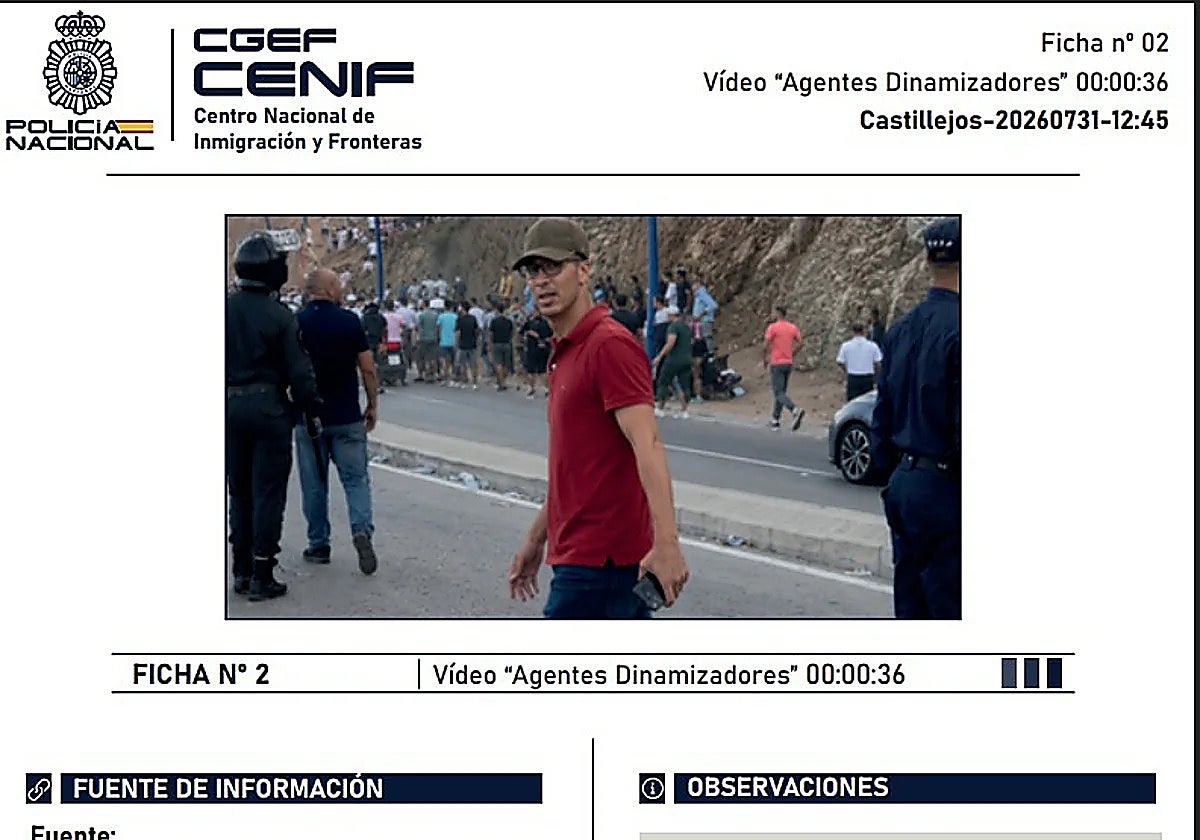

A man pushes his way through the crowd, gesturing with his hands to encourage them to continue towards Ceuta. Another helps women and children down ... the breakwater, with no apparent intention of crossing himself. The Spanish police have zeroed in on these figures dressed in street clothes: they suspect they were directing the migrant surge in July while appearing to be part of it.
Documents from the CENIF (national centre for immigration and borders), part of the National Police, submitted to María Tardón, a judge at the National High Court, reveal suspicions regarding an operation by undercover Moroccan agents to orchestrate the border crossing. The report includes five videos as annexes.
Sur has gained access to those documents, the images and the police statements of three Moroccans who crossed the border. Witnesses have identified police and administrative officials from Morocco. The investigations point to possible coordination between plainclothes officers, uniformed officers and local authorities.
Related story

In other words, officials from Rabat, far from trying to prevent the crowd from crossing, "herded" it towards the Spanish city. The CENIF report refutes the Spanish government's official version that Morocco cooperated as much as it could to prevent the assault.
There are 24 files on alleged "facilitators" and a further ten on uniformed officers. In these, the investigators are looking for a telling detail: some men appear to have a different role to those seeking to reach Spain. They observe, give orders, signal and talk on the phone. On occasions, they stand alongside the police cordon.
The CENIF claims that some civilians even gave orders to the uniformed officers. It attributes to them "behaviour indicative of control, leadership and management of the situation". This information, the report states, is crucial to the argument that the entire raid was directed by these undercover officers.
One of the faces has a name in the statement of a former chief sergeant of the Moroccan Royal Gendarmerie. He identified the bacha of Castillejos, Youssef Haji, a local administrative authority, and stated that he saw him on July 30 near the Senator Hotel, very close to the border, along with 20-30 agents.
According to the report, Haji "was talking on his mobile phone while speaking to the officers and gesturing to them with his hands". When asked if he was giving instructions, the former gendarme replied without hesitation: "Yes, I was giving orders at that moment."
Photo number two shows the man in question wearing a red polo shirt, a cap and holding a mobile phone, surrounded by police and giving instructions to drivers of riot control tankers. That photograph was taken during the return of migrants from Ceuta. The witness also identified, from photographs, the head of security in Tétouan, Mohamed El Oualidi.
El Oualidi's name resurfaces in the interrogation of M.A., who swam ashore at around 5pm. He recognised the police commander and Younes Tazi, the wali of Tangier-Tetouan-Al Hoceima, in the footage. He also identified a secretary from the provincial administration.
Z.E.Y., who crossed at around 9am, identified the man in file number six as a lieutenant in the auxiliary forces stationed at Tarajal. In the footage, he is dressed in civilian clothes and walking against the flow of people. At no point does he attempt to enter Ceuta. The witness, a former member of the armed forces, said he recognised him from previous attempts to enter. He specified that he did not see him on the day of the assault.
The photographs now show the route from the Castillejos roundabouts to the banks of the Tarajal. According to the report, Moroccan officers in uniform were giving instructions on how to get past obstacles and organising access to crossing points. In some videos, they can be seen standing by the barbed-wire fence and the breakwater, whilst whole groups move forward unhindered.
One photo shows a man helping people climb over the fence separating Castillejos from the sea. Another describes someone who "helps women and children to climb down the breakwater, with no apparent intention of setting off himself". There is also a police checkpoint which the crowd passes through "without any trouble", under the watchful eyes of the police.
Unusual outfit
The investigators focus on those walking against the flow of traffic, watching or filming with no apparent intention of crossing. Some are wearing long trousers, trainers and caps: an unusual outfit for someone intending to go into the sea. One supposed undercover officer is careless with his disguise and has left police insignia visible on his clothing.
A man is filming next to a police van, another is talking to two men in suits. Another image shows a woman gesturing to indicate the direction the crowd should take.
The report describes the Moroccan response on 30 July as "total permissiveness" and states that no serious attempt was made to disperse the crowd. The investigators also refer to the crowd being "actively guided" towards the water and the access points to Tarajal.
The five videos piece together the events: one uses Shadowmap to pinpoint time slots; another compiles images of uniformed officers; a third, lasting seven minutes and 36 seconds, follows the organisers; the fourth combines both groups; and the fifth shows people seeking asylum after arriving on the beach. The files include original stills and versions enhanced using artificial intelligence.
The CENIF report describes a phased arrival. First to arrive were mainly young people equipped with wetsuits, flippers and flotation devices. Later, adults, families and children appeared. By nightfall, young people ready to swim were once again in the majority. For the police, this sequence of events contributed to the reception centre becoming overwhelmed and limited the Spanish response.
The spread of the message that the border was open caused the movement to multiply. Among the calls the CENIF has tracked is one that is particularly explicit: "Come down (sic) to Castillejos, there are a thousand of us and we're getting in. I'll show you the way."
The campaign spread from open Facebook groups to closed WhatsApp chats. The CENIF identified telephone numbers that were active simultaneously in several groups, acting as amplifiers for the messages.
Investigators place the organisers on the ground at the third level of a five-tier structure. Below them are those who crossed the border and those who shared the calls to action online. Above them are those responsible for planning and directing. The police have not yet managed to identify the members of those two upper tiers.
