
Rail transport
Spain's civil engineers propose ten key points to prevent rail accidents such as those in Adamuz and Urda
Experts point to factors such as coordination between Renfe and Adif, staff training and the modernisation of equipment
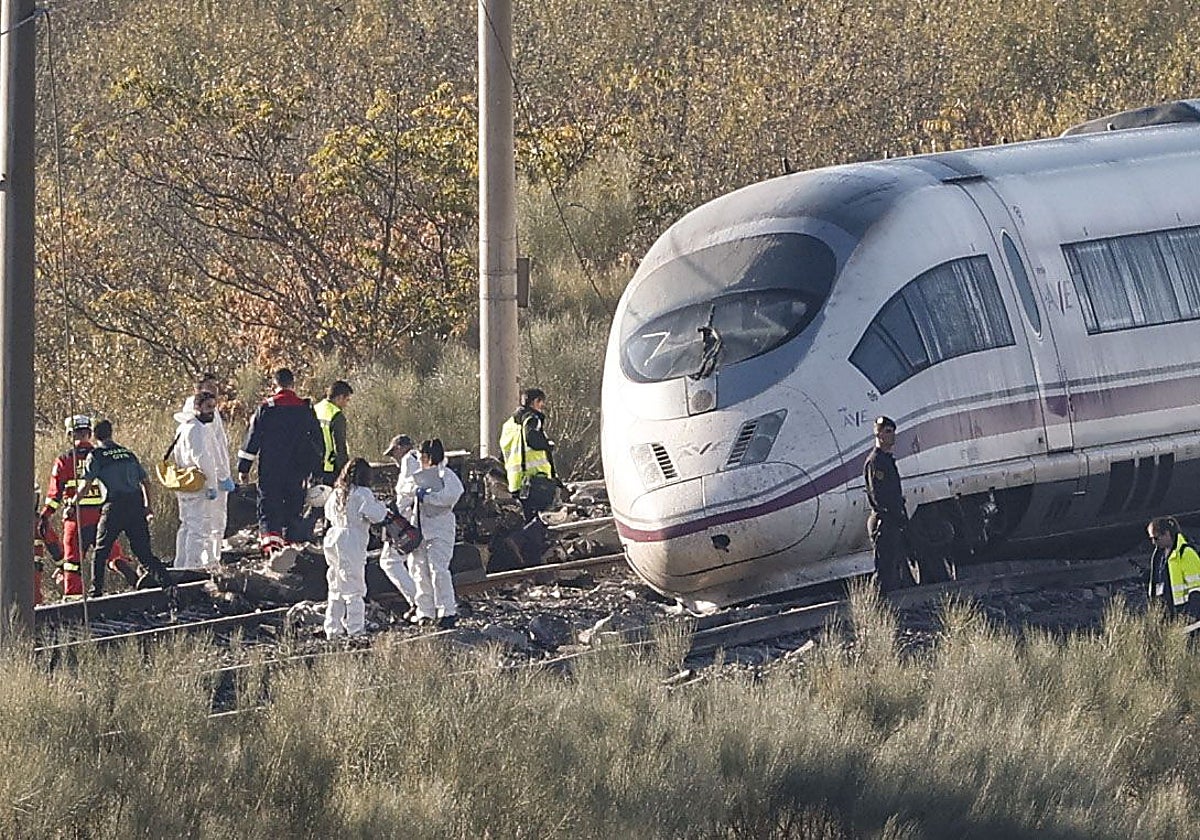

Civil engineers are calling for 10.5 billion for maintenance, to strengthen the high-speed AVE's backup systems and to install GPS on trains ... following the Urda tragedy.
While state rail operator Renfe finalises a plan to restore services between Malaga and Madrid, the association of civil engineers has put forward ten immediate and medium-term proposals to prevent accidents such as those in Urda (28 October) and Adamuz (18 January). It has identified a cumulative shortfall of over 3.6 billion in the maintenance of the rail network.
To reverse the decline in safety indicators and restore public trust, the engineers have drawn up a ten-point plan comprising five measures to be implemented immediately and five medium-term structural reforms. In chronological order, these would be:
1. Allocation of resources for accident investigation
The association calls for sufficient technical and human resources to be allocated to both the judicial bodies and the Aitat in order to speed up the investigations and clarify as soon as possible the direct, indirect and systemic causes of both the Urda and Adamuz incidents.
The report warns that the Aitat is still consolidating its structure and that, according to its staffing table dated 5 October 2026, seven of its 15 civil service posts in the rail sector remain vacant, as well as a further seven unfilled posts out of 19 in the maritime sector and nine out of 29 in civil aviation.
2. In-depth audit of the system and review of the BSL backup
The committee is calling for an immediate review focusing on the systemic causes and a report on the state of maintenance of all subsystems. Alongside the strengthening of internal and external audits of the safety management system, with the AESF (state railway safety agency) playing a key role, it proposes examining whether it is appropriate to retain the BSL system on high-speed lines. This is the lateral signalling block, which is activated as a backup in the event of a failure in higher-level systems such as the LBZ.
3. Physical and mental fitness, training and simulations
Given that daily traffic on the section of the Madrid-Seville line where the accident occurred has increased by 24 per cent between 2019 and 2025, rising from around 92 to approximately 114 trains a day following the introduction of Iryo in March 2023 and Ouigo in January 2025, the report highlights the increased workload for traffic controllers when incidents occur.
It calls for a review of the occupational and psychophysical assessments of traffic controllers and train drivers to detect signs of overload or stress, check whether staffing levels are adequate, verify that the required training and experience enable automatic responses to unforeseen risks and implement frequent incident training and simulations without losing sight of the overall picture of the system.
4. Improving the reliability of external supplies
Security systems rely on external factors such as the electricity supply or telecommunications. A failure in these causes the system to shut down. Engineers are urging that these critical infrastructure components be reviewed and strengthened in terms of their design, maintenance and resilience to ensure redundancy through dual power supplies and uninterruptible power supply (UPS) systems.
5. Redundant positioning of trains using GPS
The document proposes the immediate implementation of a redundant system to determine the exact location of trains on the track, in addition to conventional track circuits and axle counters. Specifically, it recommends investigating the safe use of GPS positioning to support remote traffic management where necessary.
6. Long-term planning and a shift in budget focus
Spain lacks an infrastructure plan following the expiry of the 2014-2024 PITVI. In contrast to models such as Switzerland's, which plans budgets 25 years ahead, the association is calling for a reorientation of budget policy.
Having allocated some 70 billion to build the world's second-longest high-speed rail network (behind only China), there are calls to prioritise capacity expansion, asset replacement, improvements to the conventional rail network and the correction of excessive radiality.
7. Stable maintenance framework: 10.5 billion
According to a preliminary estimate, at least 3.5 billion euros will be needed over the next ten years to maintain the high-speed rail lines and a further seven billion to make up for the deficit that has built up over the last twenty years.
8. Governance, the state pact and modernisation
Engineers are calling for an assessment of the model for the separation between infrastructure company Adif and the operators, which has been in place since 2005, and for a thorough review of the infrastructure manager's organisational structure to better integrate safety, simplify structures, ensure management stability with less political interference and reach a national agreement with a 2050 timeframe.
They also warn against the loss of technical expertise caused by hasty early retirements or excessive outsourcing of monitoring and maintenance.
9. Quality in technical projects and the end of auctions
The association calls for the utmost rigour and supervision in the drafting of technical projects to avoid changes and cost overruns during construction and operation, whilst balancing technical criteria against economic ones. It also rejects the use of the tendering system for railway maintenance contracts.
10. Safety culture and continuous improvement
Finally, the committee urges that a culture of safety be embedded at all managerial and operational levels and proposes reinstating the rule which entitled any worker who received an order they considered to be contrary to safety to report this to the person who issued it and to take the appropriate measures until further instructions were received.
