
Immigration
On the ground in Ceuta: relief efforts and personal accounts at the border
A detailed report on the daily operations of local services, border updates, and the ongoing support efforts in the region

Enviado especial. Ceuta
Nayua is 19 years old has seen more pain than someone her age should. She arrived in Ceuta swept up by the slogans circulating on ... social media and the calls from her friends on her mobile. "Spain's doors are open," they kept repeating.
She didn't hesitate. Nayua holds a diploma in nursing, but she had been working in the hospitality industry for seven euros a day until a couple of weeks ago, when she crossed the border seeking a better future.
Back at home, she was caring for her disabled grandmother just to endure abuse from her father's family. Believing her luck was about to change, she swam across the stretch of water at the Tarajal border, where she saw people drown, pushed by those coming up behind them.
Related story
-

Óscar Beltrán de Otálora
She then arrived at the temporary immigrant reception centre (CETI), where, others told her, she would obtain the documents that would secure her future, only to find the doors closed.
Since then, she has been living and sleeping in a eucalyptus forest overrun by rubbish, mouldy blankets and despair, with no toilets, hardly any food and no showers.
Nayua and many other women in her situation spend the nights fearing the threat of other migrants harassing them. This is forcing them to travel in groups when they venture into the thicket to relieve themselves.
Hunger is their constant companion and they try to ease it by begging door-to-door or through organisations such as Residentes Ceuta.
When asked why she puts up with this situation, her response is scathing. "Going back to Morocco isn't an option. Salaries aren't enough to live on, healthcare costs are sky-high, as is education for those with children or a rent to pay. That makes it impossible to save, lead a decent life and think about building a future for yourself."
Nayua's story is not an isolated case on that hillside she has made her home, guarded by the National Police, who withdraw as soon as night falls, leaving just one patrol van to keep watch amid so many wolves.
Aisha, 25, from Agadir and divorced, left an eight-year-old daughter in the care of her parents. She was hoping for the Promised Land, but disappointment quickly hit upon her arrival.
She doesn't want her photo taken because she's afraid her ex-husband might recognise her and take her daughter away.
Zainad, from Marrakech, had already made five attempts to cross the border and has only just succeeded for the first time. She grew up in a children's home. By the age of 18, Zainad already had two children, who were adopted by a woman from Barcelona.
For her, "Ceuta is just a transit point". "I want to get to Dortmund, where I have family. I'd rather throw myself off a mountain than go back to Morocco."
Her determination is no different from that of Gizzlan, from Tangier, who used to work for a sign-making company, and that of Boucha Shaimi, who has a diploma in Business Administration and experience working at a McDonald's, from which she was sacked as soon as she asked for a pay rise (she was earning 280 euros a month).
Hamza and Shatia's plight plunges straight into the realm of horror for any parents. "We had to call the police because a group turned up and told us they wanted us to hand over our son Riad. They said they would send him to school as long as we returned to Morocco."
Their wait is turning into an ordeal. "Every night, as soon as the streetlights go out, stones start flying. There are people coming round drunk and we're afraid for the child. This is no place for him."
Unbowed by discouragement
The failure of civilisation is playing out these days on the beaches and streets of Ceuta, where thousands of young people with no trade or means are roaming freely, awaiting a future that threatens to be anything but prosperous.
Ceuta is undergoing a crisis unlike any it has ever known, while central and regional authorities struggle to come to terms with a situation that, barely two weeks ago, burst at the seams.
The crisis has made it clear that the Spanish territory's security lies in the hands of Morocco: a troublesome neighbour that masterfully manipulates the levers of migratory pressure and shows little regard for the welfare of its own citizens. The death toll exceeds 100, yet no one on the other side of the border has batted an eyelid.
A legion of unfortunate souls arrived in Ceuta in search of a better future two weeks ago. Now, they are struggling to survive in shacks made of reeds, cardboard and plastic, while a Guardia Civil vessel patrols with the silhouette of Gibraltar in the background.
Just 300 metres from the slopes of the CETI lies El Trampolín beach, which has become a makeshift shelter for thousands of migrants seeking refuge in shacks.
Yasim, Karim and Ahmed have made 19 attempts to sneak into Ceuta, most of them by swimming. They met in Ceuta and are undaunted by setbacks. Yasim's feet are covered in sores from when he swam 6.5 kilometres from Rifien wearing flippers against the tide.
Karim has tried his luck several times hiding under lorries and buses. At 17, he wears dentures following a blow to the face with the butt of a rifle, courtesy of the 'mehani': the Moroccan auxiliary police who carry out border surveillance.
They have never got this far before and they are determined not to give up. The fear they have left behind weighs more heavily on them than the desolation that surrounds their lives.
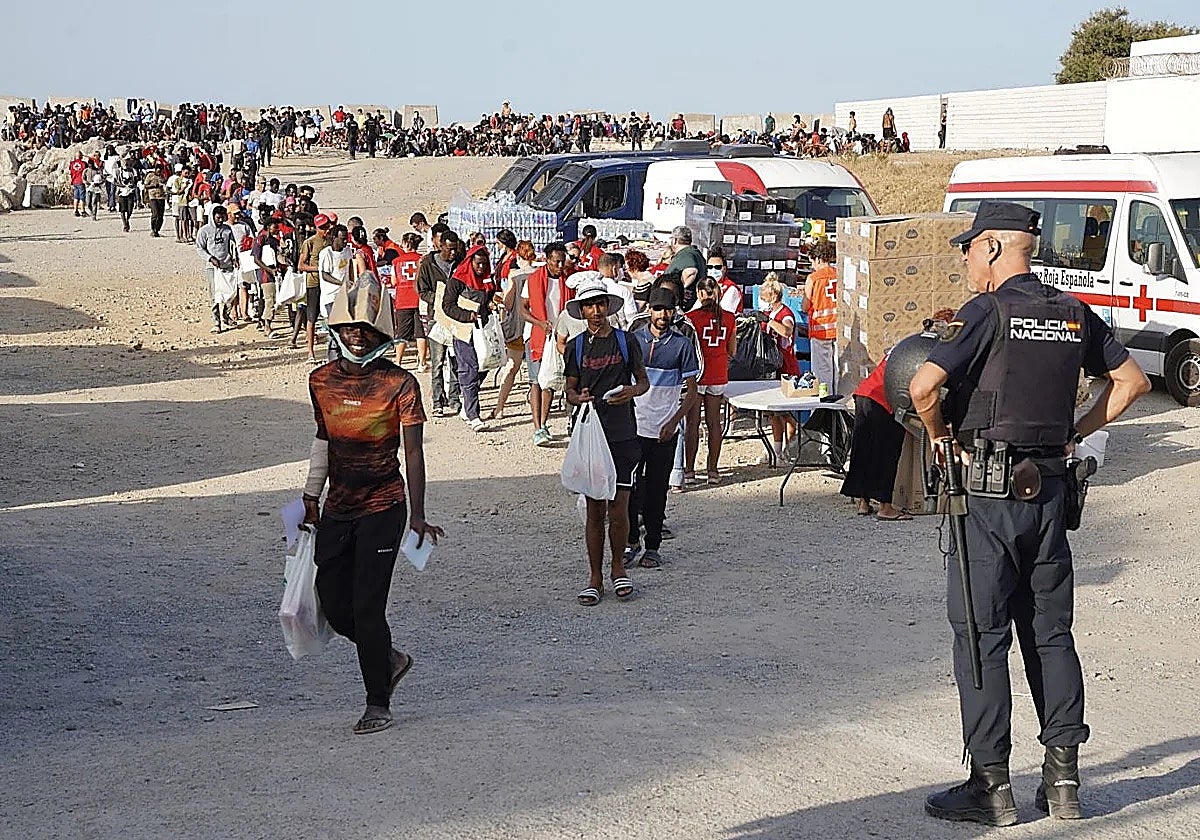
While the three wait to receive the food the Red Cross distributes once a day, a brawl breaks out between Moroccans and sub-Saharan Africans, prompting an immediate response from the officers patrolling the area.
The result: one injured person taken away in an ambulance. "The longer this goes on, the more despair will surface," a member of the National Police says.
"Bitterness and crime go hand in hand and we're already starting to notice it. Tension is mounting. There's a shortage of accommodation, space and food… And the public are caught in the crossfire, torn between anxiety and weariness over a situation that just won't be brought under control. Sometimes we go out on patrol and it feels like a zombie film," he states.
The Red Cross, meanwhile, is out on the beach from 3pm to 10pm, coordinating with the hospital's A&E department, primary care services and the health centres, whose staff are working double shifts.
Queues are forming outside ambulances for injuries consistent with scabies, numerous respiratory conditions resulting from sleeping rough and physical injuries. "To get here, many have gone through a real hell," a healthcare workers says.
Everything suggests that this ordeal is far from over.
![[]](http://static.vocstatic.com/voc26/latest/assets/images/favicon/surinenglish/apple-touch-icon-57x57.png)