
The Government ignored more than 20 warnings over Morocco's migration 'hybrid war'
The national security agency had already identified Ceuta’s vulnerability in 2021 and called for a specific plan to protect it, but this plan was never drawn up
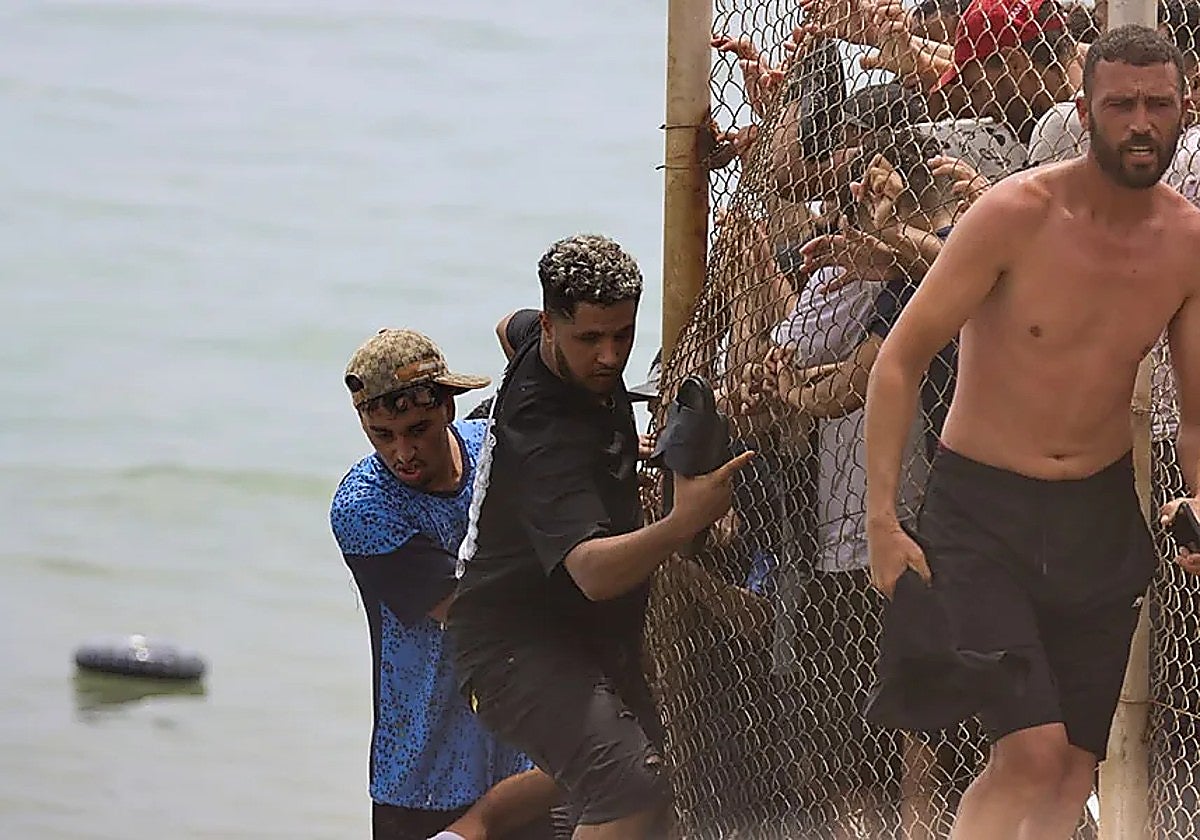

The Government has been ignoring more than 20 official reports and alerts which, since 2021, have repeatedly warned that Morocco intended to use fake waves ... of migrants as a battering ram in its "hybrid war" against Spain.
Dossiers and memos of various kinds, which, for the past five years, had been painting a picture in Melilla and, above all, in Ceuta, of a scenario such as the one that unfolded last week in the latter autonomous city.
Related story
_20260803102655-RrMurwRdCWzte4sqOuTsxXO-1200x840@RC-U41025463524PQk-366x256@Diario%20Sur.jpg)
There are five national security documents, two military analyses from the ministry of defence, six European and social policy statements, and seven operational alerts from 2026. Added to these are "several alerts" from the CNI intelligence services. Sources within the CNI have confirmed to SUR that, since last spring, there has been an increase in warnings regarding the possibility that Morocco might once again use migratory pressure as a tool in "hybrid warfare" against Spain.
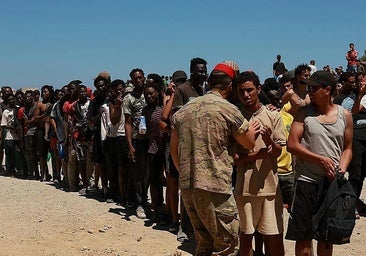
No organisation set the date or predicted that between 50,000 and 60,000 people would cross in just 48 hours. Let alone that the deaths resulting from King Mohammed VI's regime's high-stakes gamble would approach 100, according to the latest estimates.
But for five years, the documents had been outlining a scenario very similar to what has ultimately happened: Ceuta as a vulnerable point, the increase in the number of swimmers, the reliance on Moroccan control and the risk of a third state exploiting the flows. Even so, Pedro Sánchez and the ministers of the interior and foreign affairs, Fernando Grande-Marlaska and José Manuel Albares, continue to argue that the influx was a migration crisis fuelled by criminal gangs who exploited a supreme court ruling against the immediate return of those who enter by swimming.
The first structural warning came in December 2021, seven months after Morocco had eased its vigilance following Spain’s decision to grant asylum, on humanitarian grounds, to Brahim Ghali, leader of the Polisario Front. In May of that year, 10,000 swimmers stormed Ceuta. The national security strategy said that Ceuta and Melilla “require special attention” due to their location and their status as Spain's and Europe’s external border. The document called for “the development of a comprehensive security plan for Ceuta and Melilla” and envisaged early-warning systems, response plans and the integration of both cities into the national crisis management framework.
Related story
The plan never materialised. An inter-ministerial group was set up in June 2022. In April 2025, the Government said that it was still "in the process of being drawn up". In May 2026, it acknowledged before Parliament that progress had only been made on a draft text and that "no date has currently been set for the completion of the plan". Ceuta thus faced the largest influx of migrants in its history without the policy framework that had been commissioned four and a half years earlier.
The following official notice was issued in April 2022. The 2021 annual national security report analysed hybrid strategies and specifically cited "immigration […] as a means of exerting pressure". Its risk map identified irregular migration flows as among the threats most likely to materialise over the next five years.
The trend continued. The 2023 report, approved in March 2024, called for "special attention" after irregular entries rose by 95 per cent. Two months later, the national maritime security strategy said that “hybrid strategies occupy the conceptual centre of the risk map” and warned that they could exploit vulnerabilities through “political destabilisation, economic coercion and irregular migration”.
Once again, the 2025 annual national security report noted that pressure on Ceuta and Melilla had increased "significantly", particularly from swimmers. It explained that mass attempts to scale the fences had been contained thanks to the “major perimeter deployment” by the royal gendarmerie and the Moroccan armed forces, which maintained “fairly rigorous” control. The Government acknowledged that the stability of the perimeter depended on Rabat’s willingness to keep it closed.
When examining the risks associated with irregular movements, it warned of their potential "exploitation" by "third countries". It did not mention Morocco, but did describe the tactic employed when one country permits, encourages or takes advantage of human movements to coerce another.
The armed forces academy criticised the “lack of preparedness” and the “often belated or weak” responses to Morocco
The ministry of defence had also highlighted the threat. In July 2025, a study by the armed forces college on deterrence against Morocco, to which SUR has had access, spoke of a "lack of preparedness", “often belated or weak” responses, and a “low or insufficient” deterrence capability in the face of hybrid actions. In November, another report published by the higher centre for national defence studies (Ceseden) declared that Rabat had learnt to “activate or deactivate” the flow of people according to its interests and to turn it into diplomatic “bargaining chips”. These were the authors’ analyses, not official doctrine.
Nor did the warnings come solely from the state. In June 2021, the European Parliament condemned Morocco’s use of border controls, migration and minors “as a means of exerting political pressure on Spain”. Amnesty International accused Rabat of using people as “pawns” and denounced the fact that it was “playing with the lives” of its citizens. Cidob, one of the most reputable global think tanks, summarised the pattern: “When relations are good, the borders are controlled; when relations become strained, the migration card is played to exert pressure on Spain.”
The 2024 European Crisis Regulation defined "instrumentalisation" as a situation in which a third country encourages or facilitates the movement of people towards a border in order to destabilise a Member State. In 2025, the EU Agency for Fundamental Rights published a paper on this phenomenon and called for the response to be directed against those who promote it, not against the people being exploited.
Warning lights
Throughout 2026, the statistics shed further light on the situation. On 6 February, the interior ministry recorded 426 irregular entries into Ceuta, compared with 89 during the same period in 2025. By 5 March, the figure had risen to 1,257, compared with 157. By 17 April, it had reached 1,968 – an increase of 350 per cent. Whilst irregular immigration was falling across Spain, the trend in Ceuta was moving in the opposite direction.
After that, operational alerts came in almost every week. On 11 May, the unified association of the Guardia Civil (AUGC) brought the "critical situation" facing the Guardia Civil to the attention of the European Parliament. It described Ceuta as the territory facing "the greatest migratory pressure in the country" and called for 200 additional officers. On 12 June, around 80 Moroccan swimmers reached the beaches without Rabat stopping them, and police sources warned of a “hot summer”. On 24 July, the AUGC reported that staffing levels and resources were “clearly insufficient”.
Amnesty International accused Rabat of using its citizens as "pawns" and of "playing with people’s lives"
Sources within the intelligence services claim that internal alerts had intensified since the spring. They did not specify a date, but did highlight the possibility that Morocco might take advantage of a deterioration in diplomatic relations to relax its surveillance and subject Ceuta to another pressure campaign. The CNI maintains that it passed on “several warnings” to the home office regarding the risk of a mass influx. Marlaska’s department denies having received any formal alerts, although it admits that it detected an increase in the flow of migrants from mid-July onwards.
The latest public warning came on 27 July, three days before the collapse. The government delegation and the autonomous city spoke of a "migration emergency" following more than a thousand arrivals in a week, the collapse of the child protection system and the overcrowding at the temporary stay centre for immigrants (CETI). Both administrations called for an “extraordinary and immediate response” and raised the alert to the highest institutional level. On 30 July, the influx, which the Government continues to claim was migration-related, began and took it by surprise.
![[]](http://static.vocstatic.com/voc26/latest/assets/images/favicon/surinenglish/apple-touch-icon-57x57.png)