
Spain wildfires 2026
Madrid and Ávila fire stabilisation allows 30,000 evacuees to return home
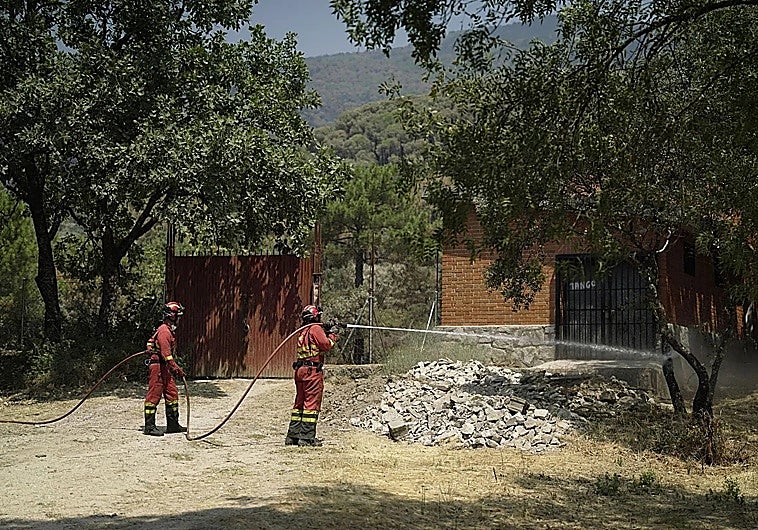
The Ministry of the Interior said on Tuesday that the fire had not spread further and that the 'mop-up phase' could start later on Wednesday

Madrid
Spain's Prime Minister Pedro Sánchez was right when he said he could "see the light at end of the tunnel", at least for nearly ... 30,000 evacuees who can now return home thanks to the stabilisation of the wildfires in Madrid and Ávila.
With their patience stretched to the limit, after three, four and, in some cases, five nights away from their homes, the evacuees received the Ministry of the Interior's order at 3pm on Tuesday.
Minister Fernando Grande-Marlaska lifted the evacuation measures for a total of 15 municipalities: five in the province of Ávila and eight in Madrid. The lockdown order was also lifted in another four towns, with the sole exception of a few residential developments that were not yet completely safe from the flames.
Related story

Related story

The residents of Fresnedilla de la Oliva and Zarzalejos started heading back home at around 8pm on Tuesday evening. On Wednesday, the evacuees of Robledo de Chavela and Valdemaqueda will also make their way home.
Both municipalities are located at two of the hotspots of the complex wildfire.
Favourable development
The easing of restrictions was possible thanks to a combination of three factors: the complete absence of hotspots, the certainty that no fires had reignited in the previous 48 hours and the guaranteed safety of the routes.
Minister Grande-Marlaska declared the development "favourable".
Despite the rise in temperatures, the drop in humidity and the southerly and southwesterly winds, the gusts were not strong and allowed the deployment of aerial resources, particularly in the Mijares area and to the north of the San Juan reservoir.
These were two other areas where the fire raged with particular ferocity. The conclusion, nonetheless, was that the fire was "contained".
"The important thing is that there has been no spread in the last 24 hours," Grande-Marlaska said.
By this he meant that the flames had not engulfed any further hectares that would add to the already staggering figure of nearly 70,000 hectares, making it the largest wildfire in Spain's history.
The minister also stated that the teams would continue working throughout the early hours of the morning with the same intensity. Wednesday presents as a crucial moment, given the expected rise in temperatures and the start of the fourth heatwave this summer.
The heatwave will last until next Sunday, affecting the centre and north-east of the country in particular. It will push temperatures above 40C, meaning the fire risk will once again reach "extreme levels". That is why the aim was to make rapid progress before Wednesday.
"I don't dare go in"
One of the hardest-hit area is El Morro in the Navas del Rey municipality.
There, the fire has raged unchecked and destroyed everything in its path. Not a single garden remains standing, though many homes still do.
At around 5.10pm on Tuesday, the first families arrived. Anxious and in tears, they rushed to check on their homes. "I don't dare go in," an elderly woman said.
Inmaculada and Daniel live in the aforementioned residential development with their daughter Noa. They were relieved to see that only one side of their house had been burnt, even though the windows were smashed and nothing remained of the garden.
"We spent the weekend at some friends' house, feeling very anxious," they said. They were allowed to go back and collect some medicines.
"I took the opportunity to feed our rabbit, who was in shock. Naturally, he hadn't eaten or drunk anything for two days," Immaculada said. They also saw how the pile of firewood they'd stored in the garden had vanished without a trace.
"To be honest, looking at the neighbouring houses, I'd say we've been very lucky," Daniel said.
Two other married couples who have been living in this area for over 50 years suffered the same fate. Carmen came home in tears, utterly distraught. The swimming pool was full of ash and embers. That said, like many others, the house itself was intact, although the garden is completely ravaged.
"Look at the state of this, the wooden shed is gone. We had a bunk bed for the children there and their dolls and toys. There's nothing left. How capricious fire is: look at that chest, completely melted, and right next to it, the pool skimmer, still intact. This house, which is intact, was built by my parents over 50 years ago and we've been coming here to spend our weekends ever since. It's so sad to see everything like this, burnt to a cinder. But we have to look on the bright side. The house has been saved," Carmen said.
Now that people are beginning to return to their homes, the authorities will be able to start carrying out a proper assessment of the damage, as regions such as Madrid have already made plans to provide aid to those affected.
Technicians at the central command post in Navalcarnero have warned that the fire is still burning and that everybody should remain cautious.
![[]](http://static.vocstatic.com/voc26/latest/assets/images/favicon/surinenglish/apple-touch-icon-57x57.png)