
Spain 29-N election
Spanish election debate: Feijóo goes on the attack as Sánchez struggles to make an impact
Conservative opposition leader grilled the prime minister over corruption scandals, housing and rail safety in a tense but less heated clash than expected ahead of the 29 November poll
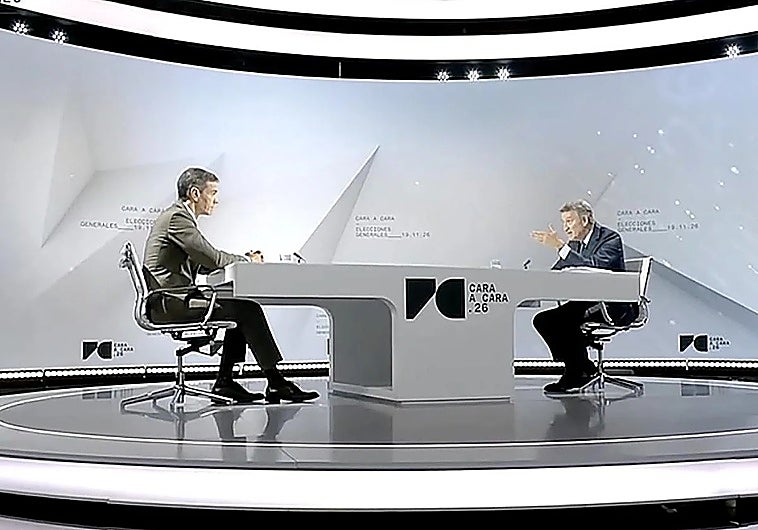

The Spanish election campaign, which seems to lack any clear direction in the wake of the shocking rail tragedy in Urda, saw on Thursday ... a debate between PM Pedro Sánchez and the PP's Alberto Núñez Feijóo that was less heated than expected, given the extreme polarisation in the country.
Tension had been building up before the start of the dialogue, demonstrating the political gulf that separates the two and the personal animosity they foster towards one another. They exchanged a cold, formal greeting, without looking at one another.
The prime minister opted for a restrained tone that portrayed him for much of the exchange as a leader on the defensive, despite the forecast predicting the absolute majority of the PP in its alliance with Vox. At one point, Sánchez even indirectly admitted acceptance of his opponent's possible victory by asking Feijóo not to repeal the housing law should he come to power.
Sánchez admitted that his government is not "perfect", that it has not eradicated the housing crisis and that it is plagued by irregularities, although he regained his composure when he retorted to Feijóo that he would not accept "lessons from the most corrupt party in the Spanish political system".
Time and again, Feijóo interrupted Sánchez, while carefully gauging the extent of his aggression. He left the message: "Spain needs a decent prime minister and you are not one."
The outcome of the election debates depends not only on how they unfold, but also on the subsequent analysis. 29 November will determine whether Feijóo has dealt the decisive blow to 'Sanchismo', something he failed to do in July 2023.
Sánchez, adopting an attitude far removed from the combative spirit that characterises him, perhaps so as not to completely alienate the centrist electorate which, according to opinion polls, has largely abandoned him, failed to emerge from the corner of the ring throughout the nearly two-hour live broadcast.
Feijóo resorted to the tactic he used three years ago by listing statistics and attacks. If Sánchez's aim was the same as that of his strategy of stalling and attempting to capitalise on what had been introduced during his eight years in government, he hit a brick wall. Feijóo didn't let a single thing slide and took the risk of interrupting his opponent, even mocking him, the more confident he seemed to feel about winning as the minutes ticked by.
With corruption as his rallying cry from the very outset, Feijóo criticised Sánchez not only for the scandal involving his two trusted aides, José Luis Ábalos and Santos Cerdán, but also for "the orgies", knowing full well the erosion this causes among the female vote.
He then set about refuting every single point on economic matters, from the housing crisis to taxation, via the pension quagmire and rail safety concerns. The opposition leader stated that the "first issue" he would address if he headed the government would be Ceuta.
"I know how to manage budgets, I know how to manage infrastructure, I know how to manage crises, I know what it means to govern. I do deliver," was Feijóo's final message.
Sánchez took refuge in emotion during those very same 60 seconds. Looking at the camera, as he did on several occasions during the exchange, and addressing the audience informally, he appealed to "the strength of the people" to stop those he identified as representing the power of "the oligarchs" and who, he said, have the bulk of the media on their side.
The prime minister's strategy so far has been to present himself as the only remaining champion to stop the far and the far right that Feijóo and "his partner" Abascal (Vox) represent, respectively.
