
Perfectly preserved incense burner depicting goddess Tanit unearthed in Alicante
Archaeological excavation at La Albufereta uncovers third-century BC Iberian necropolis containing elite weapons, trade scales, and ritual artifacts
Adrián Mazón
Alicante
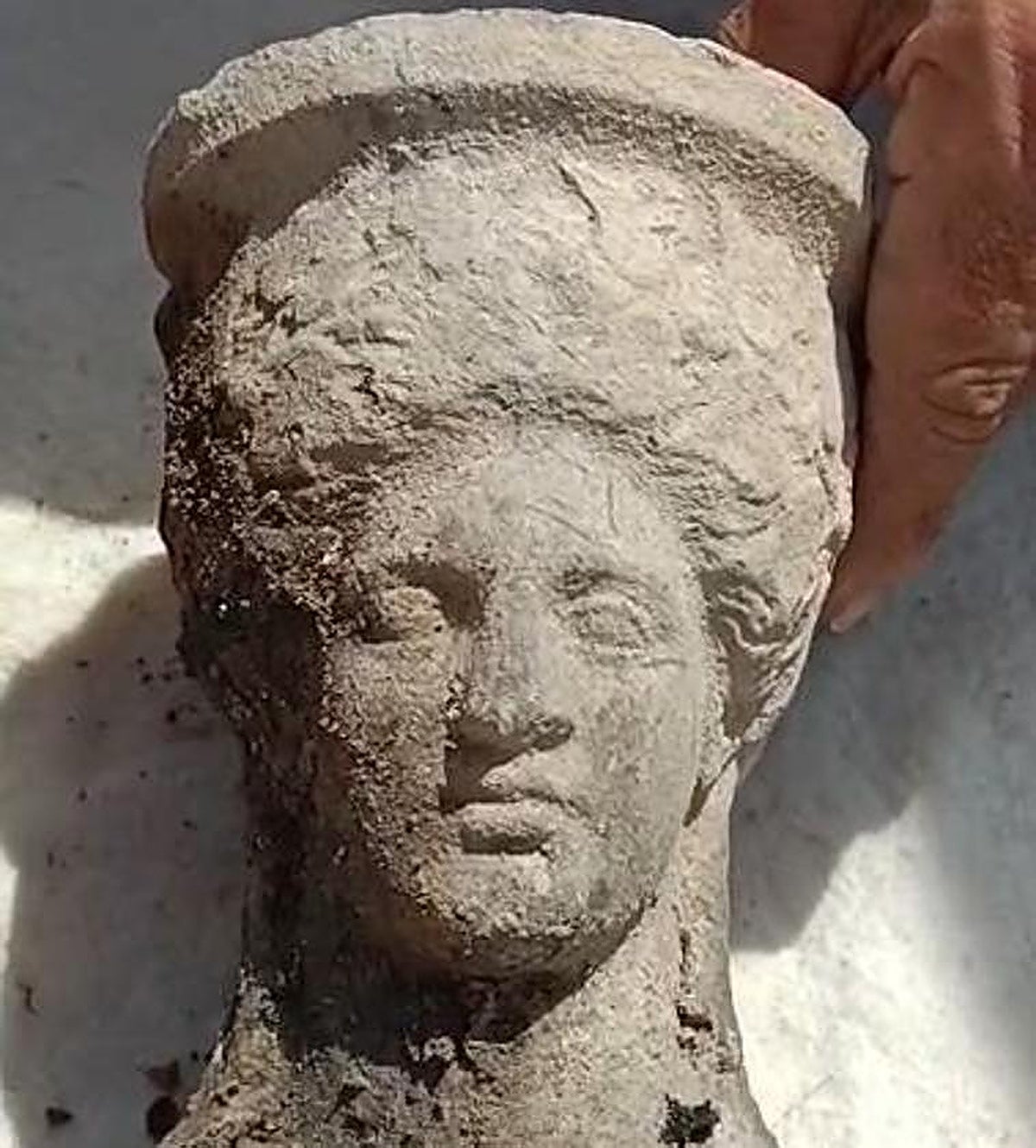
For over 2,200 years, she remained surrounded by the weapons of warriors. Falcatas, spears, knives, shields and long javelins accompanied a small female head ... beneath the earth of La Albufereta in Alicante, which has now once again seen the light of day.
According to initial investigations that face belonged to Tanit, the great Punic deity who protected fertility, harvests, and those embarking on their final journey.
The extraordinary incense burner was found in perfect condition during the excavation of a new Iberian necropolis located on a private plot in Alicante. The cemetery, dated to the last third of the 3rd century BC, consists of four tombs and two ritual areas where an exceptional collection of funerary objects has been recovered.
Related story
-
-RbBi4qykYd9p9uDIx9cEydO-1200x840@diario_abc-kCHD-U101072592324x1-366x256@Diario%20Sur.jpg) Mónica Arrizabalaga
Mónica Arrizabalaga
The complete panoplies of weapons have led archaeologists to associate the burials with a possible warrior elite. It seems that a single family or military lineage rested there, separated from the large Iberian cemetery of La Albufereta known for almost a century. Among the signs of power, wealth, and prestige placed alongside the dead, the image of the goddess Tanit stands out.
The incense burner represents a woman's head and is part of the grave goods found by archaeologists Jesús Moratalla and Gabriel Segura, from the company Arquealia. Its preservation allows us to contemplate a serene face that would have been recognisable to those who participated in those funerary ceremonies.
In contrast to the iron weapons found in the tombs of this newly unearthed necropolis in the city of Alicante, just a few metres from the Tossal de Manises in the La Albufereta neighbourhood, the figure introduced the protection of a deity who encompassed both the beginning and the end of existence.
The discovery is connected to the history of this neighbourhood. The ancient excavations of the large Iberian necropolis of La Albufereta had already recovered dozens of female incense burners, Punic tradition terracottas, and objects from various parts of the Mediterranean. The new specimen extends a relationship between Tanit and the Alicante bay that archaeology has been studying since the 1930s.
La gran señora de Cartago
Tanit was one of the principal deities of the Punic world and eventually became the Great Mother Goddess of Carthage. Her influence extended over areas that, today, might seem opposed, but which ancient societies understood as parts of the same cycle.
She was a celestial and terrestrial deity, associated with the sun, moon, and stars. She protected the fertility of fields, harvests, health, and navigation. At the same time, she had a profound funerary dimension and was considered the queen of the dead. Thus, she dominated both what sprouted from the earth and the world to which the deceased returned.
This union between life and death was part of a single cyclical vision of existence. The seed disappeared beneath the earth before germinating, the seasons died and were reborn, and nature offered an image of regeneration each year. Thus, a deity linked to fertility could also be responsible for protecting those who were buried.
Tanit's power grew until it occupied a central place in Carthaginian beliefs. Her images and symbols travelled along the Mediterranean maritime routes alongside merchants, navigators, artisans, and communities that shared products, techniques, and ways of understanding the world.
Related story
In the Iberian Peninsula, her figure came into contact with the beliefs of various populations. In this sense, the Iberians adopted Mediterranean objects and images and incorporated them into their own rituals, endowing them with a meaning adapted to their society.
An incense burner to protect the dead
The piece found in the new necropolis of La Albufereta is an incense burner or 'thymiaterion' shaped like a female head. These objects were made of terracotta using moulds and featured a hollow body. The front part reproduced the features of a woman, while the top could incorporate a small perforated bowl.
Its name is related to the use of aromatic substances. Perfumes, resins, or incense could be burned in them during ceremonies. The smoke would have accompanied the acts held around the tombs, creating a ritual atmosphere and helping to separate the everyday space from the territory reserved for the dead.
A study by Marq, led by Enric Verdú, on the ancient necropolis of La Albufereta, at the Tossal de Manises, found that some pieces showed traces of fire, although these could also have come from contact with funeral pyres or ritual bonfires. Others may have been placed as offerings or votive objects on the burials, even without burning substances inside them.
The very face of the deity constituted an offering. Her image offered protection to the deceased and helped ensure their survival in the afterlife, an interpretation that explains the recurring presence of female terracottas in Iberian and Punic cemeteries.
In this new discovery, exclusively reported by TodoAlicante, the figure has also appeared within a space where two ritual areas and about thirty small vessels have been identified. Archaeologists believe these containers may have been used during a banquet held next to the tombs. The incense burner would be part of a setting where the family bid farewell to their dead, shared food or drinks, and sought protection for them.
A familiar presence in La Albufereta
The appearance of Tanit at this point in Alicante finds a precedent in the large Iberian necropolis of La Albufereta, discovered during the construction of the road from Alicante to Sant Joan and excavated between 1931 and 1936.
Those works recovered hundreds of burials and an extraordinary collection of ceramics, weapons, amulets, adornments, and terracotta figures. The variety of materials made the site one of the great references for understanding the Iberian communities of the southeastern peninsula.
Among its most characteristic pieces were precisely the incense burners in the shape of a female head. Researcher Enric Verdú reviewed the old inventories and the collections preserved by Marq and was able to verify 35 specimens, a number far exceeding that recorded in other southeastern collections. The variety of shapes, decorations, sizes, and qualities allows us to understand the commercial relationships and religious practices developed in the area.
Some of those incense burners may have arrived from workshops related to the Punic sphere. Others would have been made after the image was adopted by the Iberian communities. In the ancient necropolis, certain models prevailed, spread during the 3rd century BC, precisely the century in which the new cemetery of La Albufereta is dated.
This new necropolis is composed, according to discoveries so far, of four tombs and was located about 300 metres from the main cemetery. This separation is one of the clues that suggest its belonging to a distinct family, possibly related to military power.
The deity placed among the warriors
The members of that family were buried with falcatas, knives, shields, spears, and various types of javelins. Horse bits, spurs, and a chariot wheel were also found.
The objects were placed to accompany the deceased and represent their position within society. The weapons spoke of their warrior identity; the bronze adornments reflected their wealth; the balance scales and weights could relate them to trade and the control of goods.
Tanit completes that representation. The family, besides showing who its members had been during their earthly existence, also had to ensure they crossed over protected to the other side. The goddess of fields and the dead offered that continuity between both worlds.
Research by Marq on the ancient necropolis of La Albufereta also shows that female terracottas could appear in the graves of both men and women, and even alongside weapons. Their value lay in the protection they provided and the role they played in funerary rites.
The female image had been strongly incorporated into Iberian ceremonies since the 4th century BC. Her presence allowed for the invocation of a great protective mother, linked to fertility and survival after death. In the case of La Albufereta, that figure acquired a face influenced by Punic traditions and the cultural currents that traversed the Mediterranean.
An open bay to the Mediterranean
The location of the ancient Albufereta, by the sea, placed it in contact with routes through which Greek ceramics, Punic products, objects from Ibiza, and artistic forms developed in other Mediterranean territories circulated.
The large necropolis excavated in the 20th century dazzled with this mix. In its tombs appeared vessels from Greek workshops, productions from the central-western Mediterranean, Iberian ceramics, weapons, ornaments, and terracottas of Punic tradition. The cemetery reflected a community that maintained intense contacts with other peoples without losing its identity.
The Marq study defines La Albufereta as a scene of "cultural interaction". Religious images imported or inspired by external models were integrated into Iberian ceremonies and received their own value. Tanit could arrive from the universe of Carthage, but her face was accepted and reinterpreted by those who lived and buried their relatives on the coast of Alicante.
The new cemetery also belongs to an intense moment. Its dating to the last third of the 3rd century BC places it during the Barcid era, when the southeastern peninsula was immersed in the ambitions of Carthage and the events that would lead to the Second Punic War.
Archaeologists provisionally link the necropolis with the Tossal de Manises, whose settlement was founded in this warlike context. The buried family may have been part of a world marked by armies, maritime trade, and the encounter between Iberian and Punic cultures.
The other face that the city will be able to see
The incense burner is already under municipal custody along with the rest of the recovered materials - just like the Venus found on the beach of La Almadraba. The weapons, adornments, scales, chariot wheel, fragmented sculpture, and vessels from the funeral banquet have been transferred to the warehouses of the Alicante City Museum.
The directors of the intervention are working on the scientific report, a study that will document each piece, reconstruct its position, and analyse the relationships between the four tombs. It will also allow for a better understanding of the manufacture of the incense burner and the role it played within that ceremonial complex.
The perfect state of preservation of Tanit makes her a natural candidate to occupy a central place when the discovery can be shown to the public. Her face will allow for an explanation of how a powerful family displayed its rank, how it bid farewell to its dead, and what it hoped to find beyond the grave. It will also serve to link the new discovery with almost a century of archaeological research in La Albufereta.
While the weapons describe the warriors, the scales speak of their position and exchanges, the vessels preserve the memory of a banquet held next to the graves; Tanit offers a glimpse into their deepest beliefs.
After 2,200 years underground, the great protector of fields, navigators, and the dead once again gazes upon the same Mediterranean bay where a family chose to entrust her with their journey to eternity.
![[]](http://static.vocstatic.com/voc26/latest/assets/images/favicon/surinenglish/apple-touch-icon-57x57.png)