
Adamuz train crash 2026
Spanish police cannot find key pieces of evidence in Adamuz investigation after sifting through 350 tonnes of debris
These are data logs, which can shed light on the commands the automatic braking system issued when the Alvia train was struck by the Iryo

Nine months after the Adamuz accident, the Guardia Civil have just informed the judge in charge of the case that they have been unable ... to locate two devices on the Alvia train capable of providing crucial information about the final seconds of the tragedy.
These are the Deuta recorders: memory units that store data from the automatic safety system and which would make it possible to verify the commands the train received prior to the crash that claimed 46 lives on 18 January.
These components could shed light on how the Alvia responded when the derailed Iryo encroached onto its track. The safety system should have triggered an emergency braking manoeuvre. Investigators know that this did occur, but they wish to verify the sequence of events and clarify the signals transmitted to the train.
Related story

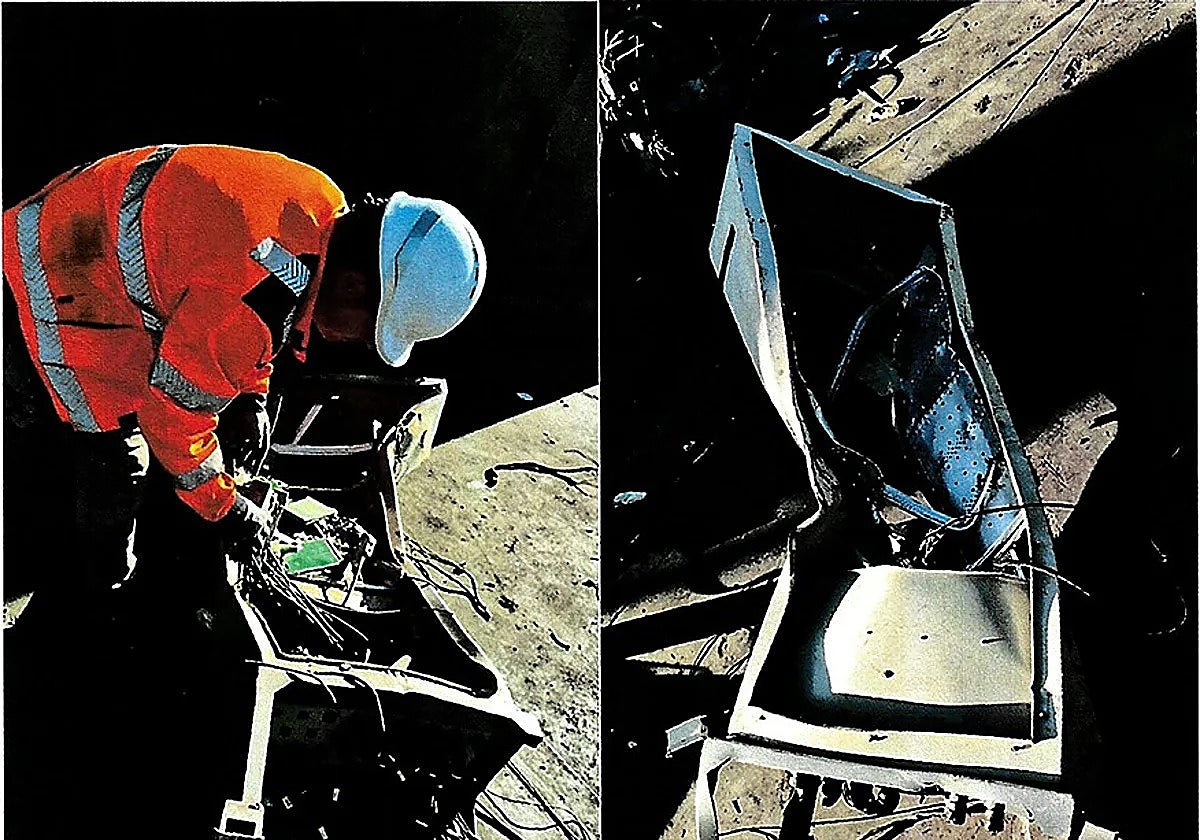
The search has ended without result. Investigators searched through some 350 tonnes of waste at a recycling plant in Dos Hermanas, Seville. They found the two connection cabinets next to the data loggers (a photograph of which is included in this report) but not the devices themselves.
The document includes seven photographs of the work, the recovered cabinets and the original location of the records. It also contains a four-page handwritten report on the inspection.
It was no superficial inspection. The wreckage lay in piles some eight metres high. The police needed a crane fitted with a huge gripper, known as an 'octopus', to lift fragments, spread them out across a clear area and allow the specialists to examine them. A second machine and another operator had to be brought in.
The images show workers wearing high-visibility vests and helmets standing in front of piles of scrap metal, two cranes moving parts and a technician examining a mangled switchboard. The Guardia Civil describes a thorough inspection of the equipment spread out on the ground.
The investigation knew where the memory modules should have been. Actren provided photographs showing their location in carriages 1 and 4 of the Alvia, one in the driver's cab and the other at the rear. They were not inside the metal cupboards: they were secured with brackets to polyester doors next to them.
This proved decisive in identifying the remains. The police located both cupboards, but were unable to recover the devices installed next to them.
The document suggests a technical explanation: the parts were attached to doors that may have come detached during the crash, while the train was being cut up or during subsequent transport by lorry. For this reason, the Guardia Civil consider that "it is impossible to locate" these components among the wreckage deposited there.
Amid the scrap, a handbag containing documents and 11.25 euros was found, belonging to a survivor who had been travelling in the first car. The police managed to contact her and reported the discovery to the court. The judge ordered that it be handed over to her.
The investigation does have access to other railway records. On 5 March, data was downloaded from the main black boxes of the Alvia and the Iryo, as well as footage from the interior cameras on the latter.
The day of the incident
At 7.43pm on 18 October, the Iryo experienced an electrical fault while travelling at 205 kilometres per hour. Nine seconds later, a safety signal turned red and the Alvia's safety system triggered automatic braking while the train was travelling at 216 kilometres per hour.
Seconds later, the Alvia's main data recorder stopped recording information. The train was still travelling at 204 kilometres per hour. Technicians estimate that the collision occurred at approximately that moment and cannot discern any action taken by the driver, who died in the accident.
In April, rail operator Renfe stated that the automatic braking system had functioned correctly. The company believed that recovering the Deuta device would provide an additional source for verifying the data from the black boxes. Its absence means that those attempting to reconstruct the seconds leading up to the impact are unable to carry out that specific cross-check.
