
Migrants
Spain's Guardia Civil investigates risk of another migrant crisis in Ceuta
According to a draft report “The risk of this call to action scheduled for 15 August materialising is real, but its scale is uncertain”

Borja Méndez
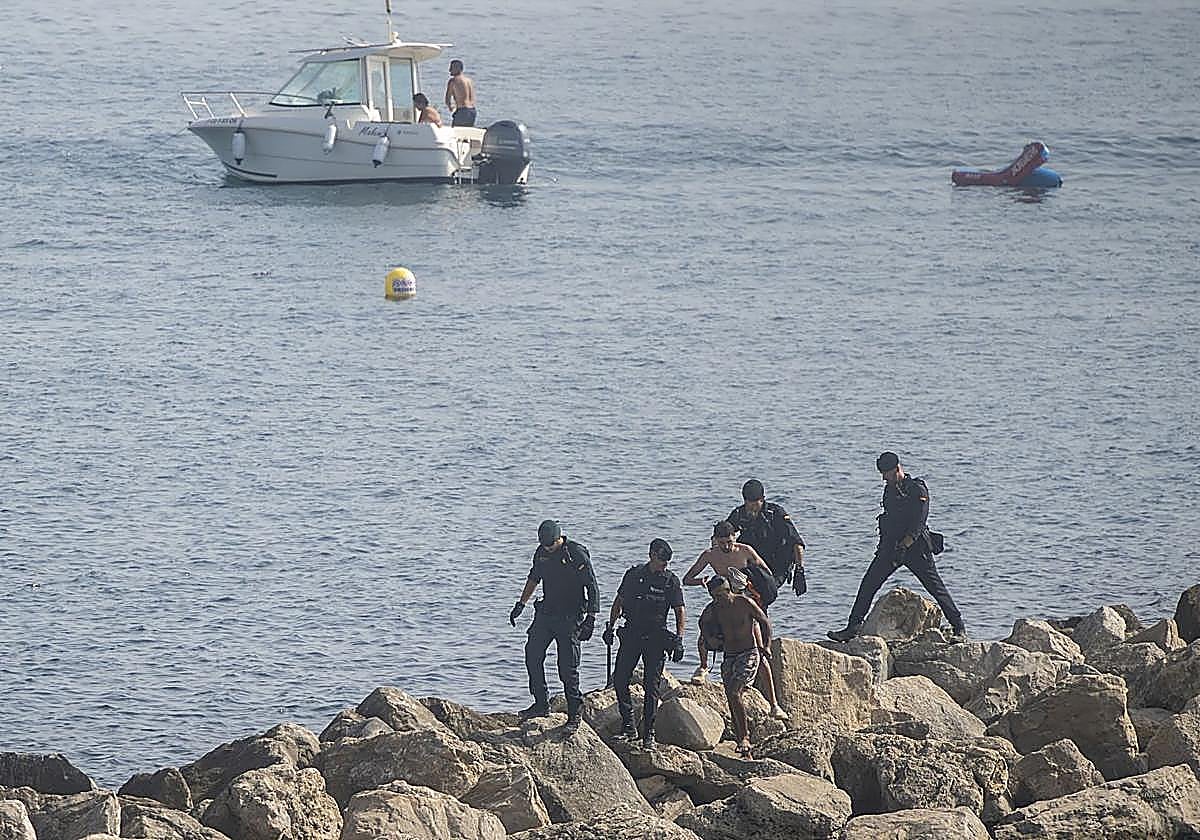
With the situation still unresolved and many unanswered questions remaining regarding the mass influx of migrants into the Spanish north African territory of Ceuta ... a week ago, Spain's Guardia Civil is already working to assess the situation and if possible, prevent future incidents.
Guardia Civil officers already have a preliminary report on a new attempt that is being circulated on social media and messaging apps in Morocco and which has been the subject of discussion for days. According to this analysis, to which ABC has had access, it states that “the risk of this call to action scheduled for 15 August materialising is real, but its scale is uncertain”.
On the basis of that document, the Guardia Civil will seek to assess a potential threat which is currently difficult to discern and quantify. The evidence, observed on both sides of the Strait, consists of thousands of posts and messages on social media platforms such as Facebook, Instagram and WhatsApp.
The effects that a mass mobilisation can bring about are still visible on the streets of Ceuta: the arrival of more than 72,000 people in just 24 hours last week put Spain in a precarious position and sparked tensions and mistrust among other Schengen countries.
In many of the messages currently under scrutiny, the phrase ‘harraga Morocco’; the term used by migrants from the north African country who are attempting to emigrate or cross the border into Spain illegally, either by swimming or via the various land borders.
Invitations are being shared to join groups with over a thousand members, where calls for a mass mobilisation can be seen, along with phrases such as ‘our last chance’ and ‘all will be revealed on the day’, in reference to the planned influx on 15 August.
Although reports on this new messaging campaign suggest it has reached an online community of almost half a million people, the report explains that “the strong indicator is not the raw number”, but rather the convergence of various elements such as “repeated dates, a variety of platforms, groups already specialising in migration, geographical references, logistical discussions and persistence over several days”.
Broad audience
The Guardia Civil's report, which does not contain the committee’s conclusions but rather material to be worked on, indicates that this call is "genuine" and "not an isolated incident". It says that the "potential audience is wide" and that there are "signs of basic, decentralised operational coordination". However, the report fails to identify the source of the message on this date or a chain of command.
On one of the key issues of the entire crisis – the active involvement of Rabat – they state that "there is insufficient evidence to attribute the call" to the Moroccan authorities. Regarding the role of human trafficking syndicates – an element frequently cited as justification by both the Spanish and Moroccan governments in this crisis – the report considers their involvement to be “plausible”, but “not proven to be the sole cause” according to the open-source material reviewed.
There is also a reference to another common feature of these chain messages: what is known as "mobilising disinformation" – false or distorted claims, such as talk of an "open border" or "automatic regularisation", which can reduce the target audience’s perception of risk.
This document states that this call is "genuine", and "not an isolated incident" and that the "potential audience is wide"
The report, which ABC has been able to consult, provides some key indicators which, should the five days preceding the stipulated date occur, could determine the likelihood of a similar incident happening again. Events such as the publication of messages specifying exact times and locations, calls for transport from major centres such as Casablanca, Rabat, Fez, Marrakesh, Agadir or Tangier; an increase in sales of wetsuits or flotation devices; or messages regarding road closures, police checkpoints or overcrowded stations. However, the document also warns that online conversations already suggest the possibility of action being taken before the aforementioned date.
![[]](http://static.vocstatic.com/voc26/latest/assets/images/favicon/surinenglish/apple-touch-icon-57x57.png)