
Immigration
Spain's government deploys military units in response to the arrival of 20,000 migrants in Ceuta
The government has refused to declare a national emergency, but has closed the border between Melilla and Morocco
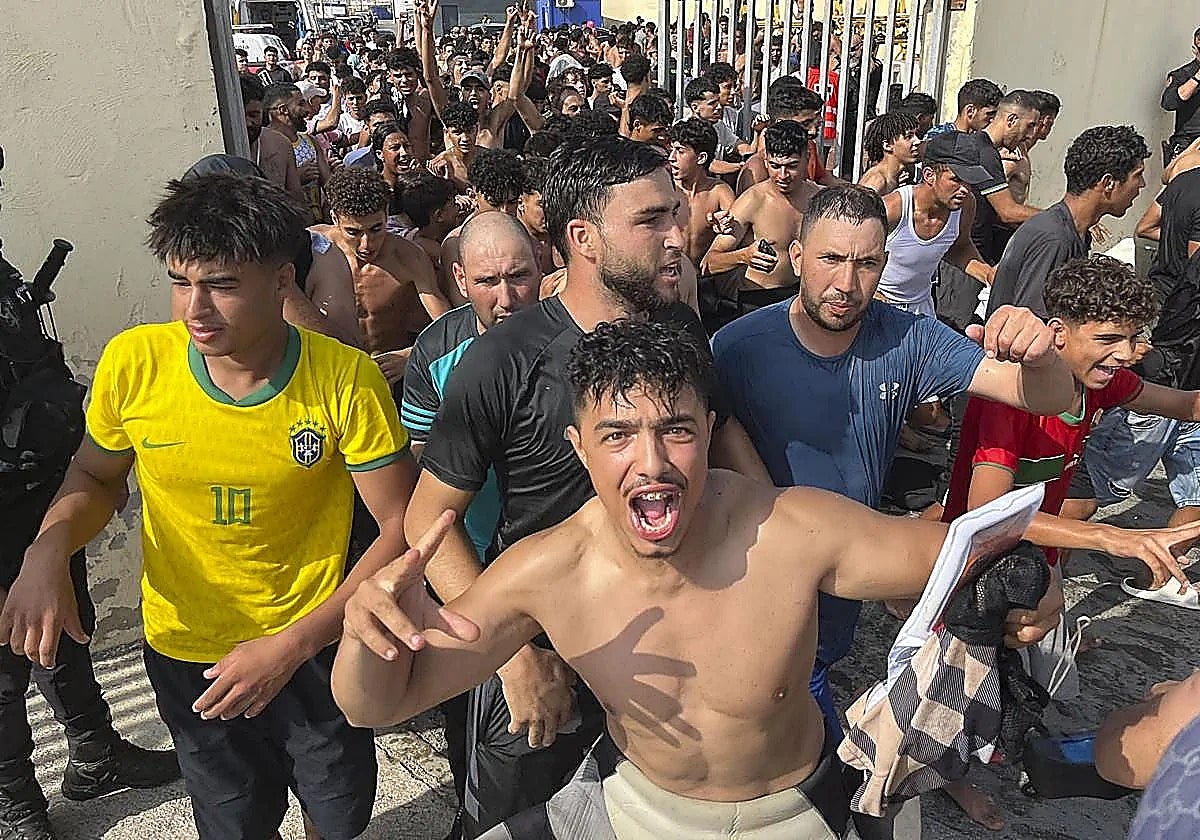

Spain's government has mobilised its military services to support the Guardia Civil in what threatens to become the worst migration crisis the autonomous city ... of Ceuta has ever faced.
On Thursday, the government refused to declare a national emergency, despite the demands of the president of the regional government of Ceuta, Juan Jesús Vivas, on the grounds that regulations do not include an event of this nature.
However, given the way the crisis was unfolding, shortly after 10pm, the government closed the Beni Enzar border post between Melilla and Morocco due to the risk of a large group of Moroccan nationals attempting to enter without authorisation.
Related story

Related story

The government delegation has not specified how long this closure will remain in place, although it has asked local residents not to go to the surrounding areas, in order to facilitate the security work of the Guardia Civil and the around 60 soldiers.
The collaboration of the two forces consists in managing the sustained and ongoing influx of migrants, which could number around 20,000 people, according to police sources.
In addition, the EU has offered "financial" and "operational" support through Frontex, the European Border and Coast Guard Agency.
Juan Jesús Vivas has once again called on Prime Minister Pedro Sánchez's government to take urgent measures to tackle the migration crisis in Ceuta, which is taking a dramatic turn, with at least 15 known victims.
He said that his regional government is "mobilising all necessary resources, working with the Moroccan and international authorities and preparing the necessary measures to restore normality as soon as possible".
At the same time, however, he called for a national emergency to be declared after nearly 800 people tried to enter the country on Wednesday. Including Thursday's figures, the total number of arrivals now stands at 1,700, the majority of whom are between 18 and 30 years old, in addition to many minors.
The government's response
Despite the alert and the deployment of the army, the government has ruled out declaring a national emergency, which would mean the state taking command, as happened a week ago during the massive wildfires in the region of Madrid and the province of Ávila.
According to the government, such an exceptional declaration "does not recognise migration flows as a risk under the national civil protection system". The government states that the only grounds for its activation, as set out in the regulations, are natural and technological in nature.
Despite this, government sources emphasised that they are "in constant contact" with the authorities in Ceuta and that the various ministries involved in managing this new migration crisis have been working from the outset to devise a response that guarantees both "security and migration control" and "the necessary humanitarian assistance" in order to prevent more migrants from losing their lives.
The Guardia Civil in Andalucía will also send 30 officers and two teams from the special underwater group (GEAS), comprising eight specialist divers, to bolster surveillance and rescue operations.
In addition, PM Pedro Sánchez is travelling alongside Interior Minister Fernando Grande-Marlaska to Ceuta on Friday to monitor "how the situation is developing and hold meetings with the local authorities".
Although the overall figures for irregular entries into Spain remained stable in the first half of the year, mainly as a result of the decline in arrivals via the Canary Islands, the number of people entering Ceuta by land or sea has risen by 149.4 per cent so far this year.
The number of deaths has also risen significantly. The Caminando Fronteras organisation has put the figure at just over 1,000 in the first few months of the year, eleven per cent more than in 2025.
The need for a "single command"
Vivas justifies his call for a national emergency on the grounds that the huge number of arrivals is completely overwhelming the city's capacity to provide assistance, which would require immediate state intervention.
Furthermore, he reiterated the need to establish a "single command structure" to coordinate management between the central government, the autonomous city and the various ministries involved.
Vivas once again placed the urgent amendment of the immigration law at the heart of his demands, as he believes that immediate return acts as a deterrent, which not only eases the burden on reception services but also prevents hundreds of young people from risking their lives at sea.
Vivas described the situation as an "absolute humanitarian and social emergency", placing particular emphasis on the strain on the child protection system, whose centres are currently 1,600 per cent over capacity. They are currently accommodating 472 young people, compared with the 29 legally available places.
The regional president called for the immediate release of state contingency funds and the implementation of a streamlined referral scheme to the mainland for both adults and minors.
Vivas is not the only one who, despite the government's refusal, is insisting on the declaration of a national emergency. All members of the board of spokespersons of the autonomous city's council, including the opposition, have called for this measure in light of the "qualitative leap" in the migration crisis.
They have also called for the closure of the Tarajal border due to the large number of people crossing on foot.
Morocco denounces criminal gangs
The Moroccan government on Thursday pointed to "criminal organisations" as the cause of the migration crisis that Ceuta has been experiencing for several weeks, stating they exploit the vulnerability of people, fostering false hopes and exposing them to serious risks to their lives.
In response to accusations that the country's authorities are not cooperating and are ignoring calls for help, both Morocco and Spain have defended the "active collaboration" between the two governments.
According to Interior Ministry sources, "the intervention of Moroccan security forces is preventing the arrival of numerous people".
![[]](http://static.vocstatic.com/voc26/latest/assets/images/favicon/surinenglish/apple-touch-icon-57x57.png)