
Ceuta migration crisis 2026
Malaga workers deployed in Ceuta describe 'biggest migration crisis in Spain'
A nurse specialising in disaster response and a spokesperson for NGO Accem recount the collapse, the suffering of the children and the Herculean effort to provide basic care for thousands of migrants
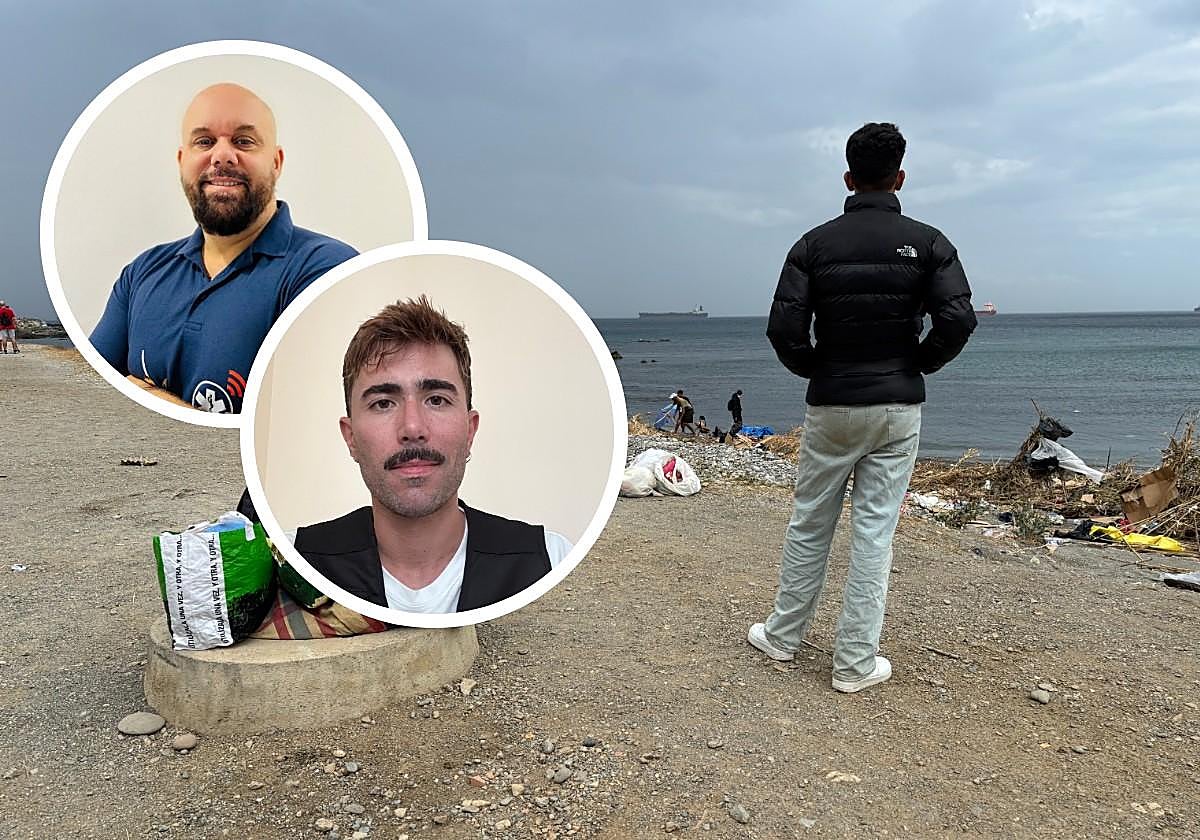

No amount of training can prepare one for a crisis of such magnitude as the one currently unfolding in Ceuta following the arrival of ... thousands of migrants at the end of July.
Two workers from Malaga, Alejandro Artero and Pedro De Santiago, are witnessing first-hand what they are describing as "the biggest emergency" in migration flows that Spain has ever experienced.
Alejandro Artero, 47, is a nurse. He holds a PhD in Health Sciences. He grew up in the Ciudad Jardín district of Malaga and has been working in Ceuta's hospital since 2022. "The situation is very tough, especially because the days go by and we're still feeling overwhelmed," Artero says.
Related story

He and other healthcare workers have been working 24-hour shifts for weeks, as the number of patients has soared with demand in the city practically doubling. "The first few days were absolute chaos because of the sheer number of cases, injuries and people showing signs of drowning and hypothermia," Artero explains.
A few kilometres from the hustle and bustle of the hospital, at the relief centre set up in Loma Margarita, the battle focuses on humanitarian logistics. There, Pedro De Santiago, 35, is the press coordinator, spokesperson and a member of the emergency team for NGO Accem.
In his first few days on the ground, De Santiago is working alongside his team against the clock to organise a response that will restore a minimum level of peace for the new arrivals. "Our job is to care for these people with compassion, ensuring they are treated with dignity and striving to uphold human rights in general," he says.
Artero has extensive experience in disaster response: he helped coordinate the Ebola emergency in Sierra Leone, the major fire in Gran Canaria in 2007, the Covid-19 crisis and the explosion of a fuel tank in Guinea-Conakry in 2023. Even so, he says that the current situation goes beyond anything he has experienced before and emphasises how heart-wrenching it is to see children on their own.
"We estimate that between 3,000 and 4,000 children must have arrived, but I'm not just talking about teenagers… I'm talking about babies and two-year-olds on their own. That's absolutely horrifying," De Santiago says.
That same sense of desperation has been evident in the care provided to pregnant women. "On the day it all began, a woman threw herself into the water just as she was about to give birth. She arrived at the hospital soaking wet and, shortly afterwards, gave birth to twin girls."
Faced with a constant stream of medical conditions, ranging from drowning to outbreaks of scabies or tuberculosis, the facility set up by Accem aims to bring some order to the daily chaos. "It's been a gradual process. We've gone from providing them with a sheltered space with single beds to ensuring they receive three meals a day," De Santiago states.
Their team have set up wash areas with taps, distributed hygiene kits and provided mobile phone charging points, "a vital necessity so that they can let their families know they are alive".
On the healthcare front, they are coordinating with the Red Cross and mobile clinics run by Médicos del Mundo to monitor injuries, gastroenteritis and flu-like symptoms, referring only serious cases to hospital.
Crisis management also involves tackling the language barrier and the families' despair. Artero recalls the harrowing search by two sisters, ten- and 12-year-old, who were trying to locate their eight-year-old sister, who has diabetes.
"The police were overwhelmed. After more than seven hours of uncertainty, the little girl turned up at the police station and the sisters rushed to the hospital to be reunited with her. We are all human and we all have hearts, but the pressure has been overwhelming," Artero says.
De Santiago highlights that the operation in Loma Margarita that takes care of more than 1,100 people of sub-Saharan origin from countries such as Sudan, Eritrea, Mali, Niger and Chad, the majority of whom are asylum seekers, is already making progress towards formalising their registration.
"In collaboration with the National Police, a group of people go through the triage and registration process every day, which is the first step towards applying for international protection," the correspondent explains.
Furthermore, just five days after the centre opened, Accem launched workshops on basic Spanish. "Language is key lever for facilitating their independence," he says.
Artero and De Santiago agree on the historic scale of the challenge. While Artero warns that Ceuta is facing an unprecedented crisis combining "a serious public health and security problem", De Santiago highlights the humanitarian aspect of the operation.
"Accem has been in the Canary Islands and Melilla and has managed the arrival of refugees from Ukraine and Afghanistan, but this is the largest emergency of its kind that Spain has ever experienced. It has been incredibly hard work, but these people are now in a far more dignified and protected situation than when they were living on the streets or on the beaches," De Santiago states.
![[]](http://static.vocstatic.com/voc26/latest/assets/images/favicon/surinenglish/apple-touch-icon-57x57.png)