
Storm Leonardo
Storm Leonardo: 160mm of rainfall and dozens of incidents in Malaga province
The Serranía de Ronda and the area around Marbella and Estepona concentrate the bulk of the problems caused by wind and overflowing rivers
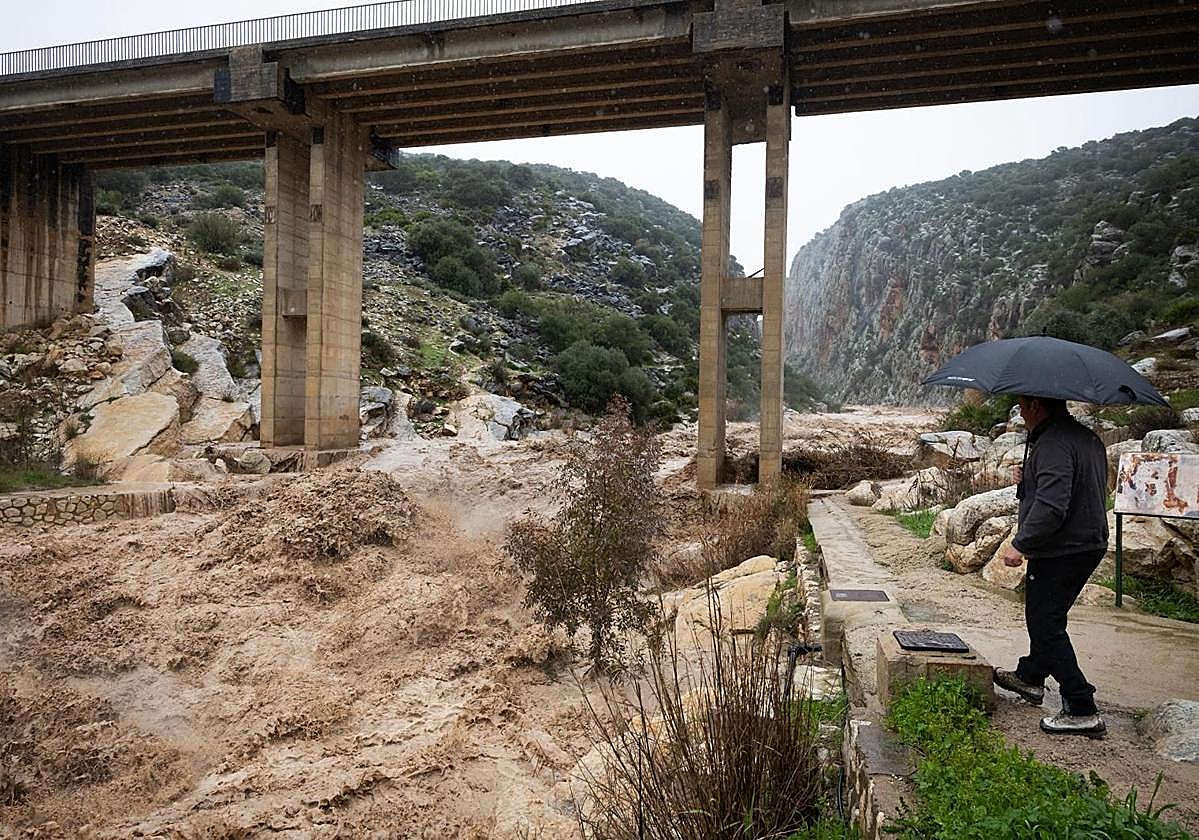

The accumulation of moderate and persistent rainfall brought today by Storm Leonardo is taking its toll on several areas in the province of Malaga. The storm, combined with a phenomenon known as an "atmospheric river" is leaving very high rainfall figures, especially in the Serranía de Ronda and the western end of the Costa del Sol (from Marbella to Manilva). In these areas red and amber weather alerts were in force from early on Wednesday morning.
The storm, however, has favoured the Axarquía area east of Malaga. It has not stopped raining throughout the night and continued to do so at midday today, which benefits the countryside and the reserves in the main reservoirs.
Any danger is due to the fact that the ground is already soaked from previous rain. Rivers and streams have already been full for the last few weeks and are setting all-time record levels, which is why several have overflowed their banks tohis Wednesday, affecting homes in the surrounding area. At the same time, the aquifers are already recharged and are infiltrating less and less, and reservoirs have been opening their floodgates for days to make room for the new inflows.
In this context, up to midday the 100mm mark had already been passed in the Guadiaro river (130); and the Genal river in Jubrique (130). Other points with outstanding rainfall are the Guadalmansa river (100); the Guadalmina (87); Cortes de la Frontera (84); Pujerra (95) and Ronda (84), to name but a few.
As a result, dozens of incidents are being reported, both due to overflowing rivers and wind, with gusts of more than 60 km/h which have blown down numerous trees and forced the closure of roads. Rail traffic has also been interrupted on the high-speed line in Álora and on the Guadalhorce commuter train.
Residents evacuated
Residents in the Serranía de Ronda received a red warning message on their mobile phones via the Es-Alert system on Tuesday night, meaning that there are few people out on the roads. But the worst effects are always those in people's homes. As a precaution, some twenty people were evacuated on Tuesday night in flood zones in the area around La Indiana, where the Guadiaro river has set a new historic record.
"It has overflowed and the water has already reached the first and second line of houses. Yesterday afternoon we evacuated almost all the neighbours but there are some of them who have not wanted to leave," explained the mayor of Jimera de Líbar, Francisco Javier Lobo. There are three people: a young man and a couple from the second line of houses, who are reluctant to leave their houses. The Estación area was already affected by the evictions last week.
In Ronda, the rain has flooded the Pelistre Bridge and caused damage to streets and buildings, as well as some traffic interruptions. On the other hand, in Arriate, a bridge has fallen after the passage of the Guadalcobacín and several houses have been cut off, so residents cannot go out. In the neighbourhood of El Pilar, in Almargen, the area remains cut off. All these incidents are being attended to by the emergency services.
Rescue in a car
The Marbella fire and rescue service rescued the three occupants of a car who decided to cross the Verde river on Tuesday night despite the fact that the point, like the rest of the flood zones in the town, had been marked to prohibit crossing.
The councillor responsible for Local Police, Fire Fighting and Emergencies, José Eduardo Díaz, has stated that it was a "high risk" rescue in view of the river's flooding due to the heavy rains and the release of water from the reservoir of La Concepción.
"The vehicle, in a reckless manner, ignored the signst and the barrier," he said.
For this reason, the mayor said that the three occupants of the vehicle have been "identified and will be sanctioned" in application of the municipal ordinances for "having broken a police cordon" and having endangered not only their physical integrity, but also that of those who came to their aid.
Reservoirs at maximums
On the other hand, Storm Leonardo has served to mark a milestone in surface reservoirs in the province of Malaga. And this is despite the fact that the reservoirs have been released one after the other in recent weeks, and are particularly intense these days.
It is the paradox of a province plagued by cyclical droughts; not long ago it was planning to bring in water by boat but now has no choice but to release water from reservoirs for unquestionable safety reasons. In any case, at the count at ten o'clock this Wednesday morning, the reservoirs exceeded the 414 million cubic metres marked in the year 2020.
The Guadalteba has the largest water storage capacity, with more than 120 million cubic metres. It alone could provide drinking water for two and a half years for the city of Malaga. The rise during the early hours of last night has been spectacular, practically three million cubic metres. It is almost 80% of its capacity.
It is followed by La Viñuela, which again increased its reserves and reached 95 million cubic metres. It is at 58% of its filling capacity. It has water for more than four years of urban consumption in the Axarquía. With irrigation, it would have reserves for about two years.
![[]](http://static.vocstatic.com/voc26/latest/assets/images/favicon/surinenglish/apple-touch-icon-57x57.png)