
Infrastructure
Mijas' new health centre project takes a big step forward with the award of the design contract
A Granada-based architectural practice will be in charge of designing the healthcare complex that will replace the CARE diagnostic and rehab centre and the Las Lagunas health centre

Mijas
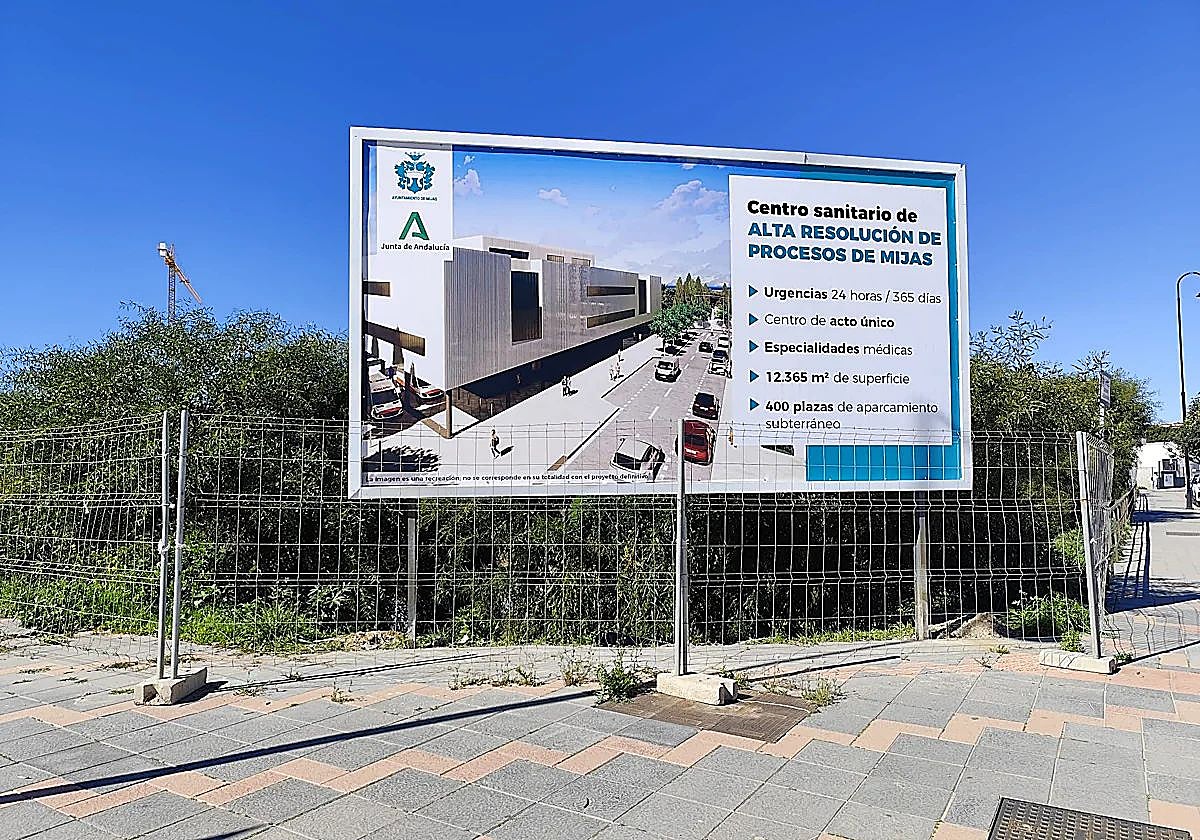
The Granada-based architecture studio of Fresneda y Zamora will be responsible for drafting the plans for the new high-resolution processing centre (CARP), to ... be built on a municipal plot in the Las Lagunas area of Mijas, next to IES La Vega secondary school and the Miramar retail park.
The company, which has won tenders in Malaga for such as the restoration of La Trinidad convent and also La Farola, Malaga city's bicentennial lighthouse, is the winning bidder that gets to sign the document that will define the design of these new healthcare facilities.
The contract includes drafting the preliminary design, the basics of the whole design and then the detailed design. While all this has yet to be formalised, the Granada-based architecture firm's proposal has already been deemed the best offer in the tender issued by Mijas town council, with a budget of 625,000 euros.
Fresneda y Zamora will have 150 days from the date the contract is formalised to complete the work and define the details of a building that will replace up to three existing healthcare facilities: the Mijas high-resolution specialist centre (CARE), the Las Lagunas health centre and primary care emergency service and, thirdly, the mental health unit, currently located in Fuengirola's municipal market in El Boquetillo.
In addition, the 061-Mijas emergency medical service headquarters, currently located in the Aquamijas water park car park, will also be housed in this future complex. The construction of the new CARP, as well as this technical work, will be funded by Mijas town hall, although the centre will serve the needs not only of Mijas residents, but also those of Fuengirola. In total, some 180,000 people, a population larger than that of 29 provincial capitals and two regional capitals in Spain.
When drafting the project, the architects must "carefully consider the flow of ambulances" arriving at a facility that will house outpatient clinics, emergency services and the 061 call centre, as noted by the regional health ministry in the tender documents. Furthermore, the tender requests that "for reasons of design consistency", the consultation rooms and common areas, including those for patient services, admin, staff, rehab and radiology, "will follow the same design criteria as those for primary care".
However, it clarifies that "the non-common areas (consulting rooms and some parts of the rehabilitation and radiology areas) must be separate from those of primary care, with clearly identifiable, independent access for users".
The centre will address increased demand and the "structural and capacity deficiencies" within current facilities.
The new centre, according to the regional health ministry's position in the tender documents, "responds to the need for more suitable and functional facilities, with the capacity to efficiently meet the growing demand for healthcare in the area". As for the current CARE centre, the regional ministry cites "structural and capacity deficiencies that limit the adequate provision of healthcare services.
Related story
-kHXH--366x256@Diario%20Sur.jpg)
"Among the main healthcare problems stemming from these limitations", the regional health department acknowledges that there is an "overcrowding" of spaces that has led to the centre "operating beyond its capacity," causing "long waiting times and difficulties in scheduling appointments". Also, the existence of an "obsolete" infrastructure, the inability to incorporate new specialities and services due to a "lack of suitable space" and "deficiencies in the coordination of care".
Reducing waiting times
Regarding the Las Lagunas health centre, inaugurated in 1993, the regional health ministry asserts that the facilities "have become completely inadequate", to the point that the centre is unable to hire neither an occupational therapist nor a speech therapist despite these posts being approved, and that the building "requires renovation due to architectural deterioration".
Thus, the regional ministry gives assurances that the new centre will address these "problems" through "expansion of care spaces", "reduction of waiting times", "greater integration of services", "improved" sustainability and accessibility and "adequate infrastructure" for the Las Lagunas emergency medical service.
However, the regional ministry for health maintains that the future CARP only involves a "relocation", making it clear that there will be no staffing increase, although it notes that "the possibility of expanding the range of services will be considered" for the Las Lagunas health centre.
![[]](http://static.vocstatic.com/voc26/latest/assets/images/favicon/surinenglish/apple-touch-icon-57x57.png)