
Weather
Costa del Sol marine heatwave increases risk of storms and torrential rain this autumn
Statistics from Puertos del Estado, satellite data, the CSIC and the Balearic Islands coastal observation service confirm three months of extraordinary temperatures
-U64162501121BVg-1200x840@Diario%20Sur.jpg)

Climate change sceptics and deniers have fewer and fewer arguments to put forward. The data is overwhelming, comes from a variety of scientific sources and ... is consistent across different analyses. All sources lead to similar conclusions, with only slight variations.
Malaga province is going through a tropical summer, with nights where temperatures rarely drop below 23C. This lack of respite is what makes matters worse, not the high temperatures in and of themselves.
The sea has also been in the throes of a persistent heatwave this summer, with the only respite coming on the occasional days when the land breeze blows.
4.5-5C
above the historical average.
Sea temperatures have been at unusual levels since the end of May.
These high sea temperatures constitute what experts call a 'marine heatwave'. They use the same statistical criteria, based on 30-year records, as for terrestrial heatwaves to declare it: it must persist for at least five days.
Related story

Malaga meteorologists have now officially confirmed that the province has been in the thick of a three-month-long marine heatwave.
Physicist at the Malaga oceanographic centre of the IEO-CSIC Manuel Vargas warns that this warming is facilitating the arrival of tropical weather phenomena and significantly increasing the risk of torrential rain in autumn.
The scientist has drawn on four different statistical sources (Puertos del Estado, Copernicus, SOCIB and the Radmed oceanographic surveys) and on data measured both at the surface and at depth.
Related story
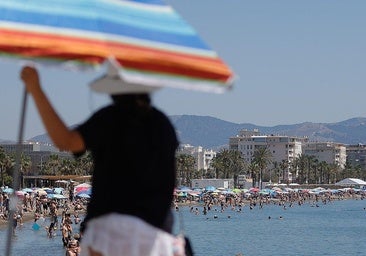
In summary, the coasts of Malaga and the Alboran Sea have experienced extreme and persistent temperature anomalies in both surface and seabed temperatures this summer.
According to the data cited, water temperatures have reached record highs of up to 28C, remaining consistently between 4.5C and 5C above the usual average values.
Data from the Puertos del Estado buoy off the coast of Malaga shows a rapid rise in temperature throughout the summer.
Up until 10 June, westerly winds and onshore breezes maintained rather low temperatures of around 19C. These winds cause the rise of deep water, which is colder, to the surface.
However, following that initial period, readings showed a steady rise. By the end of June, the buoy recorded 24C, already considered high for that month and equivalent to the usual maximum temperatures in August. In early July, temperatures exceeded 26C and in recent days, they have reached 28C.
Data from the Copernicus programme (the EU's Earth observation system, which uses a fleet of satellites to measure environmental variables) confirms the findings from the buoys.
"Satellite observations indicate that throughout the summer the water has remained well above average temperatures. Currently, temperatures are 4.5C above average, having reached peaks of between 4.5C and 5C above average, although there have been isolated days with westerly and onshore winds that caused temporary drops to normal or slightly lower levels," Vargas said.
The concept of a 'marine heatwave'
The Balearic Islands coastal observation service (SOCIB) assesses the phenomenon under the technical definition of a marine heatwave, triggered when the water temperature exceeds a historical threshold that has only been surpassed on 10 per cent of occasions.
"SOCIB's analyses confirm that the Alboran Sea has been experiencing an unbroken marine heatwave since the end of May. The temperatures can be considered exceptional," Vargas stated.
The observations are not limited solely to the surface layer. The IEO has carried out its four annual seasonal analyses, known as Radmed, using oceanographic vessels to take samples from the surface to the seabed.
The results corroborate the findings of Puertos del Estado, Copernicus and SOCIB: "This shows that temperatures, not only at the surface, but several metres below the surface, are higher than normal."
"These marine heatwaves were, in principle, an exceptional occurrence. We used to try to measure when these exceptional situations took place, but they are increasingly becoming the new normal," the physicist said.
The excess heat stored in the sea will act as a dangerous "weather fuel" in the coming months. Although heatwaves are a normal feature of the Mediterranean climate as summer draws to a close, the current situation suggests a substantial change in their behaviour.
As summer draws to a close and autumn begins, Vargas warns that these storms are set to become increasingly destructive, more intense and also more frequent.
On Tuesday, 18 August, the temperature at the buoy in Malaga Port was just 0.3C short of the all-time record of 29.1C in August 2015. This confirms the risk of exceptionally heavy rainfall in the coming months.
![[]](http://static.vocstatic.com/voc26/latest/assets/images/favicon/surinenglish/apple-touch-icon-57x57.png)