
Archaeology
Marbella shipwreck sheds light on 19th-century transoceanic trade
Italian merchant vessel laden with French building materials sank off Cabopino in 1887 bound for booming Buenos Aires

Marbella
The seabed off Marbella holds a story that goes beyond the sinking of a merchant ship.
Off Cabopino beach, the wreck of a brig that ... sank in November 1887 bears the traces of a trade that linked factories on the French Mediterranean coast with a rapidly expanding Buenos Aires, in an Argentina experiencing the greatest economic growth in its history (GDP grew by 141 per cent between 1881 and 1889).
Tiles, roof tiles and other building materials were being transported in its holds bound for Argentina when a storm cut short the voyage. Almost 140 years later, the wreck allows investigators to reconstruct part of the trade networks that linked Europe and the Americas.
The researchers’ main hypothesis points to the Galigniano, an Italian merchant ship whose name is also transcribed as Garegliano or Gagliano. This identification has yet to be confirmed. Historical records date the shipwreck to 23 November 1887 and state that all 14 crew members managed to survive. The vessel, weighing some 602 tonnes and registered in Naples, is believed to have sunk with no clear prospect of being salvaged
Related story
-

History
José Carlos García
.
The cargo is one of the key factors contributing to the site’s historical significance. The ship had set sail from Marseille and was bound for Buenos Aires, where urban growth was fuelling demand for imported materials. Among the documented artefacts are ceramics bearing trade marks linked to Marseille-based manufacturers such as Roux B Martin. Their presence enables the submerged remains to be linked to a specific industrial and commercial activity.
During the last third of the 19th century, Buenos Aires underwent a profound urban transformation. The construction of homes, public buildings and shops fuelled demand for paving, roofing and other architectural elements. In 1880 alone, Argentina imported some 14 million tiles, according to a study by the Buenos Aires-based architect and archaeologist Daniel Schávelzon. The reason for this boom in imports was simply the quality, which was far superior to that which could be produced in Argentina.
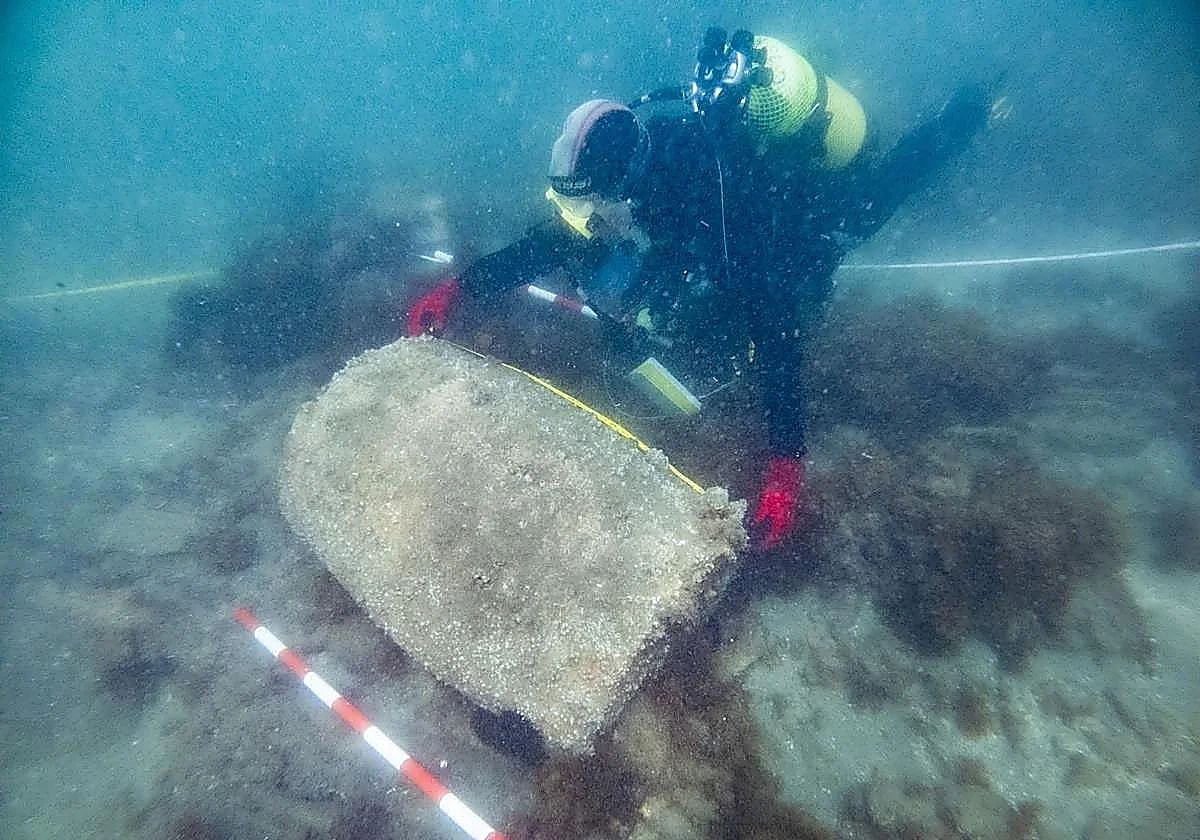
The centre for underwater archaeology is working on documenting and studying the site using archaeological techniques and three-dimensional modelling
The voyage reflects a lesser-known aspect of transoceanic trade: it was not only American raw materials and agricultural produce that crossed the ocean, but also European manufactured goods destined to transform the continent’s cities.
The economics of seafaring itself also played a part. Ships needed to distribute their weight to maintain stability, and certain building materials could serve as ballast whilst still being saleable goods. Return voyages enabled American products to be transported to European markets, thereby ensuring the continuity of the trade routes.
An underwater archive
The first archaeological survey of the wreck was carried out in 2022. The survey documented remains of the hull, frames and longitudinal members, as well as a protective metal cladding. The site was then situated at an average depth of approximately six metres, with a visible structure at that time measuring 39 metres in length and 15 metres in width.
The Andalusian institute of historical heritage, through its centre for underwater archaeology, is working on documenting and studying the site using archaeological techniques and three-dimensional modelling, following an underwater archaeological investigation carried out in the waters off Cabopino during the second half of September.
The aim is to gain a better understanding of the ship’s structure, analyse the cargo and make progress towards definitively identifying the vessel.
Combining the wreckage with naval archives can provide information on the origin of the goods, shipbuilding techniques and the circumstances of the shipwreck. Trade marks help to reconstruct the route taken by the goods from the point of manufacture to their destination market.
The Cabopino shipwreck thus transforms a maritime accident into a source for studying the expansion of international trade in the 19th century. Long before Marbella became associated with tourism, its waters were already part of the routes linking the Mediterranean with the Atlantic.
The storm that brought the voyage to an end left behind, beneath the sea, a powerful testament to the trade between Europe and the Americas.
