
Construction
Malaga brings forward start of works that will close Calle Ollerías for ten months
The urban planning department has chosen Actua Infraestructuras to carry out the 2.1-million-euro project

Málaga
Work to remodel Malaga's Calle Ollerías is drawing closer. A month after the urban planning department put the project out to tender, the city ... council's procurement committee has selected the construction company that will carry out the work.
Actua Infraestructuras submitted a bid of 2,145,999 euros and will carry out the project within the ten-month timeframe set out in the council's plans.
The company is currently completing construction of the new Neoalbéniz cultural facility for the city council, next to the Alcazaba tunnel.
Last month, the urban planning swpartment put the Calle Ollerías refurbishment out to tender with a budget of 2.2 million euros and a ten-month completion period. This means the road, which forms part of the route of several Semana Santa processions, will remain closed for almost a year.
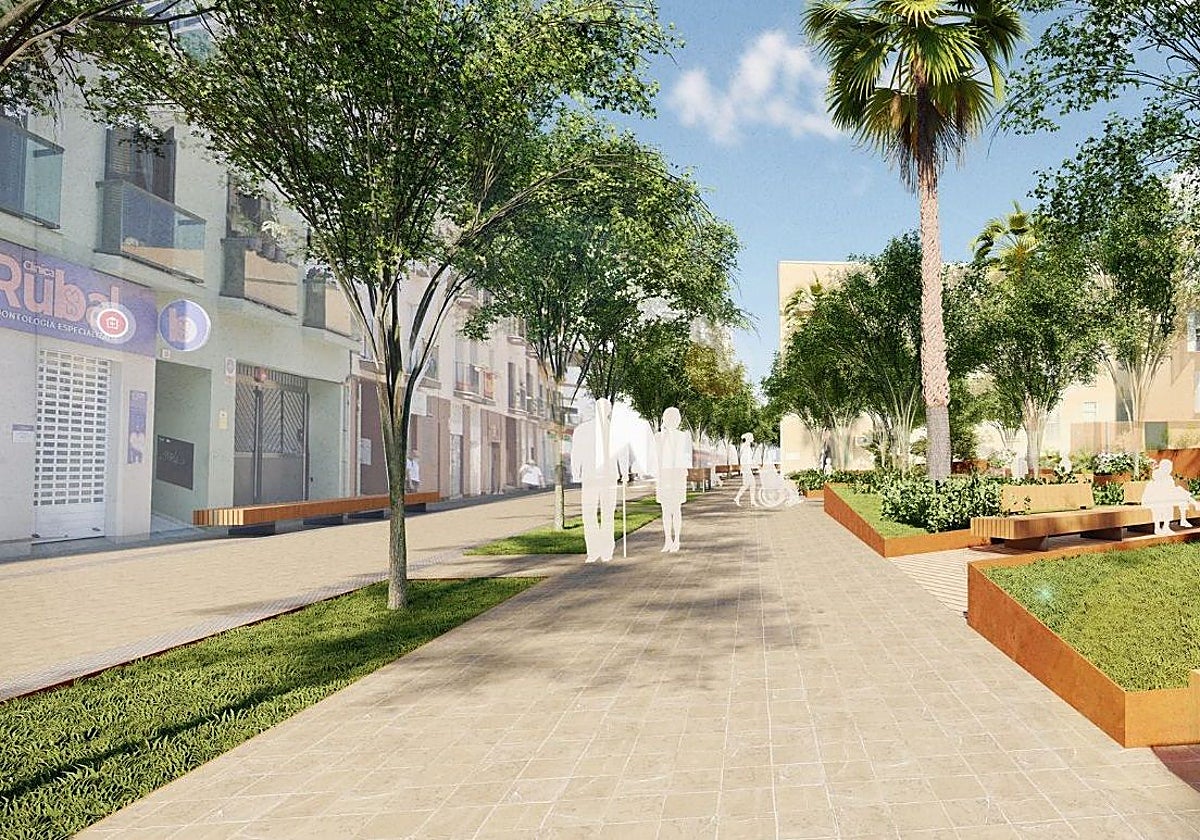
The project will maintain traffic through the street while improving and expanding its pedestrian areas, as well as completely renovating Plaza de Pepe Mena.
The plans call for granite paving on the pavements, using 60-by-40-centimetre slabs. The road surface will use a type of exposed-aggregate concrete, leaving the stones and gravel within the material visible.
The council will also install a teak-coloured bamboo deck in Pepe Mena , giving it "a warm and elegant appearance, similar to tropical hardwoods".
The project will also completely renew the street's water supply and sewage networks, drainage system and street lighting. The existing light fittings will be replaced with LED units that will provide white light at around 30 points along the street.
The council will also plant 38 new trees in Pepe Mena, along the eastern pavement between the square and the junction with Calle Cruz del Molinillo and opposite the María Victoria Atencia cultural centre.
As for street furniture, the project includes 28 benches and 18 litter bins. It also provides for 280 square metres of planted areas, which will feature species "resistant to salinity and the easterly Levante wind because of their proximity to the sea", according to the project plans.
The project forms part of a new wave of schemes that the city council plans to finance largely with European funds through to 2029.
The Calle Ollerías refurbishment could lead to a change in traffic arrangements. The tobility department plans to reverse the direction of traffic on the street so that vehicles leave the city towards El Molinillo, as they did while work was taking place on Calle Carretería.
To achieve this, the city council plans to stop operating the Tejón y Rodríguez car park as a short-stay facility and reserve it exclusively for residents. It will also examine the situation of the private Granados car park so that it can adapt to a Calle Ollerías that would no longer serve as an entrance into the city centre.
However, according to sources, all these possible traffic changes "will be studied and must be agreed with residents", so the plans have not yet been finalised.
The project also complements, to some extent, the scheme planned around the Salamanca market. That project aims to significantly expand pedestrian areas around the market and along Calle San Bartolomé, according to the design by architect Antonio Díaz Casado.
This new European-funded investment programme will receive 11.9 million euros from ERDF funds, equivalent to 85 per cent of the 14 million euros earmarked for investment.
However, the local government has said that it plans to carry out projects worth 30 million euros. It has also pledged to cover directly any part of the funding that Brussels ultimately does not finance.
The city's contribution will therefore amount to around 16 million euros, covering 60 per cent of the funding needed to carry out the works.
![[]](http://static.vocstatic.com/voc26/latest/assets/images/favicon/surinenglish/apple-touch-icon-57x57.png)