
Infrastructure
Malaga music auditorium tender fails as construction companies fail to submit bids
City hall launches inquiry with major infrastructure firms after 209-million-euro port project receives zero offers despite strong preliminary interest
Paco Griñán
Malaga's long-awaited concert auditorium has suffered another setback after no construction company submitted a bid for the 209-million-euro project at the city's port.
The tender has therefore failed, forcing the city council to restart the process and making it unlikely that it will complete the procurement before the current municipal term ends next May.
The latest setback follows the Culture Ministry's abrupt withdrawal from the project’s funding arrangements and a technical issue with an appeal by the CNC (national construction confederation) against the tender documents. The council had to amend the documents after accepting the appeal, which also delayed the deadline for bids.
Related story
The deadline passed last Friday without a single company submitting an offer. The council has confirmed that the tender has been declared void, a result that has surprised the administration led by Mayor Francisco de la Torre, which is promoting the project with support from the Andalusian regional government, the provincial authority and private investors.
This past summer, municipal company Promálaga carried out a preliminary market consultation to gauge interest and identify potential obstacles before launching the tender. Nine companies expressed interest in building the cultural venue during that initial process.
Several were major national construction firms, including Constructora San José, Dragados, Ferrovial, OHLA and Sacyr, as well as Malaga-based Sando. Yet none went on to submit a formal bid for the opera house designed by architects Agustín Benedicto and Federico Soriano.
The city council has made no secret of its disappointment and is now trying to establish why the tender failed. Municipal sources say it is "contacting companies in the sector to find out why, given that a preliminary market consultation in June produced a positive result".
Once it has completed those discussions with construction firms, the council and Promálaga intend to revise the tender documents and relaunch the competition "as soon as possible".
Dispute over the auditorium's future use
The tender has also been caught up in controversy over De la Torre's proposal to use the auditorium not only for concerts, opera and other performances, but also for events and trade fairs.
However, the architectural design makes no provision for the latter use and focuses exclusively on cultural activities. Despite this, the city council has entrusted both construction and future management of the auditorium to Promálaga, the municipal company that also runs the city's trade fair and conference centre, Fycma.
The decision has forced De la Torre to offer repeated explanations and promise that cultural events will remain the main focus of the auditorium's programme.
Building design
The music auditorium is expected to take four years to build on a 30,000-square-metre site. The project includes landscaping and infrastructure around the venue, a 500-space car park and associated access roads, including a third traffic lane along Paseo Marítimo Antonio Machado.
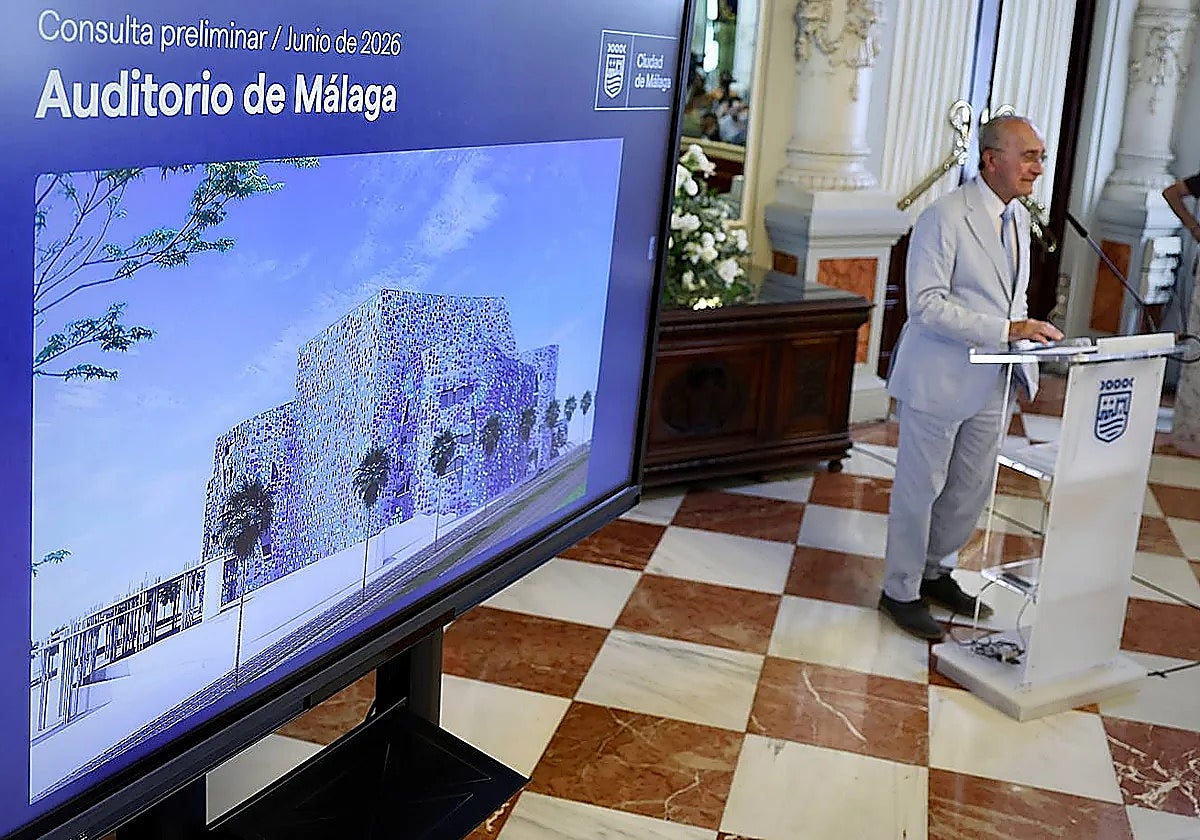
Benedicto and Soriano's design centres on a large building beside the sea on the port's San Andrés platform. The complex will comprise several interconnected volumes, with the main auditorium at its heart.
The principal hall will seat up to 1,905 people across three levels of seats and boxes. Its stage will accommodate both a 360-degree configuration, with the audience surrounding the performers, and a traditional horseshoe-shaped layout.
A second volume facing the sea will house the chamber music hall, with 465 seats, wooden flooring and gold-coloured wall panels intended to evoke the appearance of a jewellery box.
Between the two performance spaces, the design places rehearsal rooms, dressing rooms and the headquarters of the OFM (Malaga Philharmonic Orchestra). The layout will allow musicians, singers and other performers to reach both stages directly and simultaneously, avoiding unnecessary crossings between routes.
The construction of the performance halls was at the centre of the CNC's appeal last September. Promálaga accepted the challenge and amended several sections of the tender documents, including requirements that bidders employ two of the acoustic specialists needed for the project directly within their own organisations.
Despite those changes, the ambitious, multimillion-euro project has failed to attract a single formal bid.
Read dedicated local reporting for Malaga city
