
History
Malaga's Gibralfaro castle marks 100 years of municipal use
The hilltop fortress - one of Malaga's main emblems - dominates the city centre and even appears on the coat of arms granted by the Catholic monarchs in 1494
Víctor Heredia
Gibralfaro castle is one of Malaga's emblems. Its silhouette dominates the city centre and even appears on the coat of arms granted by the Catholic monarchs in 1494. It can also be seen on the ceiling of the Cervantes theatre and in the large stained glass window of the Atarazanas market.
The castle was built in the mid-14th century, although there was undoubtedly another building in its place before that, either another fortress or a lighthouse. The latter would explain the etymology - Gibralfaro literally means 'lighthouse mountain'. The castle completed the defensive structure of the medieval city by protecting the already existing Alcazaba, located at a lower altitude, when the use of artillery was already widespread. The perimeter of the fortress is adapted to the characteristics of the terrain, occupying more than 12,600 square metres. The wall surrounding the castle is 733 metres long and punctuated by eight towers. The most important of these is the Torre Blanca (white tower).
Gibralfaro was the nucleus of the resistance of the Nasrids, commanded by Hamet el Zegrí, during the Castilian siege of 1487. Considered one of the most impregnable fortresses on the peninsula, it maintained its military use under the Christians, with a permanent garrison and serving as a prison and the residence of the military governor.
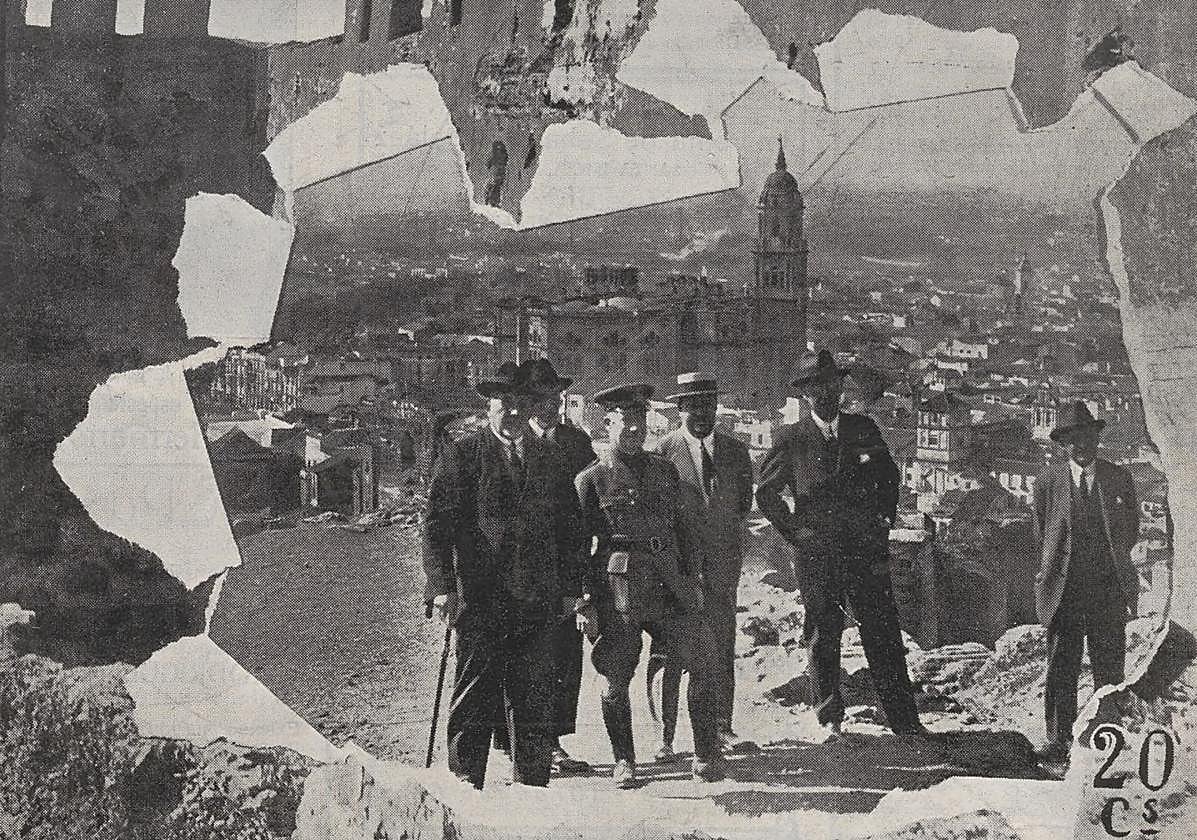
After the Battle of the Annual in 1921, the Army reorganised the military installations intended to support operations in Morocco. Gibralfaro castle was in a state of neglect and its location was not considered particularly useful at the time. In February 1924, dictator Primo de Rivera announced that a reserve brigade of some 6,000 soldiers was to be sent to Malaga, ready to go to Africa. A camp to house them was to be built close to Torremolinos. The site chosen was the Cortijo de Velarde, where adaptation work began under the direction of engineer Tomás Moreno Lázaro. On 11 March 1925, mayor Dr Gálvez Ginachero met with the Minister of War, presenting him with the request that Gibralfaro be ceded to the city.
In the following months, the proceedings progressed in parallel. In May, the city council ceded the land for the future Benítez Camp to the Army, which would not be inaugurated until October 1928. In exchange, on 6 September, Malaga city council was authorised to create a park on the Gibralfaro hill. However, the Army remained the owner of the fortress.
City castle
However, the planned actions did not take place until much later. The castle was abandoned despite a 1931 declaration of historic-artistic value. In the 1940s, the hill was reforested and the inn was built. In June 1965, the army approved the transfer of the domain of Gibralfaro castle to the city. In 1977, the military buildings were demolished in order to landscape the interior of the castle, which underwent restoration in various phases. In July 1998, the interpretation centre was inaugurated in the old powder magazine - a gem of 18th-century military architecture.
The monumental project of Ramón Santa Cruz
In 1928, architect Ramón Santa Cruz presented a grandiose project for Gibralfaro. He proposed the creation of paths with esplanades, arbours, overhanging balconies, pergolas and fountains offering attractive panoramic views of the sea and the city. This involved the planting of an abundant grove of trees to create a forest similar to that of the Alhambra and the creation of gardens in what was still the Alcazaba quarter. He proposed opening a museum in the castle and a library in the Alcazaba, as well as a restaurant and a sports and amusement area, advocating an original project - "something that does not resemble what has been done in other countries". Santa Cruz published sketches showing wide staircases, Hindu-style temples, gardens, ponds, animal statues, belvederes and a slender tower. The monumental ensemble was completed by oriental-inspired buildings with a charming kitsch air, reminiscent of Hollywood film sets.
![[]](http://static.vocstatic.com/voc26/latest/assets/images/favicon/surinenglish/apple-touch-icon-57x57.png)