
Archaeology
Coins from Egypt, Italy and France unearthed in Malaga metro's Roman necropolis
Numismatic finds in nearly 1,000 graves beneath Calle Hilera confirm ancient Malaca was a bustling Mediterranean trading hub exporting garum, olive oil and wine

Málaga
Surprises continue to emerge from the vast Roman necropolis that has come to light during the construction of the Malaga metro, beneath Calle Hilera.
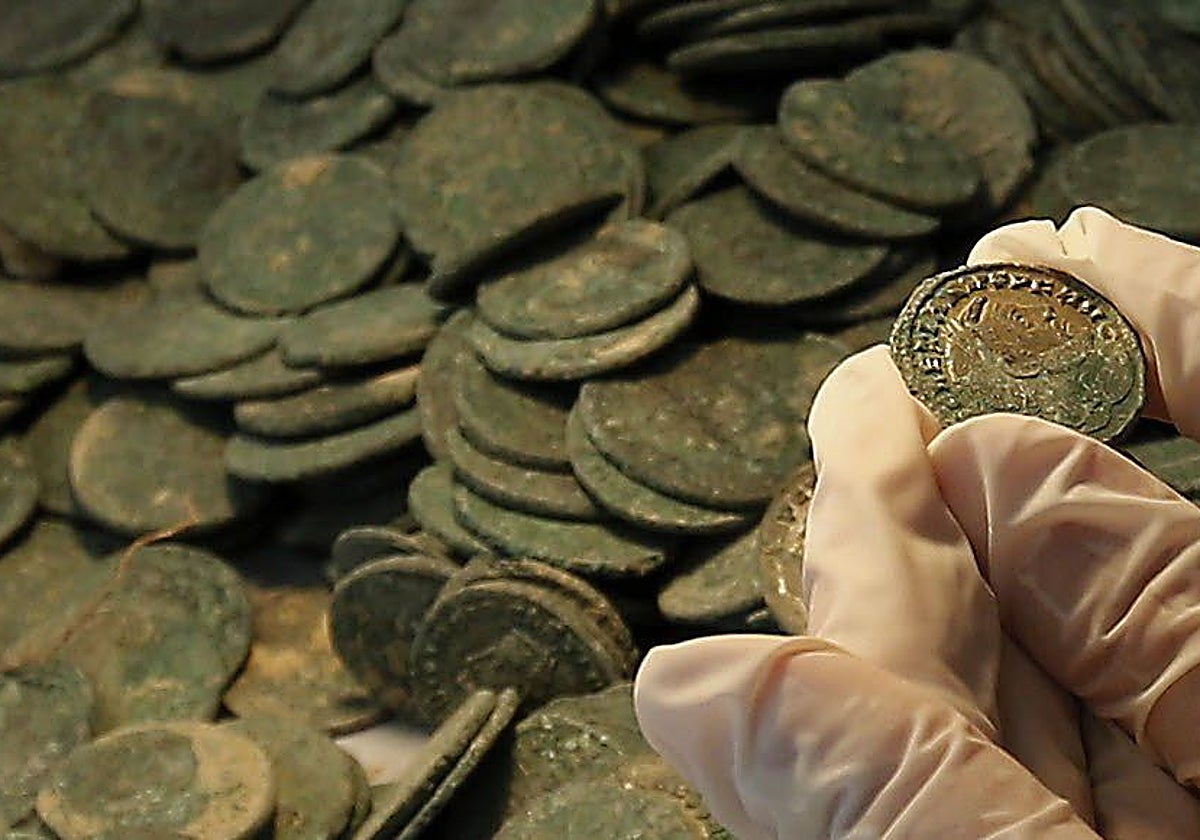
The ... archaeological work is providing a much more detailed insight into what society was like in Malaca (Roman Malaga) at that time. Some of the most significant finds are the numerous coins that have been unearthed, which illustrate just how open and cosmopolitan this city was more than 17 centuries ago, thanks to its port and maritime trade.
Initial studies (archaeologists are still carrying out fieldwork) have made it possible to date a number of small bronze coins. “This is the small change that was used on a daily basis to make purchases at the market,” explained the researchers, via the regional ministry of development of the Andalusian government, the body responsible for this project. The oldest dates from the second half of the 3rd century AD, and the rest from the 4th century. Some feature the gate of a military camp; others, two soldiers with standards; and there are coins bearing the images of the emperors Licinius, Constantius II and Magnentius.
The coins, dating from the 3rd and 4th centuries, are those of the emperors Licinius, Constantius II and Magnentius, and were minted in Rome, Alexandria and Lyon
The Empire had coin-minting workshops, known as ‘cecas’, scattered throughout its territory, and each coin bears letters indicating where it was made. At the Hilera site, coins have been found from Rome, Alexandria (Egypt) and mints in the south of France, such as the one in Lyon. Although these finds must be interpreted with caution, as there is still numismatic material to be studied, they do, at first glance, show that in Malaca, money circulated freely throughout the Mediterranean between the 2nd and 5th centuries AD, and that the city was involved in maritime trade, even with distant destinations.
The reason why artefacts of this kind have been found alongside the bodies is that in the Roman world (as in the Greek world) it was customary to bury the deceased with a coin. "According to ancient belief, it served to pay Charon, the ferryman who carried souls to the afterlife, although it could also function as an amulet or an offering." The researchers point out that while all the coins are Roman, they were not all minted in the same place. Therefore, they cannot be regarded as foreign coins from other peoples, but rather belong to the same Empire, even though they were minted in locations far apart from one another.
The port: the driving force behind Malaca
Malaca owed its long-standing open and cosmopolitan character to its port. Ever since the Phoenicians founded the city almost three thousand years ago, it has depended on the harbour throughout the ages. Goods that sustained its economy flowed in and out via the quays, and so too did people, beliefs and ways of thinking that arrived from other shores of the Mediterranean and which, over time, transformed the way Malaga’s society lived and organised itself.
Related story
As an export powerhouse, the region was famous for its salted fish and for garum, a fish sauce much prized by the Romans. These were produced in factories by the beach and transported by sea in clay amphorae. Olive oil was also a major commodity, and was produced, just as it is today, in the Vega de Antequera and the Guadalhorce valley.
Related story
-
José Carlos García
Malaga served as the gateway to the sea for a large part of Andalucía. Via the natural passage of the Guadalhorce river and the Montes de Málaga, the city was connected to other towns in Baetica – the Roman province that covered much of present-day Andalucía – and to Granada. Olive oil, wine and other produce were transported down to the coast, where they were shipped to other parts of the Empire. Consequently, the port of Malaga, together with that of Cadiz, was one of the most important in the south of the peninsula. Meanwhile, tableware and other goods arrived in the city by ship, mainly from North Africa and the eastern Mediterranean.
Scarce grave goods
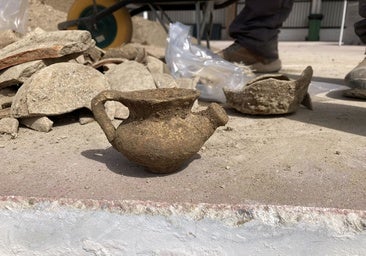
Furthermore, grave goods are very scarce, because in those days the deceased were buried with very few personal effects. "This is typical of Roman cemeteries of that period, when the custom of being buried with many personal belongings was already falling out of use." Despite this, small ceramic and glass vessels for perfumes and ointments have been recovered, as well as a small jug and a bronze bracelet worn by a newborn baby.
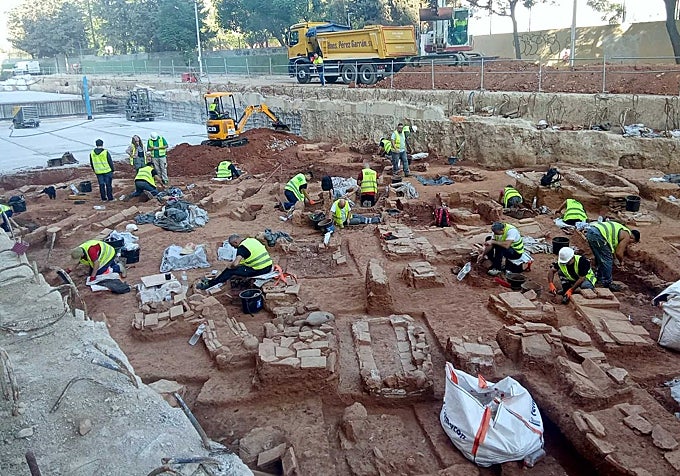
The Roman necropolis on Calle Hilera is the largest discovered to date in Malaga and ranks among the largest in Spain. Archaeologists have documented almost 1,000 tombs stretching over a distance of more than 460 metres, containing the remains of over 960 people buried between the 2nd and 4th centuries AD. The Romans buried their dead outside the city, alongside the access roads, and the niches were lined up on both sides of a road (previously unknown to historians), which led towards the western coast. In fact, the significance of this discovery has necessitated a revision of Malaca’s topography, as the Hilera area had previously been considered land reclaimed from the sea during the Islamic period.
Fifteen different types of burial have been identified at the site: simple pits, brick tombs covered with roof tiles, tombs with gabled roofs and others topped with a sort of mortar table, where families held banquets and made offerings in memory of the deceased. Babies were often buried inside amphorae. This significant historical discovery took place in May 2025, during work on the extension of the underground tunnel from Guadalmedina station (next to El Corte Inglés) to the civil hospital and the future new hospital.
As the current phase of excavation draws to a close, the human remains will be deposited in the storerooms of the Malaga museum (Aduana). Meanwhile, the remains from the most remarkable tombs will be displayed in the future exhibition space planned next to the Guadalmedina station tunnel, beneath Avenida de Andalucía, between the former central post office building and the tax agency headquarters.
