
Traffic
Malaga city's red-light cameras catch 22,000 drivers in one year
Municipal group Con Málaga has requested these regarding the 'red-light camera' system on Valle-Inclán and at the metro junction on Jiménez Fraud
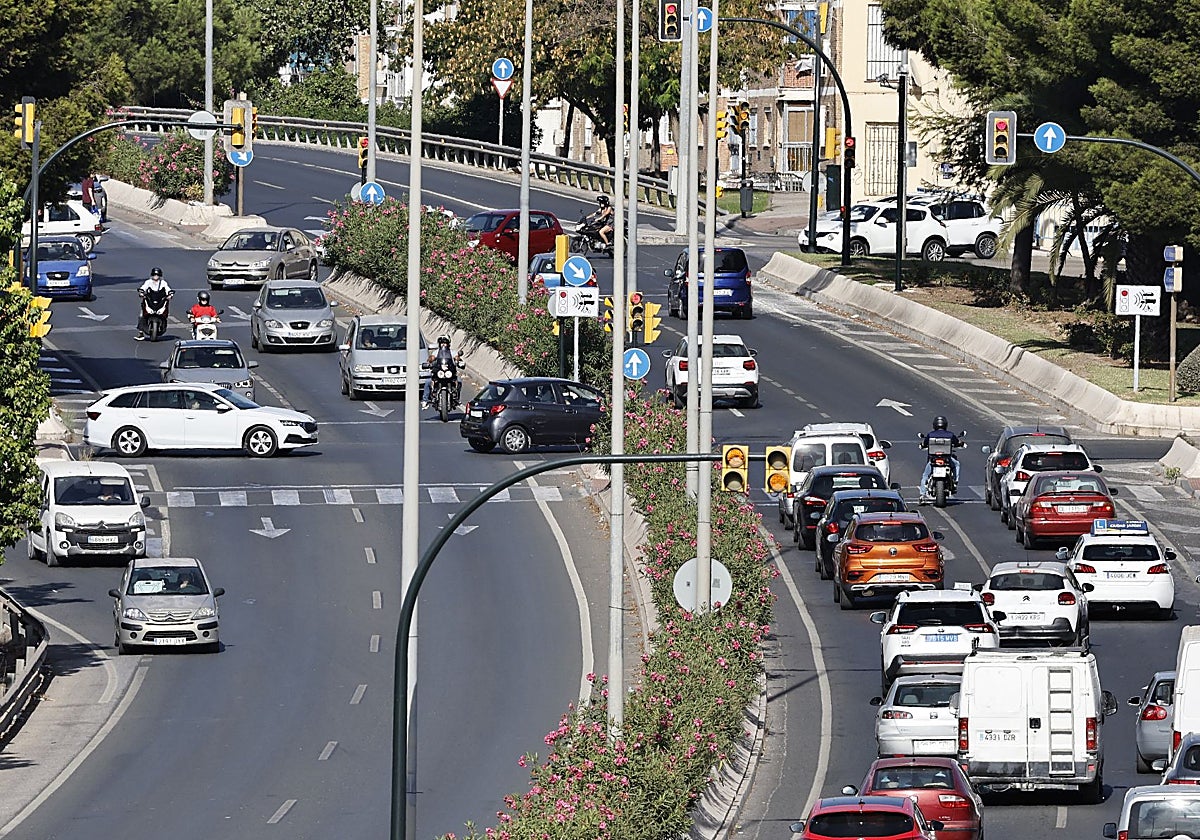

The automated red-light camera system in Malaga city detected a total of 21,746 offences between 22 September 2025 and 24 August 2026, that ... is, during its first year of operation.
These figures come from the official report of the transport department, as per the request of municipal group Con Málaga. This system is triggered when it detects that a vehicle has run a red light or has set off before the light has turned green. The aim is to prevent accidents.
In Malaga, the red-light camera system has been in operation for a year, on Avenida Valle-Inclán and at the junction where the above-ground metro line meets the road in Teatinos. The fine is 200 euros (half that amount if the offender pays immediately) and results in the deduction of four points from their driving licence.
Related story
-

Infrastructure
Pilar R Quirós
During this period, the camera on Avenida Valle-Inclán recorded 15,512 offences, accounting for 71.3 per cent of the total. This equates to an average of 46 vehicles each day. The report states that, as it is a main artery of the Ronda Intermedia, the risk of a front-side collision in the area is critical.
The camera on Avenida Jiménez Fraud, in Teatinos, near the Clínico hospital, recorded 6,234 offences (the remaining 28.7 per cent of the total), which works out at an average of 18 fines per day.
The impact on road safety has, so far, been modest. According to the response, on Avenida Valle-Inclán the number of collisions fell from 115 between September 2024 and August 2025 to 111 between September 2025 and August 2026, while on Avenida Jiménez Fraud the figures showed no significant changes.
In total, there are six red-light cameras in the city. At the junction with the metro, the measure complements the existing traffic lights, audible signals and conventional traffic signals that regulate the junction. There are two cameras in that area.
The other four are on Valle-Inclán: one at the junction with Camino de Suárez (monitoring both eastbound lanes), two at the junction with Avenida Simón Bolívar (one for westbound traffic and the other for eastbound traffic) and another at the junction with Avenida de la Palmilla, controlling both eastbound lanes.
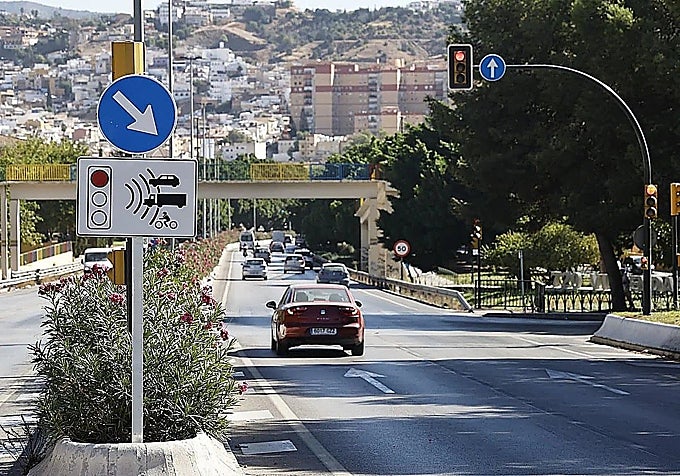
The system directly connects to the traffic light controller and takes photographs when the traffic light is red and a vehicle crosses the stop line at that traffic light. If the traffic light is green or amber, the camera does not activate.
If a driver commits an offence, the camera records the vehicle or motorbike's registration number, along with several photographs (taken before, during and after the offence) and a short video clip verifying the incident, to provide evidence for the enforcement authority.
The device operates both day and night, as it is equipped with additional infrared lighting, and is capable of detecting offences in both lanes.
Valle-Inclán experiences heavy traffic. According to official traffic counts by the city council, the heaviest traffic was recorded in the eastbound direction between May and August this year. There are 32,165 vehicles on weekdays, 30,395 on Saturdays and 26,930 on Sundays. During the morning rush hour on a weekday, at 9am, there is an average of 1,749 vehicles. On Saturdays and Sundays, traffic peaks at 8pm, with 1,860 and 1,809 vehicles per hour respectively.
In the opposite direction, towards Torremolinos, there is an average of 24,914 vehicles on weekdays, 20,556 on Saturdays and 17,422 on Sundays. The weekday rush hour is at 2pm, with 1,580 vehicles on the road. At the weekend, the peak is recorded on Saturdays at 1pm (1,442 vehicles) and on Sundays at 8pm (1,240 vehicles).
On Avenida Valle-Inclán, there is a fixed speed camera near the junction with Carlinda, in the direction of Torremolinos. In 2023 and 2024, it issued 4,767 and 2,373 fines, respectively.
An ambitious project
It so happens that the city council has put out to tender, for almost 27 million euros, a contract to transform and move Valle-Inclán underground at its junction with Calle Martínez de la Rosa and Camino de Suárez. The main aim of the project is to remove the traffic lights at this strategic junction in order to improve traffic flow.
The technical solution involves an ambitious underground project comprising two underpasses. The central infrastructure will consist of a 660-metre-long tunnel with four lanes (two in each direction) designed to handle the direct flow of traffic from the road without interruption. In addition, a second 230-metre-long underground tunnel will channel traffic joining the road from the west, heading towards Calle Martínez de la Rosa.
