
Environment
Malaga province sea temperatures plummet: experts analyse key factors
In a few days' time, the water temperature will drop from 28.8C to 15.6C, the lowest on record, providing some respite from the persistent marine heatwave
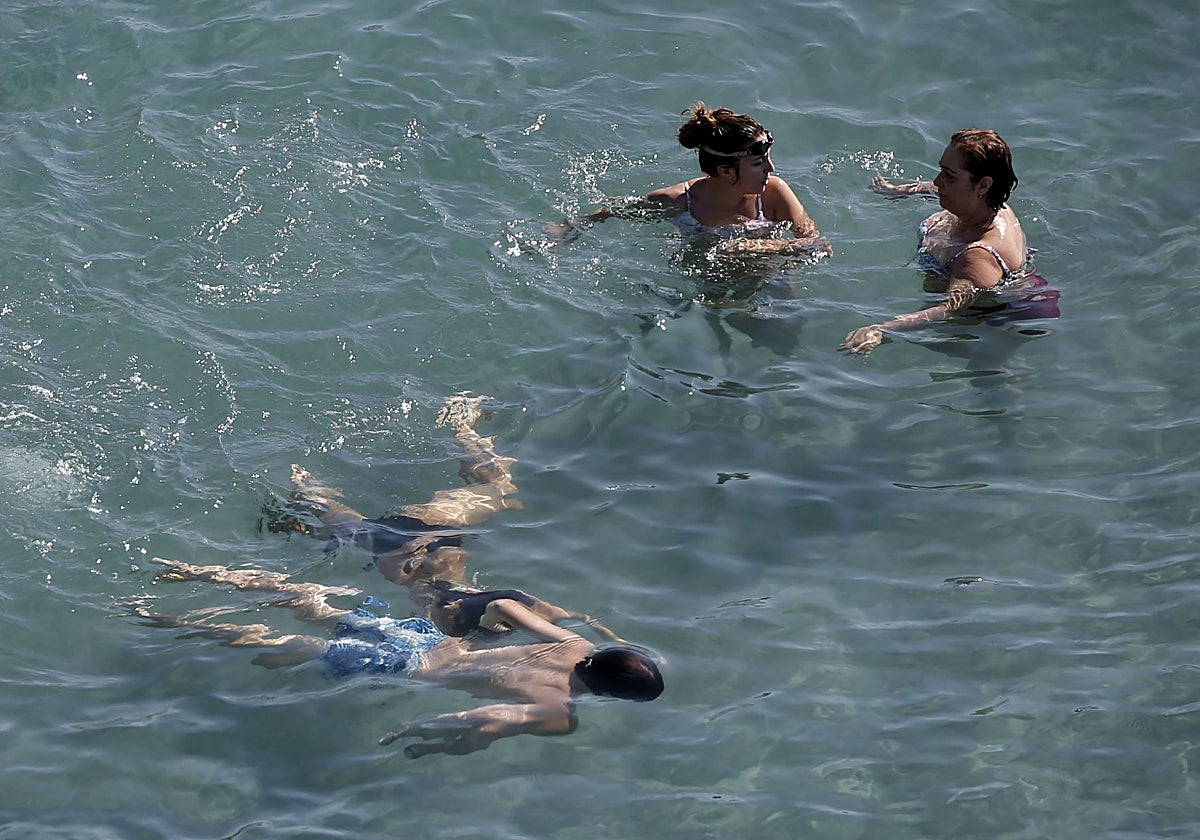

A combination of factors has led to an unprecedented "reset" in the temperature of Malaga province's waters: in the span of a week, the ... sea temperature at the Puerto del Estado buoy off the coast of Guadalmar dropped from 28.8C to 15.6C.
This has broken the record for the lowest August temperature, 16.3C in 2014.
It is an isolated occurrence that does not contradict the marine heatwave that has been affecting Malaga and the Mediterranean since May, causing concern in the scientific community.
Related story
Related story
-U64162501121BVg-366x256@Diario%20Sur.jpg)
The drop between last Tuesday and this past Tuesday is roughly 14C. What is strange is that the usual conditions for this upwelling of deep water, which typically occurs with a persistent westerly or onshore wind, have not been present. In such circumstances, the wind pushes the surface waters out to sea and the deeper waters rise to the surface, rich in nutrients, which brings environmental benefits.
SUR's weather expert José Luis Escudero noted this drastic change early on Tuesday. The lowest sea temperature, 15.6C, was recorded at 9am according to real-time data from Puertos del Estado. Just an hour later, the sensors had already risen back above the 16C mark.
The presence of cold currents has also given rise to some curious phenomena, such as the appearance of box jellyfish in the waters off Malaga's coastline, as SUR reported on Monday.
The temperature has been falling in an irregular but noticeable manner since last Tuesday, 18 August. From nearly 29C, it fell to 25.3C on Thursday, 21.9C on Friday, 20.9C on Saturday, before rising to 22C on Sunday and falling again to 17.3C on Monday.
An analysis of wind patterns in Malaga city over the past week does not provide sufficient evidence to identify them as the sole factor behind this temperature drop. While it is true that westerly and northwesterly gusts have predominated since 18 August, for more than a third of the time the wind has blown from the east or south-east.
The Alboran Sea and its own rules
Malaga is situated in the Alboran Sea, where Atlantic and Mediterranean currents converge. This can lead to different patterns of behaviour even in areas close to one another.
It is an area with complex ocean circulation, which favours sudden changes in the distribution of water masses. This helps explain why the surface can warm up markedly at certain times and cool down rapidly when there are changes in wind and currents.
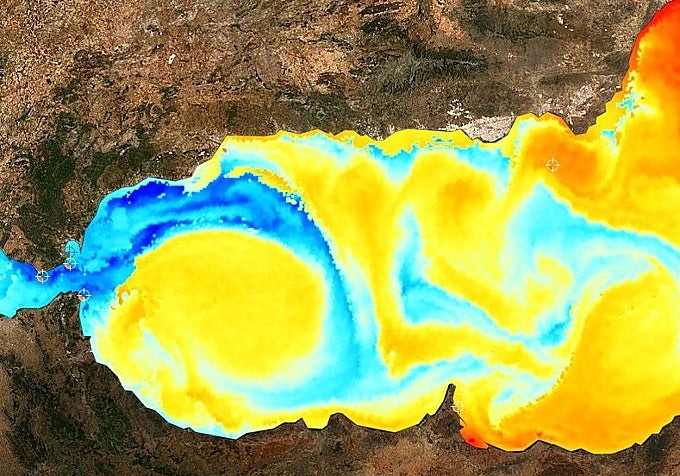
The analysis of current dynamics reveals different colours and patches between the Strait of Gibraltar and the Almeria coast. In fact, while the Malaga coastline was "tinged" with blue at midday on Tuesday, other nearby waters displayed shades of yellow and amber, the latter indicating temperatures of around 30C.
Head of the Aemet state meteorological agency in Andalucía Juan de Dios del Pino explained: "While I am no expert on the subject, it is clear that such a large and rapid change in sea-surface temperature must be due to some kind of upwelling. Neither the sun, nor the atmosphere, has the capacity to cause such a rapid and intense change."
As to whether this drop could trigger meteorological phenomena, he believes it would have to be a persistent occurrence for such a thing to happen. "It could be significant if it coincides with an atmospheric event, such as a cold snap or any other pocket of cold air in the upper troposphere (five to 12 km). Nothing of the sort is expected in the near future. It may cause fog or low cloud, but nothing significant," De Dios Del Pino said.
Physicist from the Spanish institute of oceanography in Malaga Manuel Vargas gave some tentative hypotheses. "There is no doubt that it is upwelling water. The question is whether the upwelling is local, that is, whether it has occurred off the coast of Malaga, or whether it is influenced by the upwelling that usually occurs in the Strait, whose cold waters are then carried by the current. This current sometimes approaches the Malaga coast more closely than others. It's possible it's a combination of these two factors plus a third: the waves," he stated.
According to Vargas, the role of waves could also be significant. Waves mix the water and the heat that was accumulated in a very thin layer of water at the surface would have been distributed throughout a thicker layer of water. This could lead to a drop in surface water level and an increase in depth of between ten and 30 metres.
As mentioned, this is a much-needed respite in a summer where the sea is boiling over. This general marine warming facilitates the arrival of tropical species and increases the risk of torrential rains in autumn.
In short, the coasts of Malaga and the Alboran Sea are experiencing extreme and persistent temperature anomalies in both surface and seabed temperatures this summer. According to the data, water temperatures have reached record highs of up to 28C, consistently lying between 4.5C and 5C above usual average values.
![[]](http://static.vocstatic.com/voc26/latest/assets/images/favicon/surinenglish/apple-touch-icon-57x57.png)