
Caminito del Rey
Malaga tourism: this is how Caminito del Rey tests safety of its new suspension bridge
Engineer Ángel García Vidal explained the various safety tests to SUR, the positive results of which guarantee the bridge's upcoming opening
Ignacio Lillo
Malaga
One of the safety tests the engineers of the new Caminito del Rey suspension footbridge have carried out has already gone viral. The video that SUR published shows a group of workers running across the structure. It had received over 2.8 million views on social media by Wednesday. Meanwhile, some readers have expressed doubts about these tests and their purpose.
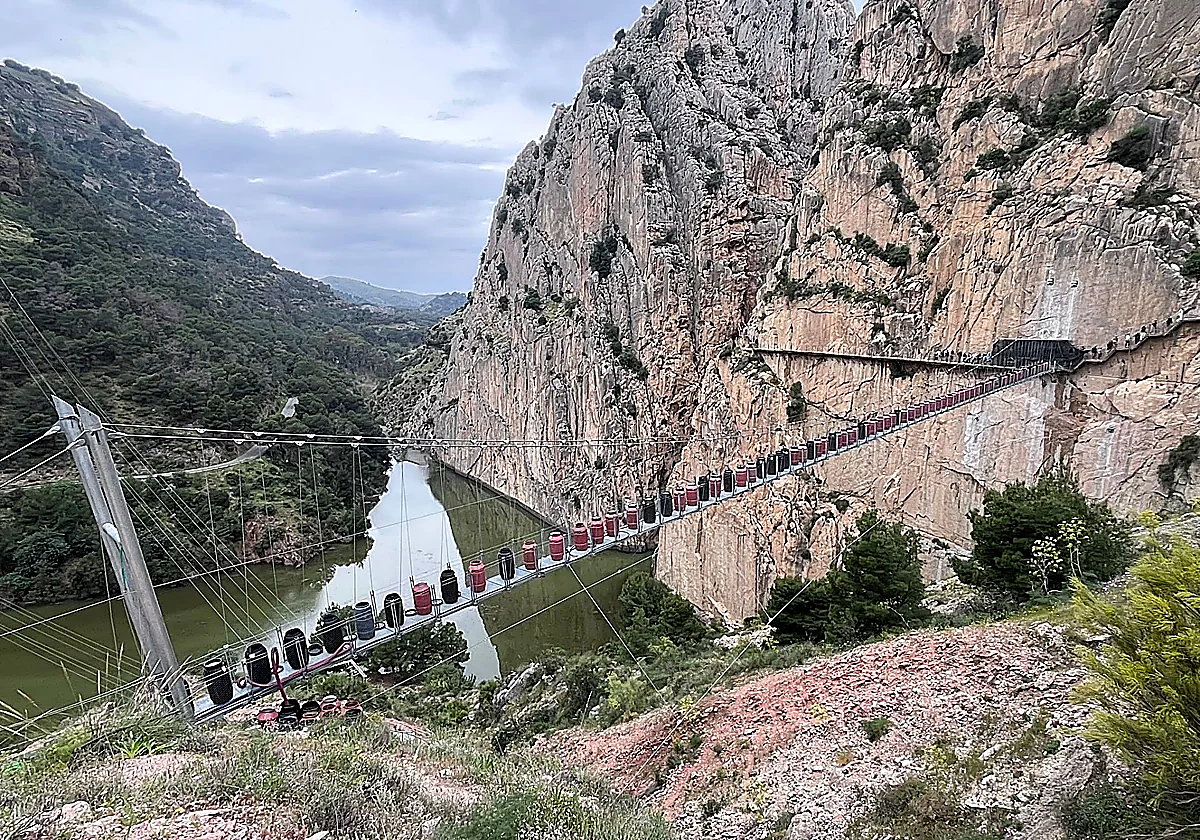
The new bridge will be (at least for the time being) the longest of its kind in Spain, with a length of 110 metres and a height of 50 metres. It is located at the end of the current tourist route. The new section runs parallel to the iron bridge over which the trains pass, before the El Chorro tunnel in Álora.
Although it's the most eye-catching, the video that has gone viral is actually just one of the numerous tests that aim to guarantee the structure's complete safety when it opens to the public. This will occur in the coming days, although the managers of the route and the engineers are still ironing out the final details and exact date.
Related story
Consulting firm Avanza, led by Malaga-based engineer Ángel García Vidal (whom many remember for his key role in the recovery of young Julen's body from the well in Totalán), has been managing the project. Joint venture Solutioma-Agranaltura has executed the construction.
Foolproof bridge
The structure has undergone numerous tests, both static and dynamic. The first involved placing a specific weight load on the bridge to check for deck deformations. First, the engineers established an "extreme load" scenario and then replicated it in real conditions using sensors and topographic measurements, before comparing the results.
"As happens on road bridges, where lorries are used to load the structure, here we used water-filled barrels totalling up to 21,000 kilos," García Vidal told SUR this week.
They ran four different load scenarios: weights spread along the deck, concentrated on each half of the bridge and placed at specific points. "The results already confirmed that we are well above the previously calculated safety margins," the engineer said.
The suspension bridge uses cable construction and remains very lightweight. Engineers had estimated deflection of up to 45 centimetres at the centre span. During testing, however, movement stayed between 32 and 33 centimetres, significantly lower than expected.
The most striking phase came with the dynamic tests, which measure how the structure responds to moving loads. "We measure how the bridge behaves under extreme conditions and we monitor it completely using sensors," he said. Only two companies in Spain carry out this type of analysis.
Engineers performed two types of tests. First, five crossings with groups of 16 people walking in two rows of eight at a normal pace. Then came the more visually dramatic stage (the one that went viral) with five more crossings where eight people ran in a single line along the bridge.
"This phase allows us to assess how the structure behaves under extreme conditions, such as a stampede scenario," the expert stated. "We still do not have the final results, but after all this work, we can already see the bridge has performed extremely well."
They have also designed the structure to withstand extreme weather events, although the Caminito del Rey closes in such conditions. It can also resist seismic activity expected in the area and the strongest wind gusts recorded there.
"We are very satisfied with its performance," Ángel García Vidal said. "For the last five months, I've almost lived here. It has been intense work, but extremely rewarding."
A total of 16 technicians took part in the design, including six structural calculation specialists from several firms, one of them based in Switzerland, a country known for leading expertise in this field. Construction required up to 20 workers using zip lines, with helicopters assisting at two key stages of the operation.
The new bridge
The project has produced a suspension bridge (not a Tibetan-style bridge) with a catenary design, where main cables support the structure through vertical hangers that hold the walking surface (known as the 'deck'). It will be the longest of its kind, although another project in northern Spain will potentially surpass it.
The main technical challenge involved anchoring the bridge into the rock face due to geological fractures in the terrain. As the site consists of ancient seabed layers, the upper rock strata could not support anchors, so engineers drilled down to depths of eight metres.
When the bridge opens, authorities will restrict access to 30 people at any one time, about one person every three metres, to ensure a steady flow as visitors stop for photos and take in the views. Two staff members will manage entry at both ends.
Despite this limit, the bridge's load capacity is far higher. For those who suffer from vertigo or prefer not to cross, the old path will remain open as an alternative route.
The total cost of 1.5 million euros comes from the Caminito del Rey's own operating revenue, which regulations require to be reinvested into improvements of the tourist site under the concession agreement with the Malaga provincial authority.
![[]](http://static.vocstatic.com/voc26/latest/assets/images/favicon/surinenglish/apple-touch-icon-57x57.png)