
Tech
'Espeto', Malaga's first-ever satellite, to tackle disaster communications from orbit
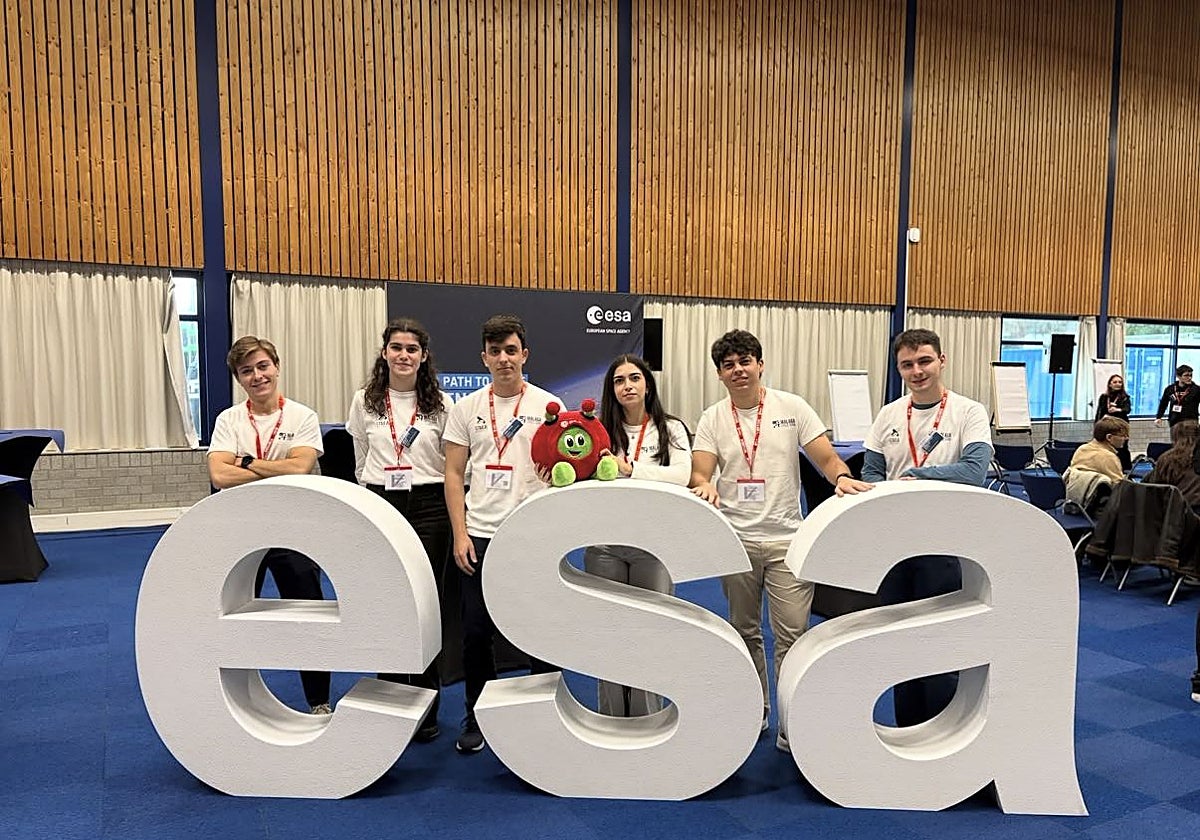
Malaga Space Team, born in the lecture theatres of the University of Malaga (UMA), is also developing 'Echo', a stratospheric balloon that will rise to 30 kilometres to locate ground antennae
Rubén Martín
Málaga
'Espeto' is the name a group of UMA (Malaga University) students have chosen for their 2U CubeSat nanosatellite.
Their Málaga Space Team comprises over ... 30 students and researchers across more than ten different degree programmes: ranging from engineering and telecommunications to computer science, physics, mathematics, electronics, industrial design and management. The team believe that this project can help address disasters and global communication challenges.
The aim of the mission is to build and launch a communications satellite into orbit. Its purpose will be to demonstrate that SDR (software-defined radio) technology and virtualisation work in space. In other words, it will carry a radio that can change the way it communicates while in orbit.
Why 'Espeto'?
The name is no coincidence. Candela Ríos, who is part of the project, explains: "We wanted a name that would reflect where we come from and there's nothing more typical of Malaga than that. Wherever we've presented it, including at the ESA, people immediately know it's a satellite from Malaga."
It also fits with the mission's philosophy: "A good espeto isn't made in a hurry. You can't rush it or seek immediacy and it's exactly the same with delay-tolerant networks. You accept that there will be delays and interruptions, but the priority isn't that it arrives quickly, but that it arrives in full and without getting lost along the way."
The nanosatellite has six modules that function as parts of a single device. It has a proprietary aluminium structure, is unpowered and will re-enter the atmosphere unaided once its mission is complete. It is equipped with solar panels and a battery to generate and store energy, as well as a system that keeps it correctly oriented, with the panels facing the Sun and the antenna facing Earth when it is time to communicate. Its on-board computer, based on open-source software, controls the satellite and is separate from the experiment so as never to lose control.
Related story
The most important part of the mission is the radio, which will be able to change its communication mode whilst in flight and automatically revert to a safe configuration if anything goes wrong. To communicate with it, the team are building their own ground station at the UMA, which is currently installed while the frequencies are coordinated.
"We are working with engineers from real missions and receiving training and for us this offers significant added value, because the UMA does not offer a degree in aerospace engineering, so this project is a way for us to gain experience across the entire lifecycle of a space mission," Ríos says.
An experiment 30 kilometres away
The team are also working on 'Ech' for Bexus, a stratospheric balloon programme for university students run by the DLR (German aerospace centre) and the SNSA (Swedish National Space Agency), with the participation of the ESA (European Space Agency).
The balloons are launched from Esrange, in Kiruna (Sweden), and will ascend to an altitude of around 30 kilometres, remaining there for over half an hour while listening for and locating ground-based antennas based on the signals it receives.
The experiment has a practical application. Mobile phones will soon be able to connect directly to satellites and high-altitude platforms. For that connection to work properly, the satellite needs to know, at least approximately, where each user is. 'Echo' is using real-world data to test just how accurately this can be achieved from space.
The project is backed by the UMA, which provides institutional support, infrastructure and academic resources. In addition, the Mobile & Aerospace Networks Lab, which specialises in next-generation networks and artificial intelligence applied to wireless networks, is collaborating by contributing its technical expertise. They are joined by Link by UMA-ATech, a platform for collaboration between the university and industry, which facilitates links with industry and the transfer of knowledge.
