
Water
New report exposes impact of tourism and private pools on Malaga's Axarquía water supply
Environmental group GENA-Ecologistas en Acción warns residential tourism and holiday rentals are placing unseen pressure on eastern Costa del Sol water resources
Eugenio Cabezas
The debate over water in the Axarquía region of Malaga province has taken on a new dimension. Alongside the well-known impact of subtropical crop irrigation and the delicate local supply situation - which has thankfully eased after heavy rainfall last winter - attention is turning to the water consumed by tourism both along the coast and inland.
Environmental group GENA-Ecologistas en Acción (the Axarquía nature research centre) has released a report detailing the tourism sector’s water footprint. The study assesses consumption not just by coastal hotels, but also by rural holiday properties scattered across the region.
The group highlights what it considers a key driver of current water pressure: the growth of residential tourism, rural estates, private swimming pools, gardens and recreational facilities.
Related story
GENA estimates that the tourism sector across the Axarquía consumes 22.6 cubic hectometres of water annually.
The organisation warns that much of this usage escapes monitoring and standard accounting by water authorities. By comparison, official consumption across the 14 municipalities supplied by La Viñuela reservoir stands at around 20 cubic hectometres per year, with an additional 15 cubic hectometres used for agricultural irrigation.
“This water use is unrecorded in official accounts or masked as routine domestic consumption. In many cases, it relies on groundwater drawn from illegal wells or water bought from farmers. But the practical effect is a net increase in regional consumption,” explains biologist Rafael Yus, coordinator of GENA-Ecologistas en Acción.
Yus notes that the 22.6 cubic hectometre figure is an estimate based on observed data, as measuring volume "pool by pool" is impossible. Málaga province contains over 82,500 swimming pools - the fifth-highest total in Spain.
Escape from cities
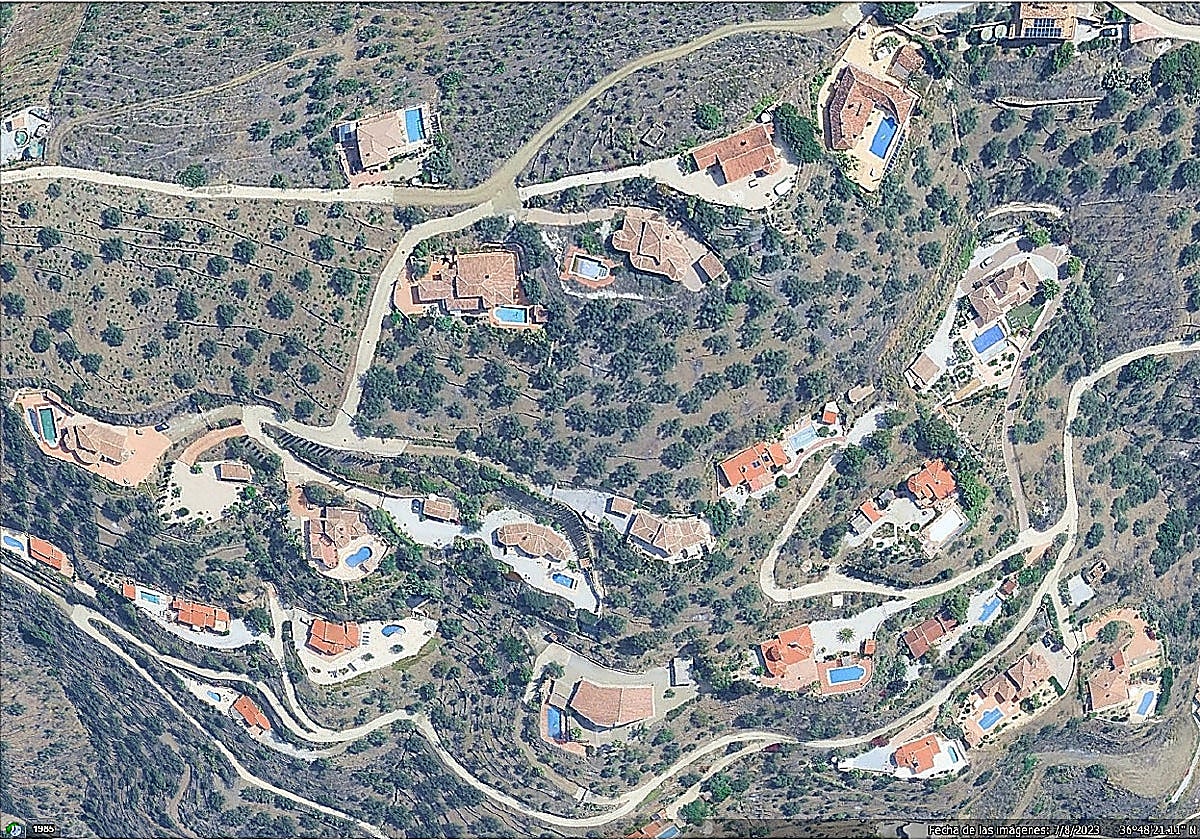
Of those pools, 16,004 are located in the Axarquía, accounting for 1.9 cubic hectometres of water consumption. According to Yus, the region’s landscape has been transformed over decades by scattered rural housing. Drivers on the A-7 motorway can see hillsides heavily dotted with detached houses built on rural land, with particularly high density in certain areas.
The report traces this back to a development model starting in the late 20th century. It attracted both European buyers and Spanish residents seeking a rural lifestyle away from major cities without sacrificing urban comforts.
GENA describes this pattern as "chaotic and dispersed urban development", warning that its impact extends far beyond planning concerns or visual damage to the landscape.
Related story
Building on a 2010 study examining unpermitted rural housing, GENA’s latest report investigates its primary consequence: severe water pressure. The group maintains that these properties generate demand that is difficult to measure, particularly when equipped with private pools, gardens and small agricultural plots.
Agriculture remains the largest water consumer in the Axarquía, accounting for 76 per cent of available resources. GENA notes that this demand is supplied by regulated water from La Viñuela reservoir alongside private water tanks and wells, which enabled a shift from traditional dryland farming to water-intensive subtropical crops like avocados and mangoes.
A key regional challenge
To this agricultural load, GENA adds tourism pressure. Along the coast, the study analyses water use by hotels and leisure facilities featuring large pools, spa complexes and water-focused amenities. Water, the group argues, has become central to the Mediterranean tourism model.
The findings align with research conducted in other Mediterranean tourist hubs, including universities in Murcia, Valencia, the Balearic Islands and Catalonia. All highlight a common issue: high water consumption linked to detached homes, residential tourism and leisure facilities in drought-prone areas.
GENA uses the concept of 'hydro-social impact' to explain how land-use choices worsen local scarcity. The group calls for an open debate on legal mechanisms to curb development on rural land, particularly in areas where water supplies are already stretched.
The organisation stresses that the issue extends beyond temporary droughts, reflecting an established economic and territorial model. In its view, combining intensive irrigation with scattered housing, private pools and gardens makes it essential to rethink growth limits and long-term water planning in the Axarquía.
The study was introduced at the Contemporary Art Centre (CAC) in Vélez-Málaga at an event hosted by the Vélez-Málaga Society of Friends of Culture, followed by a presentation at the Nerja Museum.
Read comprehensive news from the Axarquía.
![[]](http://static.vocstatic.com/voc26/latest/assets/images/favicon/surinenglish/apple-touch-icon-57x57.png)