
Environment
The seven sites that environmentalists hope to restore in Malaga province's Axarquía
GENA-Ecologistas en Acción nature research centre has published its assessments of riverbanks, olive groves and the coastline in light of the new municipal town planning scheme

From the River Vélez delta to the Peñón de Almayate, passing through the centuries-old olive grove at Poey and the ancient dunes of Bajamar ... beach in Malaga provonce's Axarquía, the Axarquía nature research centre, GENA-Ecologistas en Acción, has produced a new report setting out seven measures to restore abandoned natural and agricultural areas in the Vélez-Málaga.
The report, entitled 'Siete planes para la restauración de la naturaleza en Vélez-Málaga' (seven plans for the restoration of nature in Vélez-Málaga), was presented on Friday 6 November the Centre for Contemporary Art (CAC) in the town. The initiative aims to capitalise on the opportunities offered by the new European regulations on ecosystem restoration and to incorporate its proposals into municipal urban planning.
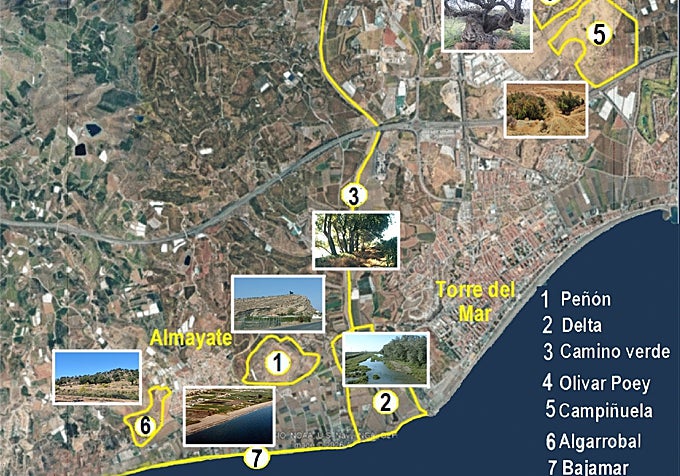
The document brings together studies carried out by the environmental organisation over recent decades and proposes action in seven areas of particular scenic and environmental interest: the Peñón de Almayate, the Vélez River delta, the green corridors along the banks of the river, the century-old olive grove at Poey, Las Campiñuelas, the Algarrobal de Almayate and the ancient dunes of Bajamar beach.
These are areas with very different characteristics, ranging from wetlands and agricultural land to coastal areas and sites of geological interest. As GENA explained in a press release, studies have been carried out on the natural wealth of all these sites, and proposals for their protection and management have been submitted by the organisation to Vélez-Málaga town hall over the years, although this does not imply that the measures have been approved.
One of the areas given particular prominence in the report is the mouth of the River Vélez, a site of special importance for biodiversity along the eastern Costa del Sol. The association believes that the restoration of this environment, together with the creation of green corridors along the riverbanks, would improve the conservation of its habitats and the connectivity between different natural areas.
The organisation has been studying this stretch of river for decades and advocating for measures to protect it, particularly given its importance for numerous species of birds and other animals associated with riparian ecosystems. The proposals aim to restore the environmental functions of areas that have undergone changes as a result of human activity and shifts in land use. Their implementation, however, would require specific projects and authorisation from the relevant authorities.
The study covers seven sites, ranging from the river mouth to olive groves and dunes, and sets out a plan for their environmental restoration
The Peñón de Almayate is another of the sites selected for its natural, geological and landscape values. GENA points out that although this site remains in private hands, it is protected as a landscape feature under the Axarquía land use plan, a circumstance the organisation considers favourable for promoting conservation measures. In addition to this site, the Algarrobal de Almayate is also included among the seven locations for which interventions are being considered. The association aims to restore and highlight the distinctive features of the traditional landscape in this part of the municipality, where agricultural areas, natural formations and features of environmental interest coexist. The report compiles inventories of flora, fauna and geological features with the aim of providing a scientific basis for potential interventions.
The proposals also include the century-old Poey olive grove, a site whose preservation has been called for by various citizens' groups for years. In May 2024, GENA, the Society of Friends of Culture (SAC), the Association for the Defence of Chimneys and Industrial Heritage, Olearum and the Axarquía Climate Emergency Citizens' Forum called on the town hall to protect it as a future agro-urban park. The initiative had already been submitted in 2018 to the town planning department. At the time, the proponents argued for the possibility of preserving the centuries-old olive trees and integrating the site as a green space within future urban development projects. The new report revives this proposal and also includes Las Campiñuelas, another site where the association believes that the abandonment of former agricultural activities opens up possibilities for environmental restoration.
New European legislation to restore ecosystems
The seventh proposal focuses on the ancient dunes of Bajamar beach, on the municipality's coastline, where GENA is proposing restoration measures linked to the environmental values of coastal ecosystems. The association considers that both this site and the banks and the Vélez River delta have legal characteristics that may facilitate the management of future projects as they are subject to sector-specific legislation on coasts and water resources, respectively.
However, these regulations also set out specific conditions and procedures for any intervention. The organisation maintains that the different levels of protection in place in some of the selected areas could serve as a starting point for developing restoration measures, although it would still be necessary to finalise the projects, their budgets and the relevant permits.
This paper draws on the European Nature Restoration Regulation, adopted in 2024, which sets binding targets for the restoration of degraded ecosystems across the European Union. The regulation sets a target that, by 2030, restoration measures should cover at least 20 per cent of the Union's land area and 20 per cent of its marine area, with a view to extending them to all ecosystems in need of restoration by 2050. The regulation covers actions relating to forests, rivers, wetlands, grasslands, coastal systems, agricultural ecosystems and urban areas, amongst other habitats. These percentages are targets set at European level and do not mean that every local authority must automatically restore one-fifth of its territory, nor that projects proposed by environmental groups are guaranteed funding.
GENA believes that this legislation presents an opportunity to revive initiatives it has been advocating for decades. As it points out in its press release, the association has been carrying out nature studies in various areas of Vélez-Málaga since 1985, including biodiversity surveys and conservation proposals that have been submitted to the local authorities. The organisation maintains that, with the new regulations, 'an important path is being opened up to turn these proposals for protection and management into reality'. The report brings together scientific studies on the flora, fauna and geological features of the seven sites, as well as setting out measures that could form part of future environmental restoration programmes. The organisation also includes guidelines to facilitate the potential implementation of these proposals, although it has not announced any specific funding commitments.
The group has submitted its proposals to the town planning department while the new municipal plan is being drawn up; no measures have yet been approved
The publication coincides with a significant moment for the urban future of Vélez-Málaga. The town hall is currently drawing up the new General Municipal Development Plan (PGOM), the draft of which was put out for public consultation during June and July of this year. The document aims to update the municipality's spatial planning framework, reconciling the creation of land for housing and economic activities with the conservation of natural and landscape resources.
GENA has explained that its report has already been submitted to the technical staff of the town planning department so that the identified areas can be taken into account in the planning process. This submission does not, for the time being, imply that the town hall has accepted the seven proposals or that it has decided to incorporate them into the final plan.
The presentation provided an opportunity to inform local residents about the findings of a study which aims to bring the need to restore various areas within the municipal boundaries into the public debate. The organisation hopes that its proposals will serve as a basis for future municipal actions or initiatives under environmental restoration programmes. For the time being, no specific investments, implementation timetables or administrative agreements have been finalised to launch the seven projects. The immediate aim is to raise awareness of the natural value of these sites and to open up avenues for collaboration that will enable the urban development of Vélez-Málaga to be reconciled with the restoration of part of its environmental heritage.
