
A smuggled Picasso finally on display in Madrid
Head of a Young Woman, worth 26 million euros, now hangs in the Reina Sofía art museum, having been seized from a sail-boat in Corsica
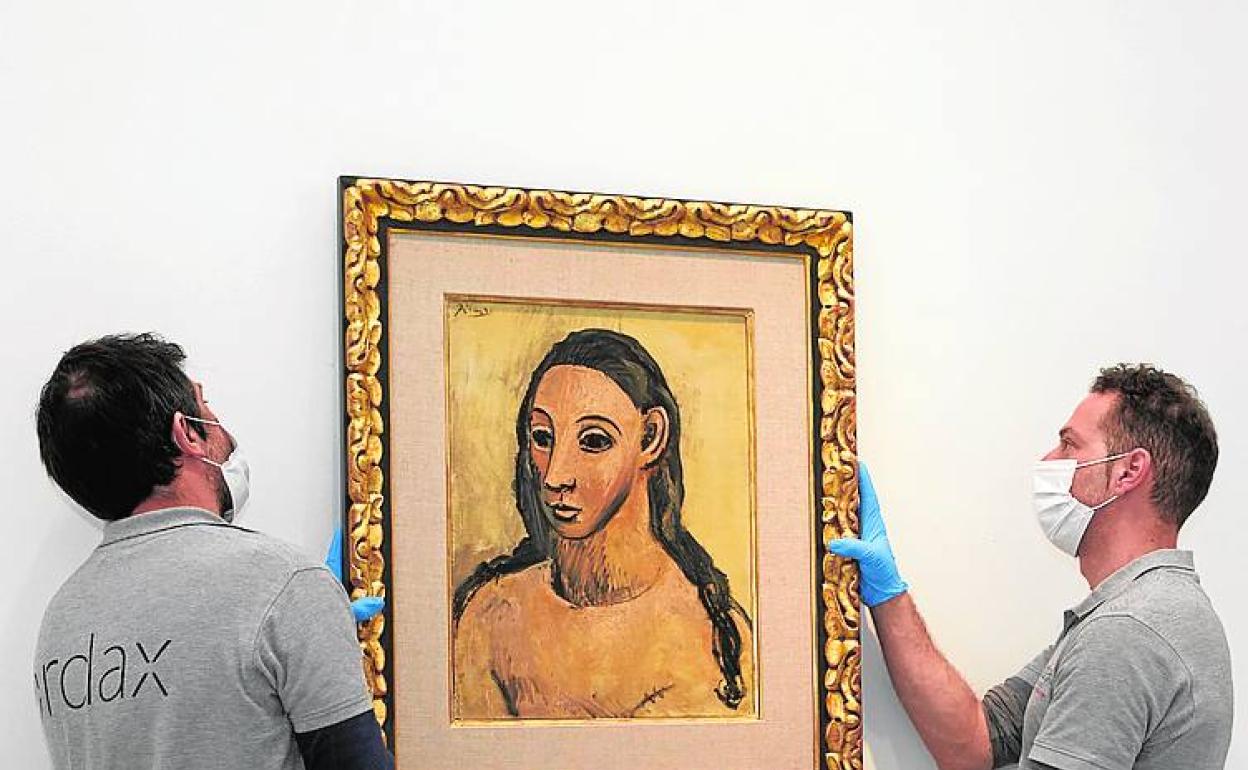
FRANCISCO GRIÑÁN
The controversial affair of Picasso's lover's portrait has finally come to an end. The Malaga artist painted Fernande Olivier during their stay in the Spanish town of Gósol in 1906. Head of a Young Woman is a unique work which was important in the artistic transition to Cubism.
The painting had been privately owned since its creation, but in 2012 it became the subject of a tumultuous legal battle which waged for several years after its owner, the banker Jaime Botín, authorised Christie's to auction it in London. That started a legal battle with the Spanish ministry of Culture which didn't want the painting to leave Spain, culminating in it being smuggled out of the country illegally on a sail-boat. It was seized by the Guardia Civil and French customs services in Corsica in July 2015.
After being in storage for almost seven years in Madrid's Reina Sofía art museum, the much-disputed painting was hung last week in the second floor gallery, near to Picasso's masterpiece, Guernica. It is the most recent addition to the museum's famous permanent collection.
This has been one of the most contentious sagas in the art-collecting world of recent years, with all the ingredients to inspire an art-smuggling thriller: a legal battle, an escape by boat, police intervention, a second return to court and millions of euros in fines.
Beginnings
Having initially belonged to a French art dealer, Paul Guillaume, the painting arrived in Spain in 1977 when the Marlborough Gallery in London sold it to Jaime Botín, president of Bankinter and brother of Emilio Botín, the late executive chairman of Santander bank. The canvas remained in Spain for over 30 years, until Botín decided to auction it in 2012.
The war that this decision unleashed is unsurprising; as well as its important artistic worth, the painting was valued at 26.2 million euros.
That was when the ministry of culture stepped in and declared that the painting was a "national treasure" and was not to be exported, given that "it is unlike any artwork existing in Spain".
However, the ministry was ignored and Head of a Young Woman was packed up and shipped off in Jaime Botín's Adiz sail-boat in the summer of 2015. The banker was not on board when the vessel was later inspected by authorities, although his son Alfonso was.
Once it had been seized in Corsica, the painting was taken to the Reina Sofía Museum in Madrid, where it has remained for the remaining seven years of the dispute.
Botín, then 85, was sentenced in 2020 to three years in prison and given a fine of 91.7 million euros (over four times the value of the painting he intended to sell), for the offence of smuggling cultural property.
Multimillion-euro fine
He paid the fine with the hope of avoiding going to prison, which he eventually achieved due to health complications.
In a statement given to SUR last Thursday, Jaime Botín explained that his intention "was never to sell the painting or evade the law". He also stated that he considered his sentence to be "strict" and "disproportionate".
In November last year, at the same time as the judge was suspending Botín's prison sentence, the ministry agreed that the painting should become a part of the Reina Sofía's permanent collection, where it now hangs.
After its long journey, Head of a Young Woman is set to be one of the main attractions in the upcoming Picasso 1906 exhibition, which will commemorate the 50th anniversary of the Malaga-born artist's death.
Thirty years ago, the capital of Andalucía had the honour of hosting the universal exposition. Just two months before the grand opening, however, on 18 February, one of the site's key buildings went up in flames.
The theme for Seville's Expo was The Age of Discovery, to celebrate the 500th anniversary of Christopher Columbus reaching the Americas.
The Isla de la Cartuja (an island in the River Guadalquivir) was chosen as the venue for pavilions where over 100 countries were represented. In addition to the Royal Pavilion, there were five themed buildings, the star of which was the Pabellón de los Descubrimientos (the Discoveries Pavilion).
Designed by the architects Javier Feduchi and Alfredo Lozano, the building was already finished. The parallelepiped construction with a rectangular base (126 by 66 metres), was divided into eight square modules. On that fateful Tuesday 18 February it still needed finishing touches to its interior and the Copernican armillary sphere, one of the highlights of the building, was being painted.
Fire broke out shortly before 2pm. It immediately spread throughout the building, which contained large quantities of cork, paint, wood and expanded polystyrene, all highly combustible materials. Fifteen units of the Seville fire brigade were quickly on the scene but the fire was fierce and the building's structure became a burning torch in minutes. The thick column of smoke could be seen from practically everywhere in the city. All the workers inside managed to leave without suffering serious injuries, although the last two were evacuated by ambulance with symptoms of smoke inhalation. More than a thousand workers gathered around the burning building, many of them weeping with helplessness.
The fire burned for more than three hours. Later, the organisers confirmed that the pavilion had been destroyed and would not be in the exhibition.
Artist Eduardo Arroyo was commissioned to create a cover for the burned façade. In the end the damaged pavilion was concealed by nearly 2,000 colourfully painted ladders and 50 giant chimney sweeps.
Expo '92 took place as planned from 20 April to 12 October, 1992.
![[]](http://static.vocstatic.com/voc26/latest/assets/images/favicon/surinenglish/apple-touch-icon-57x57.png)