
Astronomy
Malaga student experiences gravity-free flight: 'It was out of this world'
17-year-old Lucía Torres was among the participants in the first special programme for young people of the Spanish Space Agency
Susana Zamora
Lucía Torres searched for the exact words to explain what she felt more than 10,000 metres above the ground, floating inside an Airbus A310 Zero-G that, for a few seconds, transformed into a small space laboratory. When SUR spoke to her on Thursday, she summed up the experience in a simple sentence: "It was completely out of this world."
The 17-year-old girl from Malaga is a second-year student in the technological Bachillerato at Novaschool Añoreta. She has just returned from the San Javier air base in Murcia, where last week she participated in the first 'Astronauta por un día' (Astronaut for a Day) programme of the Ministry of Science and the Spanish Space Agency (AEE).
The initiative aims to bring space and science closer to young people and inspire scientific and technological vocations.
Of nearly 400 applicants from across Spain, the AEE selected only 30 students (25 high school and five university students) to participate. They had all undergone academic and medical tests, as well as personal interviews.
Lucía spent several days with students from different parts of the country, military personnel from the general air and space academy and Spanish astronauts Pablo Álvarez and Sara García from the European Space Agency (ESA). Minister of Science Diana Morant also participated in the parabolic flight at the end of the programme.
Related story
"It has exceeded my expectations by a hundred, by a thousand, astronomically speaking," Lucía said. "Everything we learn from birth is related to gravity: walking, moving, breathing... And suddenly it disappears. Your body stops understanding where is up and where is down."
The experience began several days before the flight. The participants settled into the academy, where they shared training sessions, activities and educational workshops in the aerospace field. "We were very surprised by how the military treated us. From the outside, it seems like a very rigid environment, but they were friendly and made us feel like one of them," she said.
The days started early. There were physical activities with the students from the academy, followed by talks about the workings of the Spanish Space Agency and Spain's role in European projects. "They explained how a space mission is born, how scientists, companies and different organisations work together and why some projects take so many years," Lucía said.
For Lucía, who is passionate about engineering and aeronautics, one of the most impactful activities was visiting the simulators and training aircraft. "Getting on the Pilatus was amazing. I love understanding how things work and I experienced it like a little girl." It's no wonder she wants to study Mechanical Engineering in Malaga next year.
If there's one moment she recounted several times during the conversation, it was her meeting with astronauts Pablo Álvarez and Sara García. "They make everything seem possible." There's a phrase that still sticks in her mind. "They told us that in recent years they have lived ten different lives." For her, that perfectly sums up what it means to dedicate oneself to space.
The initiative didn't end with the flight. The 30 students have been named Space Ambassadors by the AEE for a year and will participate in outreach activities in schools. "I'm really excited because I love public speaking and sharing everything we've experienced," Lucía stated.
The night before the parabolic flight, she barely slept. The following morning, they boarded an Airbus A310 operated by French company Novespace, which specialises in parabolic flights capable of recreating brief periods of weightlessness similar to those in space.
During these flights, the aircraft follows an arc trajectory (a steep climb followed by a controlled freefall) to create microgravity. For approximately 20-25 seconds per manoeuvre, the aircraft and its occupants float together, eliminating the sensation of weight.
The aircraft performed 16 parabolas during the journey, 13 of them in zero gravity, while others simulated Martian gravity. "In the first one, which simulated Martian gravity, they made us do one-handed push-ups and we felt invincible," Lucía said, laughing.
Before takeoff, everyone received preventative medication for motion sickness. These types of flights are popularly known as 'vomit comets', a nickname for the research aircraft Nasa and private companies use to simulate weightlessness.
Then came the most anticipated moment. "Just by pushing off with one finger, you could float across the entire cabin," Lucía explained.
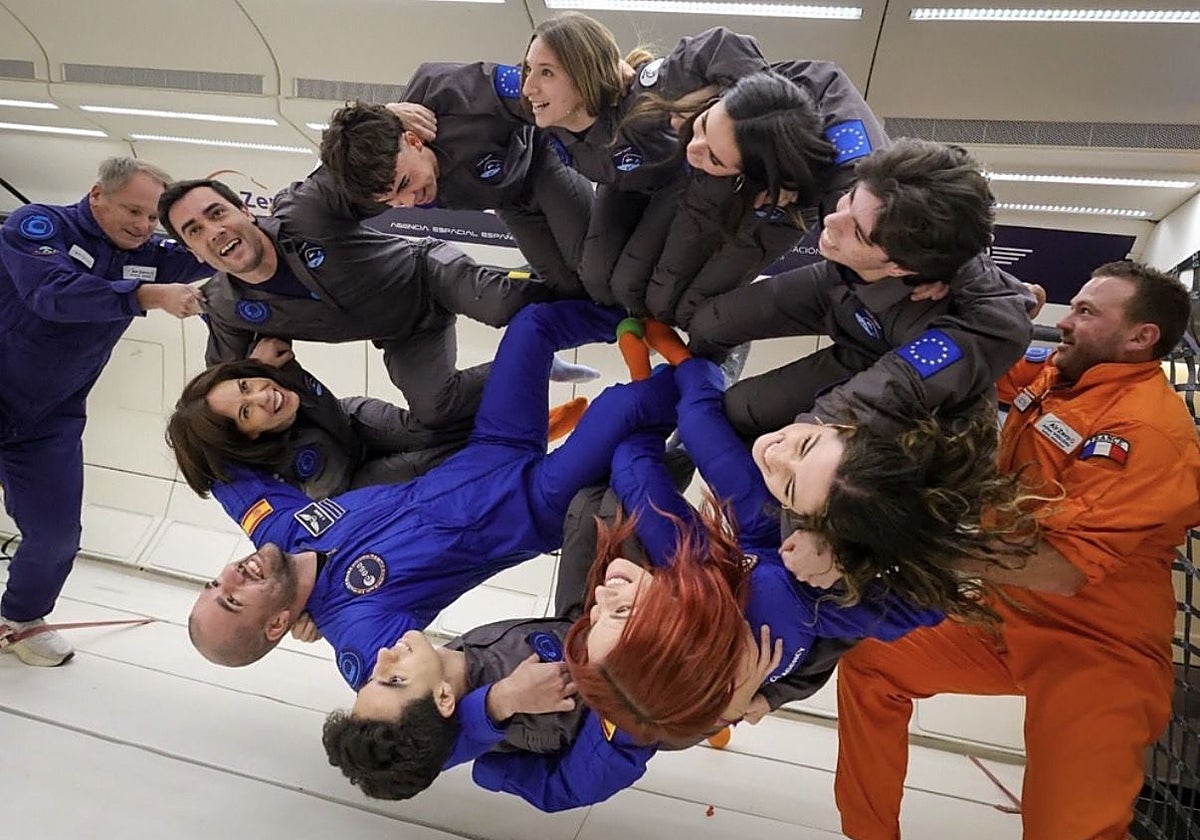
The participants performed exercises to experience microgravity: floating, forming human chains and observing how water behaves in weightlessness. "The drops became spheres suspended in the air," Lucía said. They also walked on the ceiling of the aircraft. "The only reference point were the lights."
Among all the images she keeps from that morning, one stands out: a circle of participants floating alongside Sara García and Pablo Álvarez as they slowly rotate in the middle of the cabin. "I had a ponytail and I could see my hair completely suspended. These are images I'll never forget."
After landing, the students received their diplomas as ESA Ambassadors in a ceremony with the music from 2001: A Space Odyssey as the backdrop.
On Thursday, Lucía returned home. She admitted she's still processing the experience. "I had seen videos and thought I knew what it would be like, but actually experiencing it is completely different," she said.
Although her routine awaits, something remains suspended in her memory, just as it did during those weightless seconds. "If you experience it with enthusiasm, it stays with you forever," she said.
![[]](http://static.vocstatic.com/voc26/latest/assets/images/favicon/surinenglish/apple-touch-icon-57x57.png)