
Health
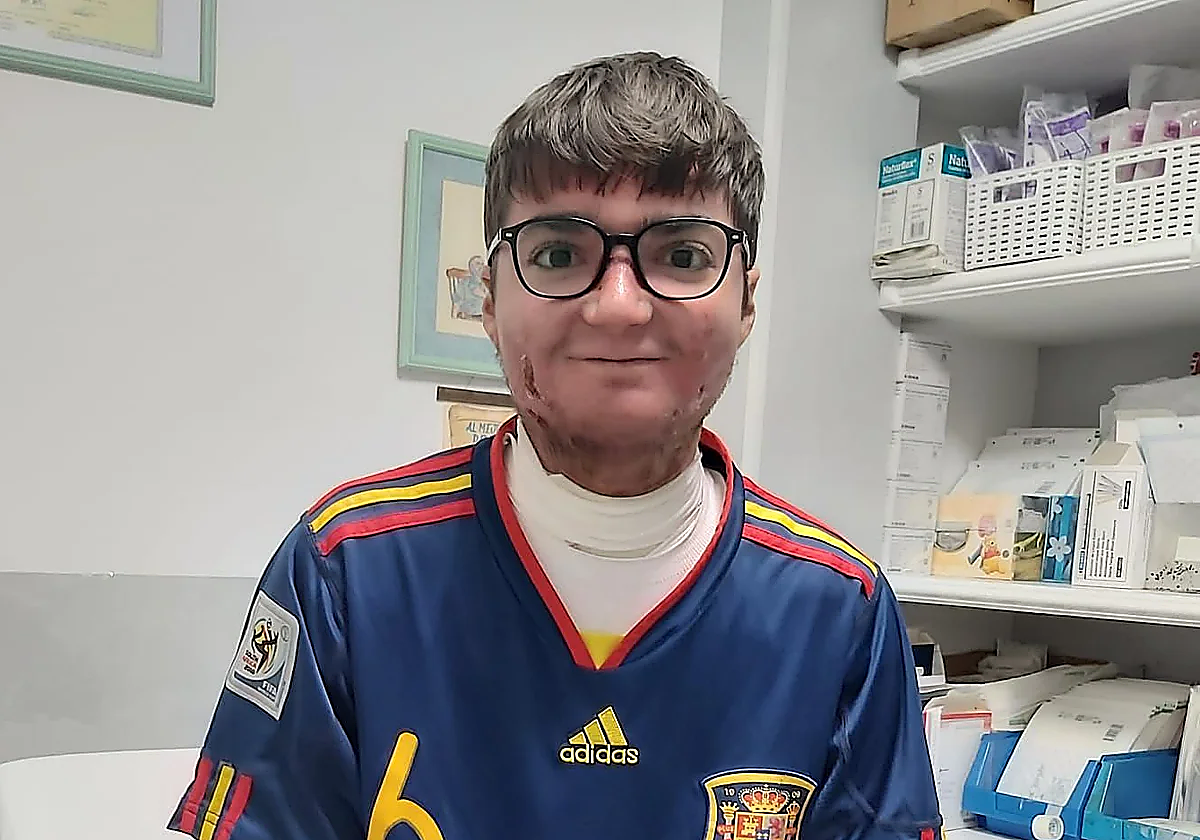
Malaga: young man becomes first in Spain to receive gene therapy for 'butterfly skin'
Adrián Soto's mum describes the arrival of the Vyjuvek drug as a "miracle" for patients with the most severe type of epidermolysis bullosa
José Antonio Sau
When Adrián Soto was born 22 years ago, his mother Virginia Cortés noticed that, as soon as she would touch him, "lesions would appear" on his skin. After his birth via a C-section, the doctors took him to the neonatal unit where they kept him isolated. "After ten days, we decided he should come, home because we preferred to be with him, and well, we started bandaging and treating his wounds," Virginia tells SUR.
Adrián suffers from a rare genetic disease called epidermolysis bullosa (EB), also known as 'butterfly skin'. He has the most severe variant - the dystrophic form. In mid-March, the Andalusian regional government announced that it would fund adopting an ambitious drug called Vyjuvek, which will bring significant benefits to the 45 Andalusian patients with the most severe subtype of the disease.
Adrián will be the first person from Malaga to receive it and, almost certainly, he will also become a pioneer in Spain, because his case is precisely the one that has made the regional ministry of health agree to pay for it.
"Healthcare professionals are currently undergoing training, as they need to learn how to handle, prepare and administer the drug. It will be very soon, but the days feel like years," Virginia says.
Adrían and his family live in Tolox, but the young man has always received treatment at the Costa del Sol hospital in Marbella. "They are the ones who opened the door for Vyjuvek to arrive in Spain and be dispensed in the public health system. They were the first to follow all the scientific evidence and publications as they came out. In fact, the dermatologists and the whole team kept telling us: 'This is promising, it's fantastic, we have to get it.'"
A 22-year struggle
"We've been battling this for 22 years, dealing with treatments and countless surgeries. Adrián has had multiple surgeries on his hands to prevent stumps from becoming stumps and fusing together. He's also had corneal surgery, as the injuries left him blind. Even his eyelashes, when they brush against his cornea, cause a wound and an incredibly painful ulcer. He also has severe difficulty swallowing. He can't eat anything, only very clear liquids and in small sips. He has damage to his heart valves and his kidney. It's a very tough illness and we've managed it as best we can," Virginia says.
Related story

"This illness is far too devastating and cruel: you have wounds upon wounds that you'll never forget, because for everyone else, a wound heals and you move on, but not for us: it's bound to reopen, because the skin has a memory," the 22-year-old man's mother states.
The problem is that the wounds are opening more and more frequently, "until it becomes impossible to close them and they can become malignant and turn into tumours". "These children often die after a terrible battle against this disease that has left them disabled, with more sequelae. Some end up mutilated, with amputations, sepsis, carcinomas," she says.
The "miracle" treatment
That's why the arrival of the new treatment has been "the miracle" Virginia has been praying for since her son was born. There are about ten people with dystrophic epidermal necrolysis (DAN), also known as 'butterfly skin' disease, in Malaga. "This is the variant that damages all layers of the skin, from the outermost layer to the hypodermis, the dermis, all the inner layers, even the organs and all the mucous membranes. It's the most severe. They have a deficiency in a protein that anchors the layers of the skin to each other, collagen VII. They suffer from a genetic mutation," Virginia says.
Sometimes, Virginia treats her son's wounds in the evening and they close but only for a few hours, before reopening in the morning.
Vyjuvek is a topical gene therapy that introduces a functional copy of the gene responsible for collagen VII. Applied weekly, it helps to promote the gradual healing of the chronic wounds characteristic of this condition. "It's a miracle, a wonderful achievement of science and we hope it continues to be refined and opens the door to more drugs," Virginia says.
The Costa del Sol hospital is a leading centre for the treatment of these patients and Adrián Soto "has set a precedent". Until now, Virginia says, "there were no treatments, only palliative care, infection control and wound care".
She criticises the fact that the medicine is not yet included in the national health system's standard drug list, which means that each case must be processed individually through authorisations from the Spanish medicines agency and subsequent funding by the autonomous communities.
The fight
Their fight began in 2023, once the US approved the dispensing of Vyjuvek. Europe approved it in early 2025. "It started in Germany, in France, in Italy, in Moldova, in Norway. We mobilised ourselves when we saw that it wasn't arriving here. We wrote letters to the king, to the minister, to Juanma Moreno, to the regional ministry of health, to the Spanish agency for medicines and health products. We have met with all the political parties," Virginia says.
Today, Adrián lives with the hope of mitigating the effects of the most severe form of epidermolysis bullosa (EB). He is studying for a double degree in education at Malaga University, although his mother says he struggles to keep up with his classes due to the treatments he receives. For now, his fight has paved the way for inflicting the first defeat on EB.
![[]](http://static.vocstatic.com/voc26/latest/assets/images/favicon/surinenglish/apple-touch-icon-57x57.png)