
Education
Ninety per cent of the work Malaga University students submit relies on AI
The university has introduced a new assessment framework for this academic year, in which oral examinations are given greater weight
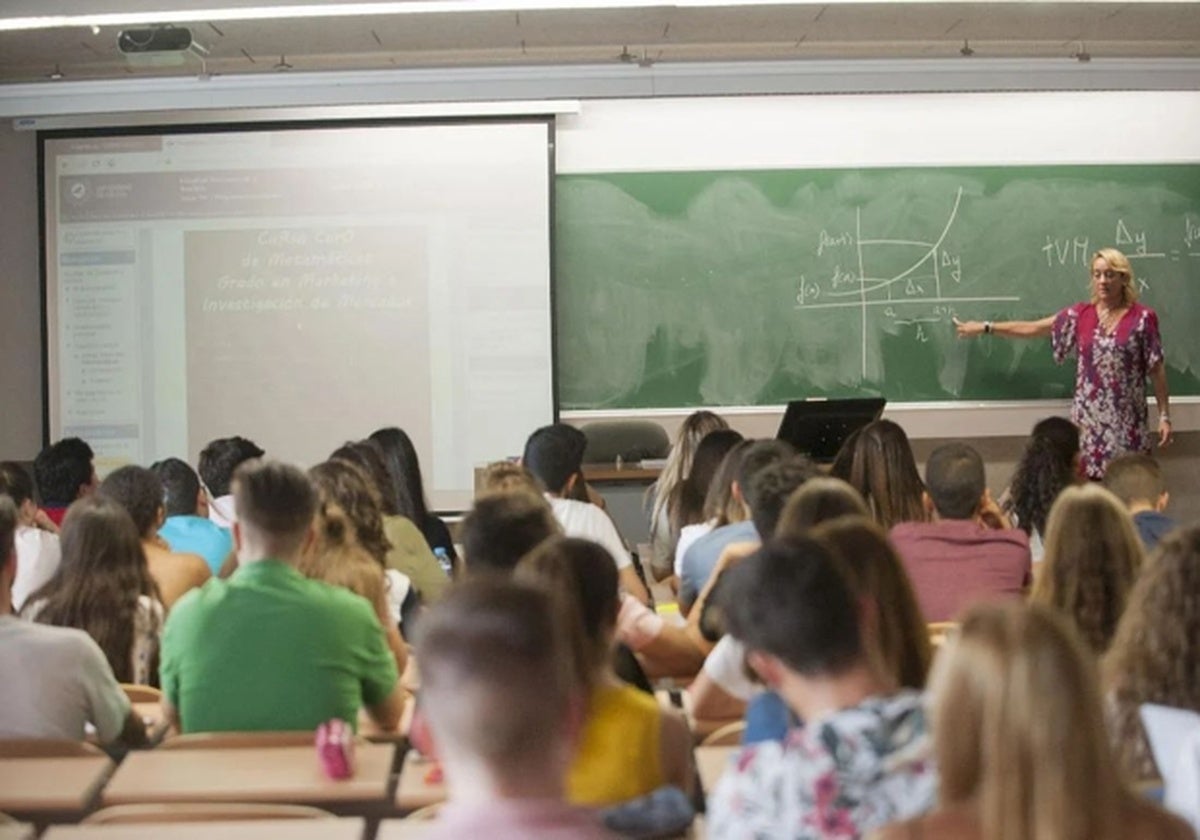

Since the Bologna Process harmonised higher education standards and degrees across 49 European countries, universities have been regarding coursework the cornerstone of academic assessment.
We ... have moved away from sitting a single exam at the end of each term (a sort of "all or nothing" approach) towards what is known as continuous assessment. Its aim is to gauge students's abilities and evaluate their performance, while always ensuring fairness.
However, with the advent of AI (artificial intelligence), a question arises: how meaningful are these assessments when the work is produced by a machine rather than by the students themselves?
Related story

According to data compiled from internal surveys at the UMA (University of Malaga) for the 2025-26 academic year, 90 per cent of the work students submit shows clear evidence of the use of AI. This indicates that the use of this tool is not a marginal phenomenon, but a widespread practice among students in virtually all faculties.
The impact of AI at the UMA has led the institution to question the validity and usefulness of current assessment methods. According to various working groups and many hours, this academic year will mark a turning point for the university in its relationship with AI. A new framework is to come into force to regulate how it can be used and where the boundaries lie.
Although the detection of AI does not always imply fraudulent use or plagiarism in every case, the near-ubiquity of the technology poses a challenge for all lecturers.
In an interview with SUR, the Dean of the Faculty of Philosophy and Arts, Sara Robles, warned of a new reality in the classroom. As AI is generative, it can easily transcend the role of a mere "assistant" or support tool.
"AI is challenging the concept of coursework or the final-year dissertation," Robles said. "We need to start rethinking our assessment systems. Our assessment is very text-based, relying on exams or written assignments."
Joaquín Canca is the IT and digital strategy representative at the UMA. "There are traces of AI in almost every job," he told SUR.
Canca is one of the "masterminds" behind the UMA's new AI portal. In practice, it is a framework that integrates AI into the university for the first time. It offers guidance on how to use it as an aid and sets out the boundaries that must not be crossed. A central element is the guidelines on ethics, information privacy, data protection and authorship policies within the UMA.
A practical and highly revealing example of how these copyright laws are infringed is an assignment a student at the faculty of Philosophy and Humanities submitted. While marking the paper, the lecturer realised that it contained conclusions and points that formed part of a piece of scientific research which the lecturer himself had previously published. The student had accessed the content via AI, incorporated it into their paper and claimed authorship.
According to Canca, the anti-plagiarism software they had been using until now "had been working well", but "with AI, that is no longer the case", because generative technology "creates new text that has never before been written in that way".
Against this backdrop, the UMA is developing the aforementioned integration model, which will lead to the adoption of specific regulations for the coming academic year.
Within this new framework, the UMA plans to amend its assessment regulations to set out in detail how to deal with potential conflicts of authorship. "If there is a suspicion that a piece of work has been produced using AI, this must be agreed upon. If it has been used, this must be stated, just as is done with the bibliography," Canca said.
The UMA is also considering starting "an authorship test with the student" to verify the work in cases of doubt.
Oral examinations
Canca admits that "any form of home-based assessment is highly susceptible to the use of AI". He advocates a fundamental transformation of methodological models:
"Assessment must shift from the result to the process. There is no value in simply handing in the work; we must assess the process and verify authorship," Canca said.
As a result of this restructuring, he predicts a substantial change in the nature of academic assessments. Canca predicts "a significant increase in oral examinations", although "they are very time-consuming".
Despite the difficulties in measuring performance, Canca recognises the educational potential of the synthetic environment, emphasising that the utility of AI is "very interesting for teachers" as it enables the creation of a considerable amount of teaching material.
However, he expressed concern about the impact of overuse on students' formative years. "When I hear that one of the benefits of AI is helping you tackle a blank page, I believe that a student facing a blank page is when they learn the most," Canca stated, warning that systematic reliance on these tools may result in pupils ultimately learning less.
The impact of AI in the academic sphere now extends beyond final exams and has become part of everyday life in the classroom. Professor of Law Elsa Álvarez stated that, although it was initially thought that the use of these tools was confined to final-year undergraduate dissertations (TFG) and final-year master's dissertations (TFM), it has turned out to be a widespread phenomenon.
"Then you realise that it's all-encompassing. In any activity or exercise you set for a student, they rely less and less on thinking for themselves," Álvarez said.
![[]](http://static.vocstatic.com/voc26/latest/assets/images/favicon/surinenglish/apple-touch-icon-57x57.png)