
Earthquakes Granada 2026
1,000 properties to be inspected following more than 100 earth tremors across Granada province in two days
Experts say damage is largely superficial following an earthquake of magnitude 5 in the early hours of Saturday

José Antonio Muñoz
Granada
It has been just five years since a series of earthquakes struck Granada city and the surrounding metropolitan area between 2020 and 2021. On that ... occasion, more than 3,000 seismic events were recorded. By the afternoon of Sunday 16 August this year the number had already exceeded 100, leaving many wondering how long this period of earthquakes will last.
So far there have been no personal injuries and despite the main earthquake on Friday night reaching a magnitude of five, in general, the damage to homes has not been particularly severe.
In Granada city the number of requests for inspections was close to 1,000, including those received by the fire service and those submitted to other city hall departments. Gradually, as the day went on, many residents of Granada who had been away also contacted the authorities as they returned home to see that some damage had been done.
Related story

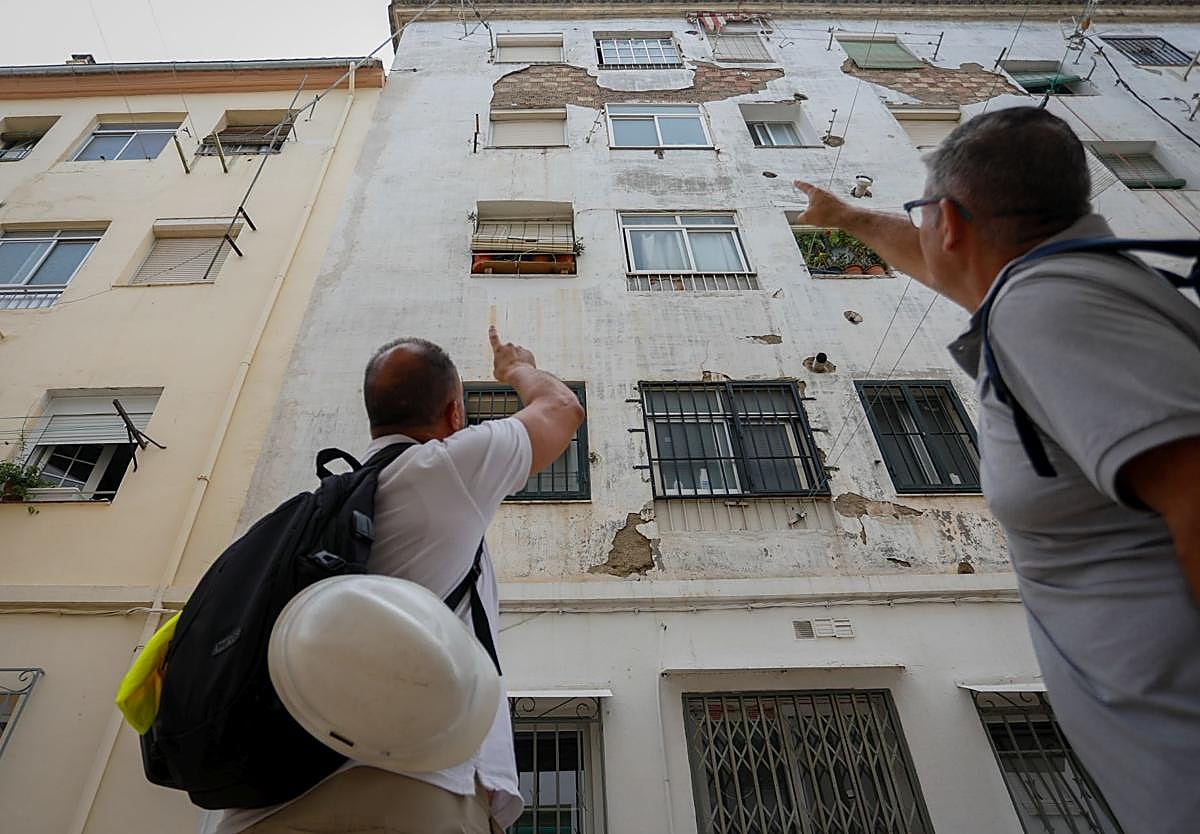
Data provided by the city council indicate that there were around 225 calls in the first 24 hours following the main earthquake, 70 per cent of which involved requests for inspections by technical experts. A close inspection of the streets, even in areas with older housing stock, reveals, relatively speaking, few instances of debris falling from façades and external features – which are the most dangerous due to their unpredictability. The fact that the earthquake struck at 1.04 am on a weekend in August prevented more serious damage.
Technical inspections
In a press release, the mayor of Granada, Marifrán Carazo, reassured the people of Granada while also urging them to exercise caution. “From the very outset, we mobilised all municipal resources and are working in a coordinated manner to respond to every report and carry out technical inspections of those properties that require them,” she said.
The mayor went on to say, “We will keep the response team on standby and will continue to review all cases that may require a specialist assessment,” she said. Between 8.30am and 6pm on Saturday the municipal Fire Prevention, Firefighting and Rescue Service (SPEIS) handled approximately 400 calls and carried out 122 operations relating to the inspection and stabilisation of unstable building structures.
Of these operations, 106 were carried out in the metropolitan area, mainly in Ogíjares, one of the towns most severely affected by the main earthquake due to its proximity to the epicentre and its particular topography. During this period, several homes were also evacuated in the area around Calle Marqués de Mondéjar and Alhamar, as well as in the municipality of Ogíjares.
Between 6pm on 15 August and 8am on 16 August, the fire service handled approximately 150 calls and carried out a further 32 operations relating to the inspection and stabilisation of unstable structural elements. Of these, 26 took place in the southern part of Granada city and six in the metropolitan area, mainly in Ogíjares.
Traditional buildings
As a result, the cumulative total for the first two full days following the earthquake stands at nearly 600 requests processed and over 170 inspection and clean-up operations. When prioritising where to take action, they have been working to remove loose elements from façades, which could dislodge debris if any of the aftershocks were to be stronger, and securing cornices, overhangs and chimneys – elements that are highly fragile as they are external to the structures themselves and have their tops finished with materials such as brick and plaster, which are more likely to collapse in the event of seismic activity.
Engineers are paying particular attention to traditional buildings constructed with load-bearing brick masonry walls, as in these buildings the walls themselves form part of the load-bearing structure. In some cases, cracks have been particularly visible on façades and in homes, and a more detailed assessment has therefore been carried out.
One of the areas that has been the focus of the greatest concern amongst local residents has been the Zaidín, particularly the homes in Santa Adela, where technicians have responded to numerous requests from residents asking for their homes to be inspected. In many cases, these are properties well over half a century old, remnants of a Granada that had not yet exhausted its available space for housing development.
“Granada is gradually returning to normal, but we are not going to let our guard down. We will continue to respond to requests, step up inspections and coordinate all available resources,” said the mayor yesterday, after thanking everyone involved in the operation for their cooperation.
Alternative accommodation
The mayor of Armilla, Loli Cañavate, said that nearly a hundred properties were inspected in her town between Saturday and Sunday. “Municipal technicians spent the whole of Saturday visiting the worst-affected areas and responding to calls from residents asking about the extent of the damage to their homes,” she says.
In virtually all cases, the damage was superficial and did not affect the structure of the property, except in one instance: an old detached house on Calle Salamanca, home to an elderly lady, where the roof is in danger of collapsing. “She is a woman who lives alone, with no close family, and the technicians, given the risk of collapse, advised her to evacuate the property. For the time being, as she has no alternative accommodation, she has been put up in a hotel while a solution to her situation is sought.”
The mayor spoke to several hundred concerned local residents on Sunday: “We have tried to explain to them that we are in an earthquake-prone area and that we are in the middle of a series of seismic activity that will continue to produce aftershocks, although, in principle, these will be less severe than the major tremor recorded in the early hours of Sunday morning. Furthermore, we have made ourselves available to help them file claims with the insurance and to answer any questions they may have,” she said.
In the neighbouring village of Las Gabias, around 20 incidents were dealt with, and the 112 emergency service received reports from Alhendín, Churriana de la Vega, Ogíjares, Padul, Almuñécar, Gójar, Dílar, Guadix, La Zubia, Pinos Puente, Granada, Armilla, Motril and Cenes de la Vega.
![[]](http://static.vocstatic.com/voc26/latest/assets/images/favicon/surinenglish/apple-touch-icon-57x57.png)