
Spanish government set to declare Almeria fire area a 'disaster zone' to speed up emergency aid
Third deputy prime minister Sara Aagesen pledged that Madrid will cover half the cost of restoring forests destroyed near Bédar, while renewing calls for a cross-party pact to tackle the climate emergency
Miguel Cárceles
Almería
Spain's government has begun the process of declaring the Almeria wildfire zone a disaster area, in a move designed to speed up emergency financial ... aid. The area will be classed as a zone seriously affected by a Civil Protection emergency, commonly known as a "disaster zone".
The fire broke out near Los Gallardos on 9 July and has claimed 13 lives. The fire directly hit five municipalities: Los Gallardos, Bédar, Lubrín, Sorbas and Antas.
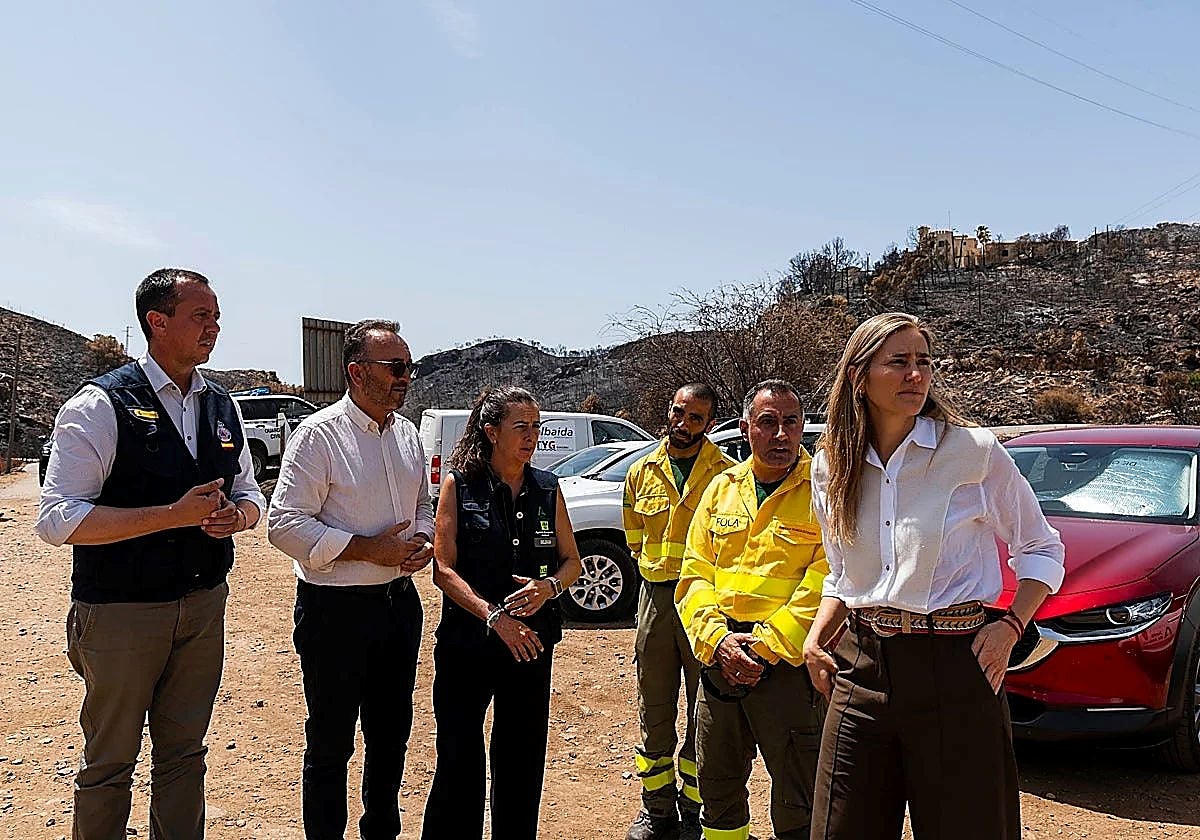
Sara Aagesen, Third Deputy Prime Minister and Minister for Ecological Transition and the Demographic Challenge, announced the measure on Tuesday after visiting Bédar, one of five municipalities where a total of 7,000 hectares have been destroyed.
Speaking at the scene, Aagesen offered the government's condolences to the families of those who died. She also pledged support for residents who have suffered significant property losses.
"The emergency doesn't end when the fire is out," she said. "It ends when full recovery has been achieved." She promised "maximum cooperation" between all levels of government during the reconstruction phase.
The central government will cover 50 per cent of the costs of restoring the damaged forests and other affected environmental areas, Aagesen confirmed. That funding will go to the Junta de Andalucía, the regional government.
Aagesen also praised the firefighters and emergency personnel who worked tirelessly to bring the blaze under control. Cooperation between all the agencies involved, she said, had been the defining feature of the response.
Climate emergency
Aagesen used the visit to renew her call for a State Pact on the Climate Emergency. Spain needs a long-term political agreement, she argued, one that "goes beyond electoral cycles and party colours." Any such pact, she said, should be grounded in scientific rigour, anticipation, preparedness and adaptation measures to protect the public and Spain's natural heritage.
She was also asked about proposals on natural disaster management from opposition leader Alberto Núñez Feijóo. Aagesen said the government had already formally proposed a pact last September, and that its "hand remained extended" to reach an agreement.
But she had strong words for governing pacts between mainstream parties and the far right in some autonomous communities. "Doing deals with climate deniers completely leaves the public unprotected," she warned. It amounts, she said, to "denying reality and scientific evidence."
A grim year for wildfires
More than 50,000 hectares of forest have already burned across Spain this year, Aagesen said. That is almost three times the figure recorded over the same period in 2025, a year already regarded as an especially severe one for wildfires.
She attributed the surge directly to global warming. Europe is heating up at twice the global average rate, she noted, leaving Spain in a position of extreme vulnerability. The country has just recorded its second-hottest June on record and its third-driest. Together, those conditions act as a tinderbox, sharply raising the risk of fires starting and spreading.
Aagesen also warned that Aemet, Spain's state meteorological agency, expects temperatures to keep rising this week and has not ruled out another heatwave next weekend. She urged the public to exercise caution during the summer months, particularly when visiting natural areas, and called for extra care in August, when large numbers of people are expected to travel to view the total solar eclipse.
![[]](http://static.vocstatic.com/voc26/latest/assets/images/favicon/surinenglish/apple-touch-icon-57x57.png)