
Spain wildfires 2026
Huelva fire spreads to over 28,000 hectares hours before the eclipse temporarily restricts aerial efforts
Due to the astronomical phenomenon, aerial resources will have to withdraw at 7.30pm, while the emergency services keep 681 people under precautionary evacuation orders
C. P. S.
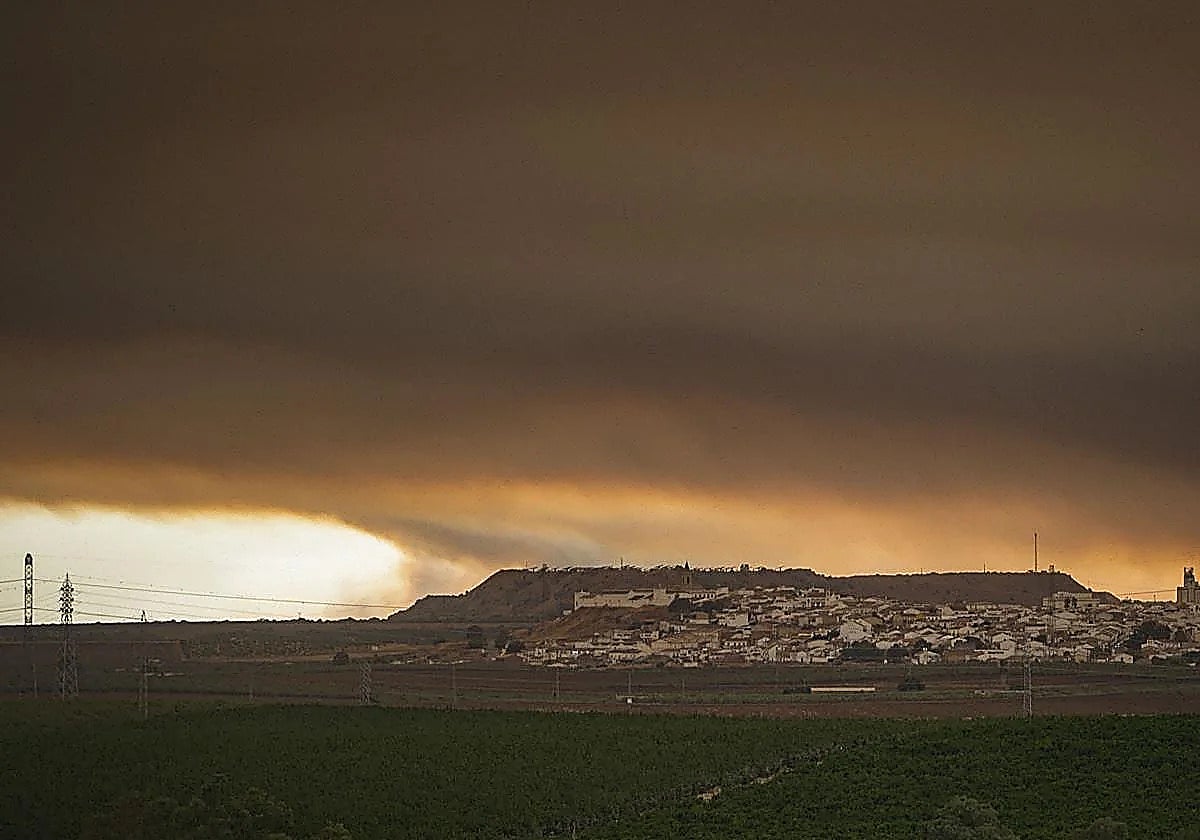
The wildfire that broke out on 6 August in the Raboconejo area of Niebla, Huelva, has now spread across a perimeter of around 28,000 ... hectares after what regional authorities described as an "extremely difficult" night, with repeated fire jumps, headwinds and thermal inversion.
Speaking to reporters after a meeting of the operations committee, regional minister of emergencies Antonio Sanz said emergency crews had managed to "progressively slow" the flames' rate of growth despite the adverse weather.
Crews are now focusing on containing the fire's perimeter, but the operation will face an additional challenge on Wednesday when aircraft have to withdraw at 7.30pm because of aviation restrictions linked to the solar eclipse.
Related story

Sanz stressed that, although the figures show the scale of a "terrible wildfire", containment efforts are "bearing fruit" in what he described as a "long-distance race full of obstacles".
"The day before yesterday we reduced its growth by 50 per cent compared with the previous day and yesterday we reduced it by another 50. In other words, yesterday it grew by just 25 per cent compared with two days earlier. Today's aim remains to close off routes for the fire and reduce its energy," Sanz said.
The head of emergencies detailed an "intense" defensive operation overnight as the fire displayed "abnormal" behaviour, including "large-scale" fire jumps that occurred "against the wind".
He said the situation forced crews to redirect 15 teams (around 120 firefighters) along with heavy machinery to the north-west at short notice to prevent the flames from advancing towards El Pozuelo, in the municipality of Zalamea la Real.
"We managed to stop it and, despite the huge effort involved, we have stabilised that north-western area and prevented the fire jumps from taking hold," Sanz said.
Wednesday's weather forecast points to another difficult day, with the wind changing direction repeatedly as it shifts from easterly to south-westerly during the afternoon, coinciding with the most dangerous hours. Thermal inversions recorded early in the morning have also delayed the effective deployment of aircraft.
The most active and critical fronts on Wednesday lie in the north-east, around Berrocal, which flames have surrounded without damaging its infrastructure, and in the east, around Pata del Caballo in Escacena del Campo.
Crews are working intensively to stop the fire crossing the road linking El Álamo and Aznalcóllar. By contrast, Sanz said the southern flank "is behaving much more favourably and remains stable".
Eclipse forces aircraft to withdraw
Wednesday's forecast points to a challenging situation. The wind, which began the day from the east and pushed the fire westwards, will gradually turn clockwise and become south-westerly in the afternoon, bringing "strong gusts and critical conditions during the central hours".
The operation also faces "convective and fire-whirl phenomena", while a thermal inversion this morning delayed the effective deployment of planes and helicopters.
Sanz also highlighted a constraint affecting Wednesday's operation: the mandatory withdrawal of the aerial fleet at 7.30pm. "The state aviation safety agency (AESA) has ordered this across Spain because of the solar eclipse, so aircraft can only operate until that time. It is a general aviation safety measure that affects us directly, but ground crews will continue fighting the fire on the ground," he said.
700 firefighters and 681 evacuees
The firefighting operation continues under operational level 2 of the emergency plan, with almost 700 professionals now working on the ground, supported by 257 vehicles and other resources. Local industries are also providing logistical support.
Meanwhile, authorities have ordered 681 people to remain away from their homes as a precaution. Of these, 62 are staying in accommodation provided by the authorities.
The regional government will continue to allow strictly coordinated, limited access for urgent needs, such as caring for animals or collecting medication.
Sanz also noted that eleven roads in Huelva and Seville provinces remain closed to traffic: HU-3106, A-493, HU-5104, HU-4103, HU-6104, SE-6400, HU-6106, SE-6402, SE-5400, SE-538 and HU-6108.
![[]](http://static.vocstatic.com/voc26/latest/assets/images/favicon/surinenglish/apple-touch-icon-57x57.png)