
Earthquakes
Alhambra Palace gradually reopens following series of earthquakes in Granada
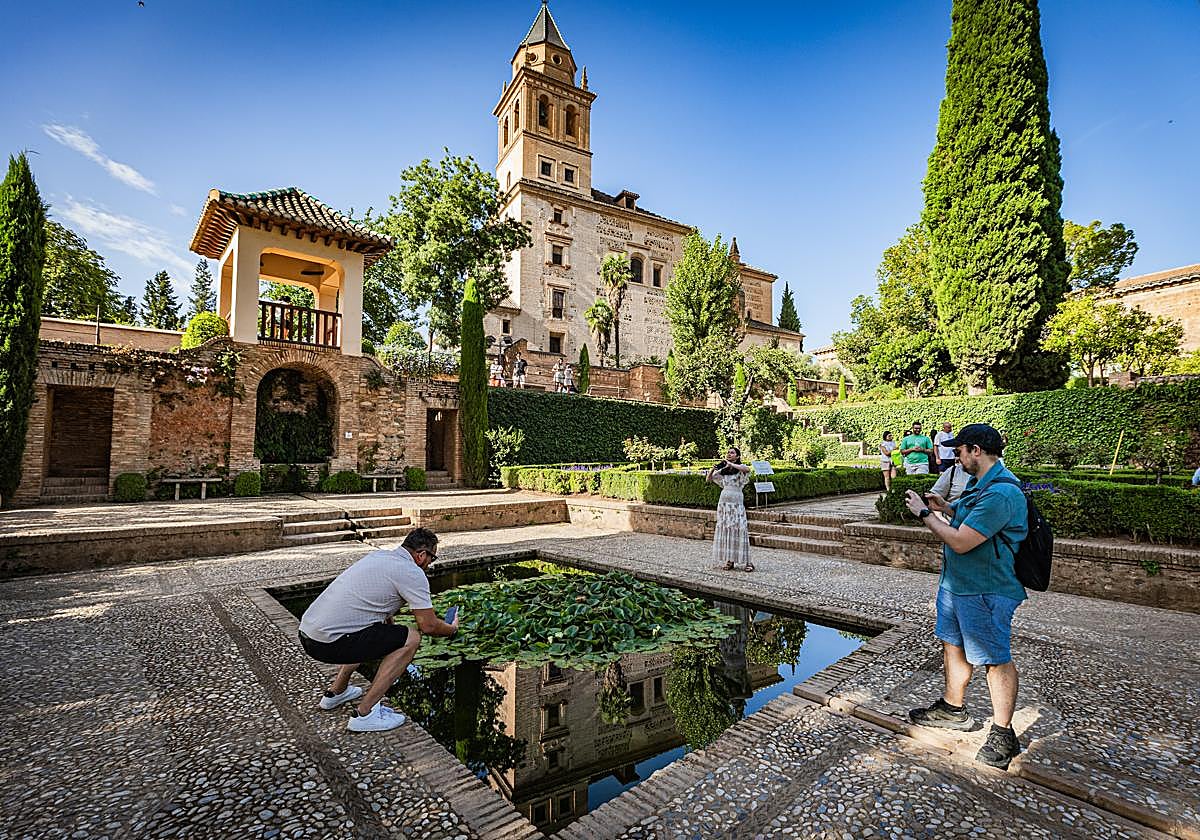
Areas including the Partal Gardens, the Emperor’s Chambers and the Lindaraja Courtyard have reopened following inspections carried out in the wake of the quakes

Jorge Pastor
Granada
The Alhambra palace's history, stretching back eight centuries, was disrupted on Tuesday 18 August at 10.37am when a strong earthquake, with its ... epicentre in Gójar and the numerous aftershocks that were felt shook the foundations of Granada city's most famous historical monument.
In just under an hour, the Alhambra had been evacuated and a process began to inspect the structures and ornamental features to determine which areas could be visited and which could not. The Alcazaba and the Torre de Comares were closed, as was a large part of the route taken by the eight thousand people who visit the Alhambra every day.
However, the Patronato, the foundation which manages the Alhambra, has begun a gradual reopening of the site starting with the Partal Gardens and the Paseo de las Torres.
The Torre de Comares and the Alcazaba remain closed for the time being. In the former, experts are carrying out a detailed examination of all the plasterwork, as microparticles of plaster, which were applied in the 20th century as filler, have begun to flake off. The fragments, which are minuscule in size, have been left exactly where they fell, so that all the circumstances surrounding the earthquakes can be analysed in detail and incorporated into the Alhambra Living Lab. The aim? To ensure that the digital twin of the Nasrid complex is as complete as possible.
The solution adopted is that visitors may temporarily look into the Sala de la Barca and, once this space has been cleared, move on a few metres to view the Salón del Trono, one of the Alhambra’s greatest treasures, thanks to its interlaced wooden ceiling depicting the seven heavens of the Islamic cosmos and its walls covered with epigraphic inscriptions in Arabic. The Patronato will establish a viewing point inside the room, where a great deal of inspection work still remains to be done. It also remains to be seen how temporary this measure will be, the possibility of restricting access to this spot, where crowds are a frequent occurrence, has been under consideration for some time.
The Alcazaba
In the Alcazaba the restrictions will be extended and a date has not been set for its reopening to the public. The reason is the stability of some battlements, which have been affected by the latest quake. In fact, these are extensions added during the 20th century, and their mechanical behaviour is independent of the rammed-earth walls on which they rest.
In any case, the Patronato intends to ensure that visitors can continue to climb the Torre de la Vela; to this end, a path will be marked out through the Adarves, leading out via a false door. In the meantime, further assessments will continue to be carried out using drones. The aim is to model, with millimetre precision, how the Torre de la Vela – one of Granada’s most iconic landmarks – behaves depending on the direction from which seismic waves strike it. Scaffolding will also be erected so that experts can access the walls directly.

The Alhambra has certainly proved its resilience when the ground in Granada begins to shake. Why is this? Firstly, because it is built on ‘Alhambra conglomerate’, a geological formation that provides firm ground whilst also offering a certain degree of malleability and flexibility. Furthermore, the accumulation of clay combined with water creates a water table that acts as a natural shock absorber, very effectively absorbing the energy of earthquakes.
Access to the Throne Room will remain restricted whilst all the walls and plasterwork are being inspected
The bricks used to construct the buildings were made from the same earth. This symbiosis prevents the formation of cracks that could lead to further damage. Architectural advances from the Al-Andalus period also played a part. In the Patio de los Leones, for example, the different sections of the columns – the base, the shaft and the capital – are connected internally by small metal cylinders. This prevents the marble from cracking or splitting.
The tremor on 18 August has once again demonstrated that the Alhambra is not an inert mass of stone, but a dynamic organism capable of responding and adapting.
![[]](http://static.vocstatic.com/voc26/latest/assets/images/favicon/surinenglish/apple-touch-icon-57x57.png)