
Andalusian Escapade
An unusual Roman city
Tucked into the hills north of Seville, this remote Roman mining town and stepped sanctuary offers a rare glimpse of ancient Hispania
Tony Bryant
Hidden among the hills north of Seville, the Munigua archaeological site contains the remains of a Roman settlement that feels far removed from the grand monuments of the better-known Andalusian cities. Although the Roman city of Italica (also in the province of Seville) was considerably more important overall in Hispania, Munigua was a surprisingly significant city in its own right, particularly for mining, metallurgy and religious architecture.
Munigua's origins date back to pre-Roman times, and it reached its peak between the 1st and 3rd centuries AD. Its location was closely linked to the copper and iron mines in the surrounding area. The town gradually declined as its mining resources were depleted, while an earthquake at the end of the 3rd century further accelerated its downfall.
Today, extensive archaeological remains can still be seen, and the site is officially designated as a 'historic-artistic monument'. Many Greco-Roman sculptures and numerous Greek, Roman, Iberian and Arab ceramic fragments have been discovered on this site, providing evidence of its rich cultural heritage and its importance as a meeting point for different ancient civilisations.
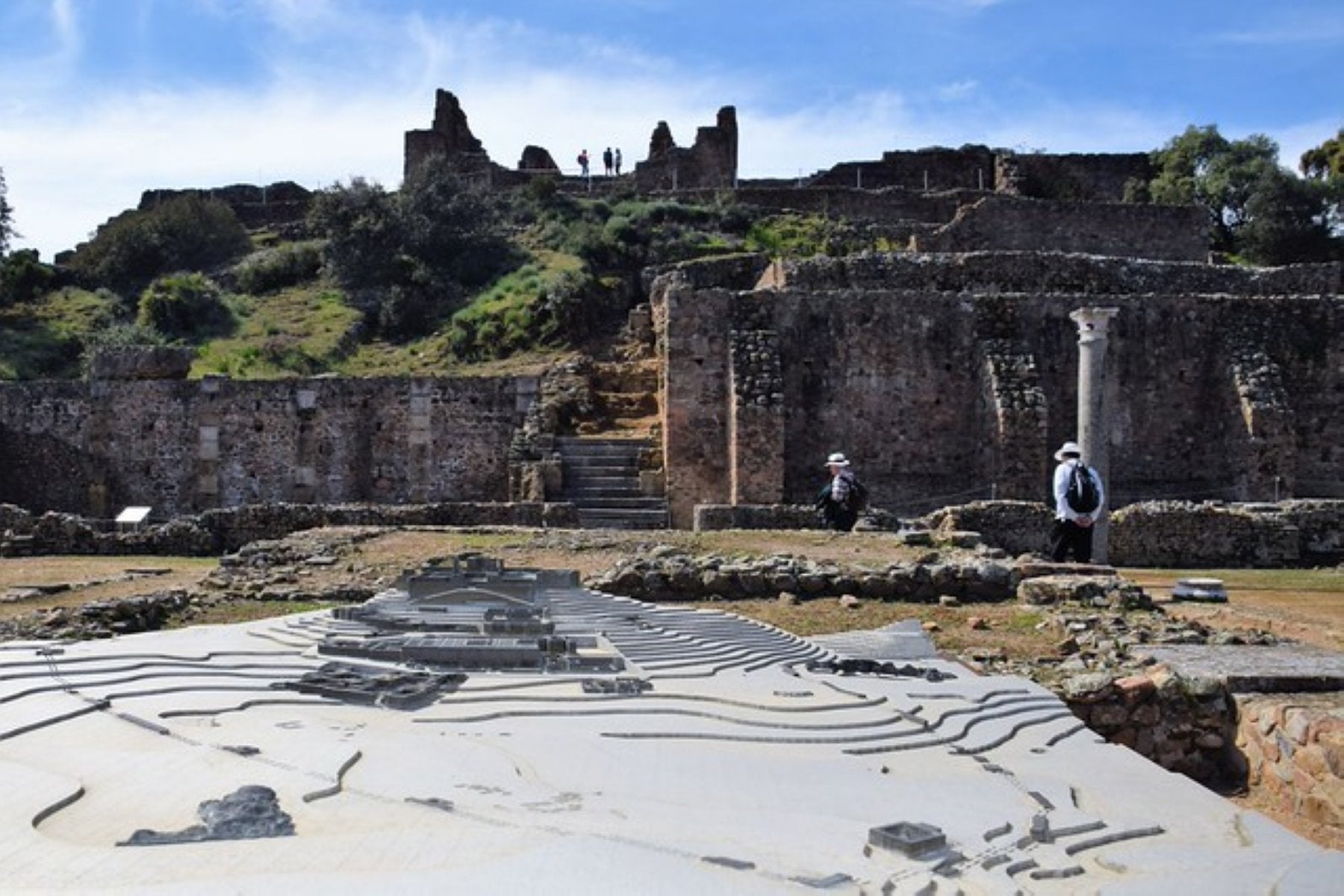
Munigua, also known as Mulva, is one of the most fascinating and unusual Roman archaeological sites in Andalucía, offering countryside views and a wonderfully remote atmosphere. The winter temperatures are ideal for a stroll among the ruins of the Roman houses and a series of monumental retaining walls and stairways. The remains of the public buildings offer a glimpse into how the inhabitants organised their civic life. The thermal baths date from the 1st century and were remodelled during the construction of the Forum, the political, commercial and social heart of the city. The necropolis and mausoleums are particularly interesting because they offer an insight into burial customs and the importance of the mining community.
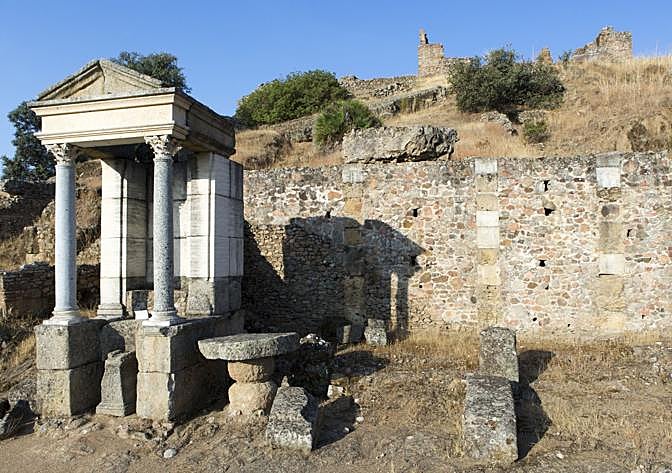
The site was first documented in the 16th century, and in the 18th century, a report identified the ruins of a castle. However, it was later found not to be a fortress or castle, but more likely a Senate House.
This site is particularly interesting for those interested in the history of Hispania - the Roman name for the Iberian Peninsula - because it is not a typical Roman town: it is built on a hillside, surrounded by spectacular views and has an impressive monumental sanctuary rising above the remains of the city.
The settlement is unusual in Roman Spain because of its resemblance to the great terraced sanctuaries of Italy, such as the Sanctuary of Fortuna Primigenia, considered one of the greatest masterpieces of Roman republican architecture.
Although some of the architectural remains visible today date back to the Augustan period, most of Munigua's public and religious buildings were constructed during the final third of the 1st century AD. This period of intense urban development coincided with Emperor Vespasian's granting of municipal status to the city.
Unconventional sanctuary
The most spectacular part of the site is the large terraced sanctuary built high on the hillside. Its monumental, stepped architecture distinguishes it from many other Roman sanctuaries in the Iberian Peninsula. Rather than being a conventional temple standing independently in a flat forum, this magnificent religious complex was integrated into the natural landscape. It was built using a succession of artificial terraces connected by monumental stairways and architectural structures. The terraces formed a striking ascent towards the sacred area, transforming the approach to the sanctuary into an integral part of the religious experience.
Munigua is easily accessible from Villanueva del Río y Minas, a town situated approximately 40 kilometres from Seville. Those who enjoy hiking can take a beautiful rural walking route through the countryside of the Sierra Morena foothills to access this remarkable Roman city. Known as the Camino de Munigua, the route follows part of the historic Cordel del Pedroso, a traditional livestock track.
