
Immigration
Ceuta on high alert amid fears of another migrant influx due to campaign that warns of the day 'everything will make sense'
Six platforms, dozens of chat groups and hundreds of thousands of users are rallying behind the uncertain call to repeat the human tide of 30 July
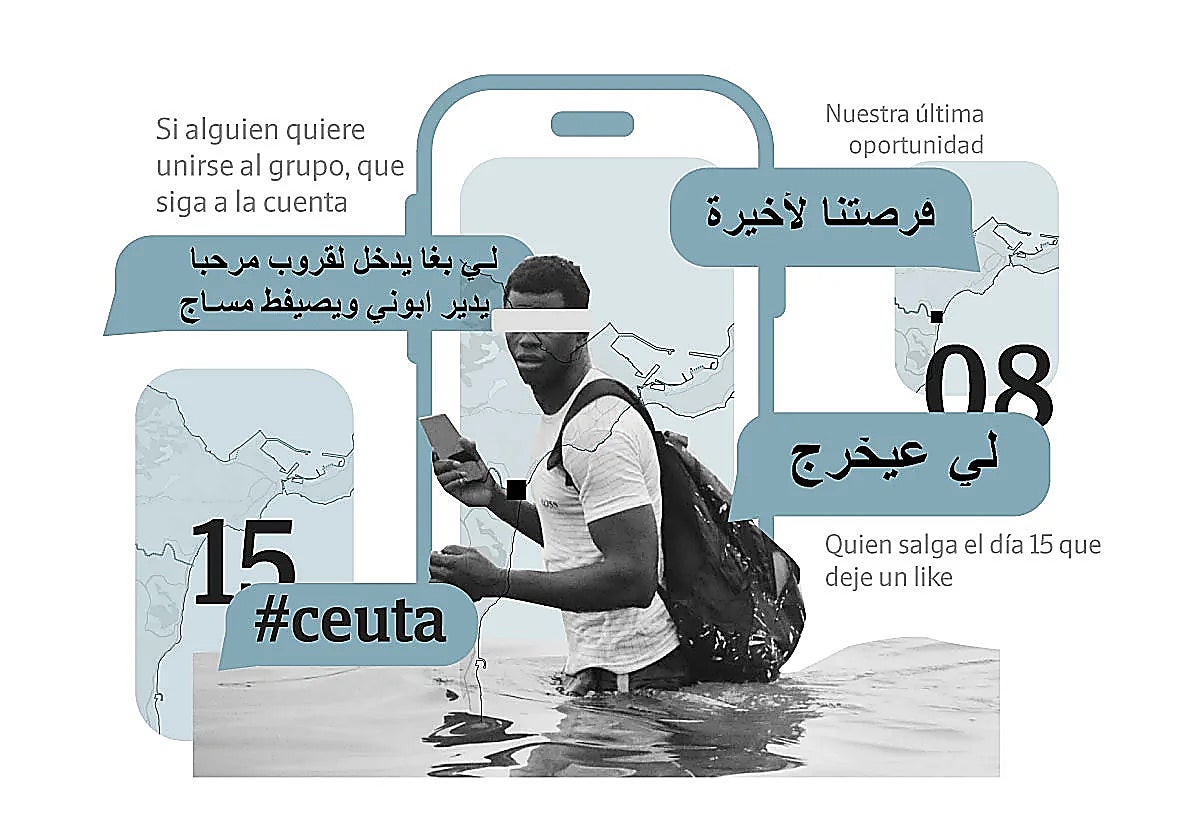

On Friday, 31 July, at 8.52am, an anonymous Facebook account posted a question: "What will happen on 15 August 2026?".
Hours after tens of thousands of people entered Ceuta on the previous Wednesday and Thursday ... , rumours were already circulating about a second attempt: this Saturday, 15 August.
The Ministries of the Interior and Defence have been trying for days to secure Ceuta by land and sea, preparing for what could be a real risk.

The call has spread beyond all control across social media. The Guardia Civil believe that the fast-spreading message has the potential to mobilise people.
National Security documents insist, however, that it is impossible to predict whether this call will elicit a genuine response, let alone forecast whether it will result in a mass influx like the one at the end of July.
Official analyses, based on open-source information, all issue the same warning: there is a risk that this could happen, but no one can yet gauge its scale.
There is unease among officials at the department of National Security and very little certainty. To date, not even the CNI has managed to establish with certainty who is behind that first message that lit the fuse.
Official reports have identified small-scale coordination, synchronised messages and offers of transport and accommodation.
Facebook, WhatsApp, Instagram, TikTok, Telegram and X make up the ecosystem through which the calls to action, slogans and messages circulate. Facebook serves as a showcase and recruitment tool; Instagram and TikTok turn phrases and videos into viral content; Telegram directs users to chat groups; WhatsApp hosts the more specific conversations.
There is no central command centre. Instead, there are small groups, users who jump from one community to another and messages forwarded almost simultaneously.
Since 1 August, a deliberately ambiguous slogan has been circulating on WhatsApp: 'On that day, everything will make sense'. On 3 August, a post in the Facebook group 'Alhucemas, gateway to Ceuta' was more categorical: "Brothers, at sunset and sunrise on 15 August, everyone will get in."
Reports from the Spanish intelligence services indicate that, in the last few hours, there have been around 30 active WhatsApp groups with more than 2,000 participants. For the past two weeks, five large Facebook communities have also been active, with a combined total of more than 210,000 members.
These 30 WhatsApp groups and the five Facebook communities account for a significant proportion of the activity, although the call to action extends much further and is also circulating on Telegram, TikTok, Instagram and X.
Officials from the state security services have warned, however, that a very significant proportion of this traffic stems from news content disseminated by pan-Arab media, rather than from organisers or potential participants.
"There is no reliable tally of recruiters, let alone a credible estimate of attendees," a senior security official in Ceuta said.
Morocco has been monitoring 23 Facebook groups with over 1,086,000 members and an average of more than 1,400 posts per day. Subsequently, some of that content has migrated to job forums, local groups and smaller chat rooms. This constant movement makes it even more difficult for the CNI and the department of National Security to make any reliable assessment of the likely response to next Saturday's rally.
In the chat groups, participants vote on dates and destinations, exchange forecasts and discuss provisions. Some participants feature in several groups and act as bridges between them.
There are almost identical messages posted just a few minutes apart: commercial offers relating to transport, equipment and accommodation are also circulating, alongside warnings about potential scams. "These are signs of facilitation and economic opportunism. They do not prove the existence of a single central command," Spanish police documents state.
Those same documents highlight the age of the alleged would-be migrants planning to make the crossing this weekend. In internal surveys, the majority of respondents said they were between 14 and 17 years of age. Some asked which law would apply to them or assumed that Spain would not be able to send them back.
The legal information circulating is fragmentary and, often, false. Expectations are fuelled by messages portraying the border as open, asylum as automatic or transfer to the mainland as guaranteed.
The immediate precedent helps explain the strength of that message. On 8 July, the Supreme Court's long-awaited ruling on the return of people who arrive by swimming was made public.
The ruling neither grants residence nor prevents return. It establishes that, if a physical barrier has not been breached, special refusal of entry at the border does not apply and the standard return procedure must be followed.
Between 8 and 31 July, a study by Maldita.es identified 1,171 posts in Arabic by 727 users, with over 150,000 reactions, 14,000 comments and 7,000 shares across more than 200 groups.
On 30 July alone, there were 695 posts, compared with a previous average of around ten a day. Around 215 identical copies of a text falsely promise no immediate deportation upon arrival.
According to some sources, the Spanish secret services were "obviously" aware of that "surge" in messages and that they issued the "necessary warning".
The Ministry of the Interior has stated that there were no reports from the CNI warning of the imminent surge at the end of July, which resulted in at least 72,000 people crossing the border and more than 100 deaths on both sides of the border.
The messages refer to people from Fnideq, Tetouan, Tangier, Casablanca, Salé, Marrakesh and Agadir. Other users, described as "influential profiles" in official documents, claim to live in Rome or Istanbul. Algerian, Turkish and Danish area codes have also appeared. None of this information makes it possible to geolocate the writer: a profile may be true, false or out of date.
The confusion surrounding the origin of the call for the illegal border crossing on 29 and 30 July and the call to repeat it this Saturday makes it impossible to identify those responsible.
SUR has not had access to, nor been able to consult, any official document attributing the organisation of these events to the Moroccan government, its security services, Algeria, a political party, an NGO or a specific criminal organisation.
The documents drawn up by state security analysts describe a three-tiered structure: private coordination, public dissemination and micro-recruiters. The result is a decentralised ecosystem in which youthful frustration, peer influence, intermediaries, underground businesses, viral accounts and disinformation all intermingle.
Both sides are now aware of the date. Spain has stepped up surveillance and Morocco has set up checkpoints on roads, at stations and at entry points to the north.
This could reduce the size of the mobilisation on 15 August, bring it forward, postpone it or fragment it. Publicity surrounding the event is already altering conversations. Some groups are voting for other dates, while others are expelling anyone who asks too many questions.
On August 10, five days before the event, an Instagram account posted the same message twice regarding Ceuta and Fnideq: "Our date is 08/15/2026." One post had no comments.
![[]](http://static.vocstatic.com/voc26/latest/assets/images/favicon/surinenglish/apple-touch-icon-57x57.png)