
Education
Spanish teachers' discontent marks start of school year with strike threats
The Ministry of Education is proposing a reduction in class sizes, while teachers are calling for pay rises and a reduction in the bureaucratic burden

Madrid
The start of the new school year, which for teachers begins on 1 September and for pupils between 7 and 15 September, depending on the ... region and the stage of education, is looming on the horizon.
The normal return to school, however, remains uncertain in the Spanish territory of Ceuta due to the migration crisis since the end of July.
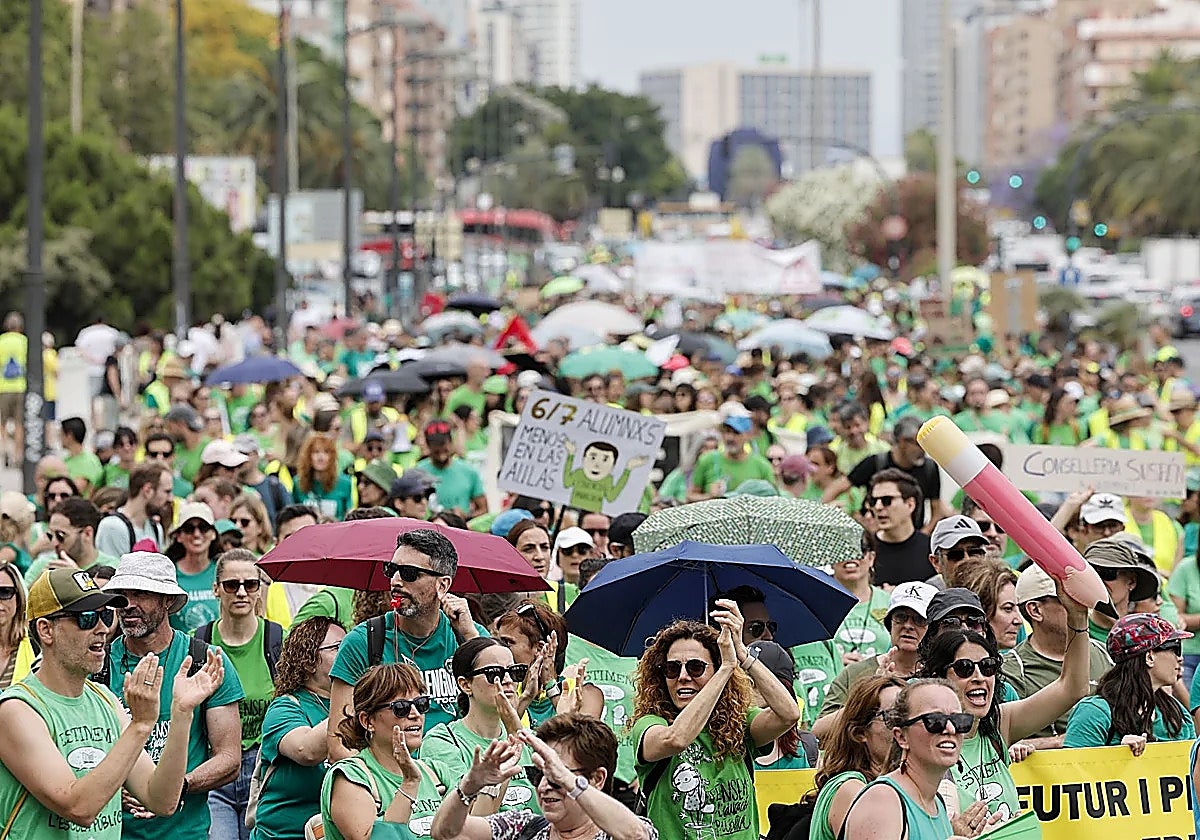
Following a school year that ended with protests in almost every region, the reopening of schools will serve as a barometer of the tension between teachers and the Ministry of Education.
Catalan teachers have already announced a strike on 8 September, while in Madrid they have scheduled a strike for 14 October.
Also on 8 September, the OECD will publish the findings of the Pisa 2026 report, an assessment that Spain has consistently failed for many years and which will serve as a barometer of the state of education in the country.
Teachers' demands cover every aspect of their work. In May, when they took part in mass demonstrations in defence of their rights, they called for a reduction in pupil-teacher ratios, fewer teaching hours so they could provide more personalised support, an increase in staffing levels, more specialist support for vulnerable pupils, higher salaries and less bureaucracy, stating that administrative tasks limited the time they could devote to teaching.
The protests by early years teachers (ages 0-3), the group with the worst working conditions, marked a turning point. With a collectively agreed salary of 17,094 euros gross per year (1,332 euros net per month paid in 12 instalments) they staged the most intense strikes last year.
The tension spread to other regions and other stages of education. In Valencia, teachers went on strike for two weeks to secure better conditions; in Catalonia, they demanded pay rises; in Aragon, they protested against the privatisation of upper secondary education and in defence of state education.
In such a difficult climate, the Ministry of Education sought to make a gesture towards teachers and, on 24 June, put forward a proposal aimed at easing the discontent.
The proposal would more than halve the maximum number of pupils in the first cycle of early-years education, for children in the 0-3 age group. It would also reduce class sizes in the second cycle, for children of ages three to six, from the current 25 pupils to 20. In sixth-form education, it would lower the maximum from 35 to 30 students.
The government expects to approve the royal decree in the final quarter of 2026. It does not need parliamentary approval and only requires Cabinet to give it the green light.
According to the draft, the measures would come into force from the 2027-28 school year, initially applying to the first year of the first cycle of early-years education. The changes would then extend gradually to the second and third years, with full implementation due at the start of the 2029-2030 academic year.
The unions are now studying the proposal but have not ruled out strike action. They broadly welcome the plans but want the government to include financial improvements and introduce smaller class sizes immediately rather than phasing them in until 2030, as the ministry proposes.
The government and unions will also have to negotiate entry requirements for the teaching profession, including changes to teacher-training degrees, placements and the syllabus for competitive teaching examinations. Meanwhile, the lower house has its own legislation to consider: a bill that would reduce class sizes in primary and secondary education and limit teachers' classroom hours.
Screens and vocational training
The new school year will also reopen several debates that remain unresolved. One concerns the use of screens in education. Several regions have moved towards sharply reducing children's use of digital devices, at least until the age of 12, and returning to a more traditional approach centred on books. The growing use of artificial intelligence, however, is adding new layers to the debate over technology in the classroom.
In vocational education and training (VET), which continues to grow in popularity, the main problem is a shortage of places in the public system, forcing many students to turn to private providers. Last year, 1.2 million students enrolled in VET, a record for Spain.
Another challenge involves integrating immigrant pupils into the education system. During the last school year, the number of foreign pupils rose by 2.3 per cent to 1,175,063, according to the statistics on non-university education. They now account for 13.5 per cent of all pupils.
The same annual report puts the total number of pupils enrolled in primary and secondary education last year at 8,249,174, including 4,238,725 boys and men and 4,010,449 girls and women. That represented a 0.8 per cent fall on the previous year, largely because of demographic decline among school-age children, particularly in the second cycle of early-years education, where numbers fell by 2.4 per cent.
Spain's education system has 806,178 teachers, of whom 589,083 work in state schools and 217,095 in private and state-subsidised schools. The teaching workforce grew by 8,815 last year, an increase of 1.1 per cent. State schools added 9,490 teachers, up 1.6 per cent, while private and state-subsidised schools lost 675, a fall of 0.3 per cent.
Tensions in Ceuta
The start of the school year in Ceuta will take place against the backdrop of the migration crisis, which has forced the government to introduce emergency measures.
At a meeting with the education community on Thursday, education secretary of state Abelardo de la Rosa announced that police would be present at schools when pupils arrive and leave. Security would also increase around school buildings during the afternoons and nights to prevent unauthorised people from entering.
Security will also protect school transport routes.
De la Rosa said schools, which he described as already "ready, clean and repaired", would reopen for teachers on 1 September and for pupils on 8 September. "Educational activity will not be interrupted," he said.
The Education Ministry also announced a support programme in schools for pupils who may be struggling most with the crisis. The aim will be to help them process what is happening, reduce its psychological impact and support their emotional well-being.
"We will look after the pupils' emotional well-being and mental health, as well as ensuring good coexistence in our schools," De la Rosa said.
![[]](http://static.vocstatic.com/voc26/latest/assets/images/favicon/surinenglish/apple-touch-icon-57x57.png)