
Spain wildfires 2026
Spain's PM announces end of national emergency the fires in Madrid and Ávila triggered
The coordination of the operation to extinguish the fire is now the responsibility of the regions
Salvador Vallejo
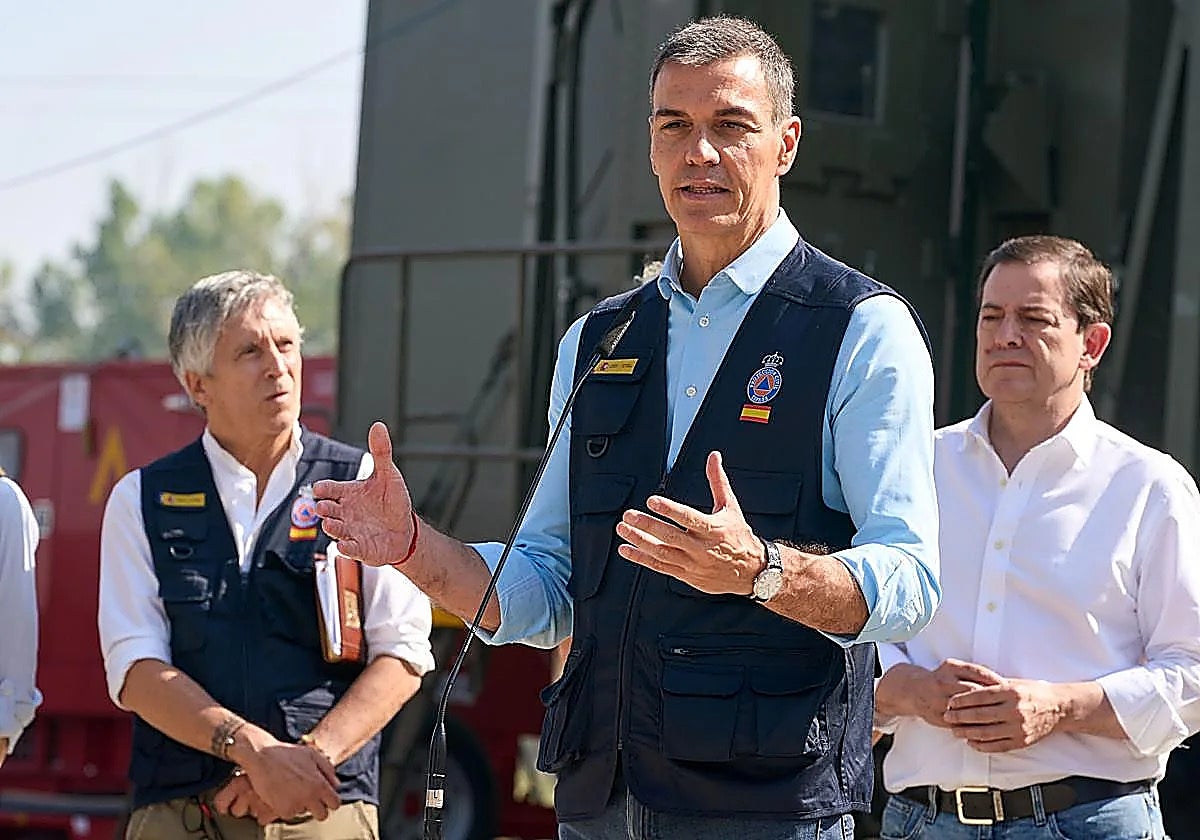
Spain's Prime Minister Pedro Sánchez announced on Thursday the end of the national emergency the fires in Madrid and Ávila had triggered. On Wednesday night, the authorities declared the fire "stabilised".
"Having heard the proposals from the regions of Madrid and Castilla y León, as well as the technical criteria of the operational command, we have decided to move to operational level 2 and lift the national emergency," Sánchez said from the command post in Navaluenga, Ávila.
This means that the coordination of the firefighting operation is now entirely a regional responsibility.
Related story

"This is reassuring news," Sánchez said. Despite the emergency level reduction, the military emergency unit (UME) and the civil protection services will continue providing support to the firefighters in the two regions.
"We need to continue with the cooling and mop-up work. Residents can rest assured," Sánchez stated.
First national emergency
The Spanish government declared a national emergency due to forest fires for the first time in its history on 23 July.
The country has been under a national emergency only once before: on 28 April 2025, during the nationwide blackout.
The prime minister congratulated the emergency services for the "effective response" and the "more than 150 consecutive hours of tireless work".
He also expressed his "eternal gratitude" to the workers who "risked their lives" to fight the fires and to the town halls and regional governments that collaborated in coordinating.
"We come from different levels of government, but we worked as if we were a single team," Sánchez stated.
Despite the improved situation in Madrid and Ávila, Sánchez warned that "the emergency continues". He reminded the public that Spain is "facing a new heatwav, the fourth this year".
"Let's all take extra precautions," he urged, while condemning the fact that "some of the most devastating fires are due to carelessness". "These kinds of acts will not go unpunished," he said.
PM Sánchez also insisted on a state pact against climate emergencies, to work on the prevention of future forest fires and on the recovery of the affected areas.
Damage in numbers
The provisional estimation is that over 70,000 hectares have burned between the fires in Madrid and Ávila. The latter has become the most devastating in the history of Spain.
There are still 1,000 evacuees in the residential areas closest to the San Juan reservoir.
Access the broad Spain national news archive
![[]](http://static.vocstatic.com/voc26/latest/assets/images/favicon/surinenglish/apple-touch-icon-57x57.png)