
Archaeology
Roman kitchen dating back more than 2,000 years discovered in Burgos
This find marks the conclusion of the tenth archaeological campaign in Sasamón, organised by the Mérida Institute of Archaeology (IAM) and the University of Salamanca
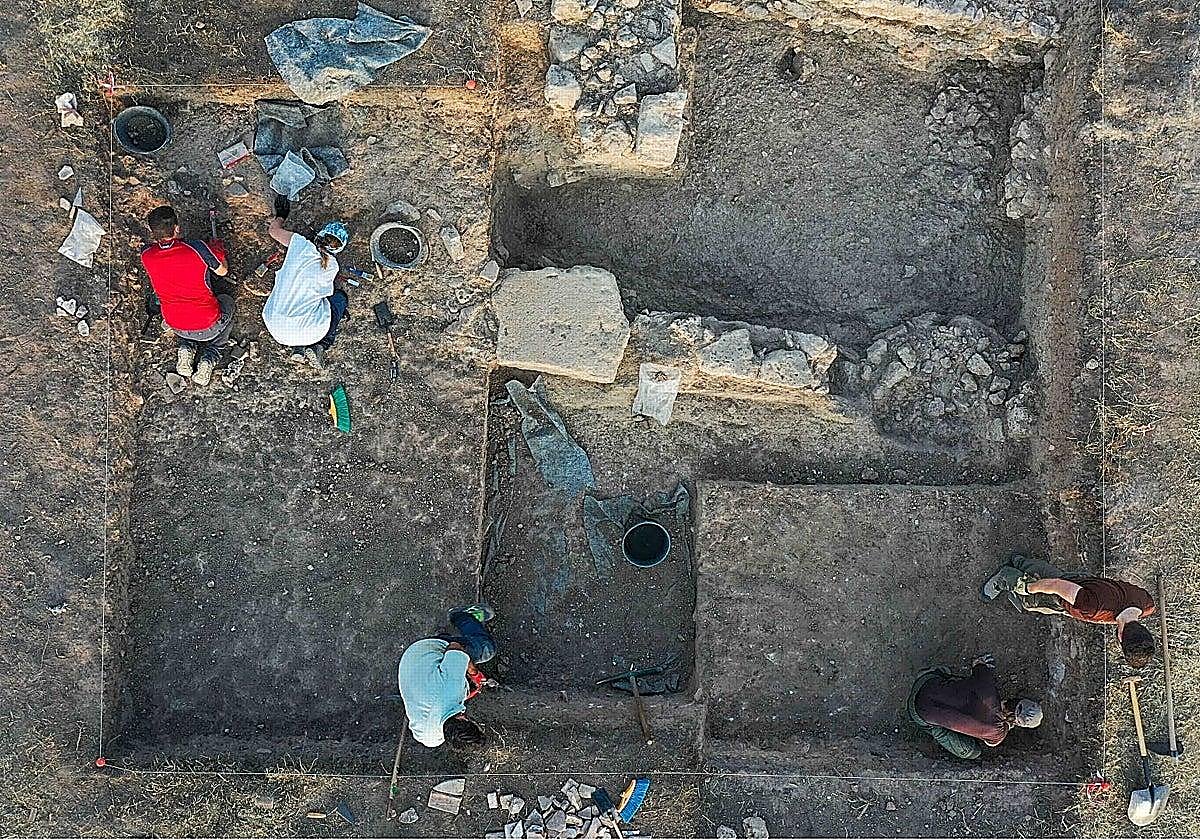
I. Cortés
The archaeological excavation at Sasamón (Burgos) in northern Spain has unearthed a Roman kitchen dating from the late 1st century BC and the early 1st ... century AD.
This discovery forms part of a research project that has been led for the past decade by the Mérida Institute of Archaeology (IAM) and the University of Salamanca to study the historical development of ancient Segisamo and its territory, under the direction of José Manuel Costa García (University of Salamanca) and Jesús García Sánchez (Institute of Archaeology of Mérida, IAM-CSIC-Junta de Extremadura).
In this context, the excavations carried out during August on the La Era site, next to the church of Santa María la Real in Sasamón, revealed various structures dating from the first phase of occupation of the Roman town, including this millennia-old kitchen.
As Costa explains, the Roman kitchen "has been severely affected by subsequent looting, but it is still possible to make out the remains of a clearly functional space, a possible oven and numerous materials associated with food preparation".
The walls of this room were built of adobe on stone plinths and were probably plastered, a technique that has endured in traditional Castilian architecture. The floors were also simple and economical in design: a layer of compacted clay was laid over a bed of pebbles, ensuring durability and ease of cleaning.
"We have a somewhat idealised image of Roman cities as monumental spaces, but we rarely come across mosaics and painted walls in domestic and productive areas," explains the professor from the University of Salamanca. A small step marked the edge of a raised area that probably served as the floor of a furnace, now almost completely destroyed. This is where the fire would have been lit; its remains have been found by archaeologists two thousand years later: a thick layer of ash and charcoal from which numerous artefacts have been recovered.
“The ceramic remains recovered are consistent with the space having been used as a kitchen,” notes Jesús García, who highlights the age, diversity and good general condition of the tableware: "We have documented large containers used for food storage (dolia), as well as jugs, bowls and other utensils for food preparation, such as mortars."
These are joined by other pieces directly related to cooking: in addition to the modest pots, there are frying pans (patera) with non-stick coatings, the famous pottery with Pompeian red slip, and even fragments of a clibanus, a small portable oven that would have allowed bread to be baked on a refractory surface. Some of the artefacts undoubtedly originate from the Italian Peninsula; others would have been produced locally.
The researcher from the Mérida Archaeological Institute points out that "during the reigns of Augustus and Tiberius, there were people living in Segisamo whose culinary practices were entirely Roman, but this does not mean that all the city’s inhabitants were foreigners, as some of the pottery follows the Turmoga tradition". This mix of people and customs undoubtedly gave the inhabitants of ancient Sasamón a distinctive character. “It’s as if we were looking at a Turmoga grandmother’s cooking: a bit of the new; a bit of the old,” joke the researchers.
Older remains
It is possible, however, that this is not the earliest phase of occupation at the site. Another pit clearly shows that the Roman structures were preceded by others whose construction style is reminiscent of Iron Age settlements, such as the one excavated at the neighbouring Cerro Castarreño, revealing that the indigenous population played an important role in the construction and identity of the new city. Archaeologists wish to continue exploring new areas to understand how this community lived and how the city developed over the centuries.
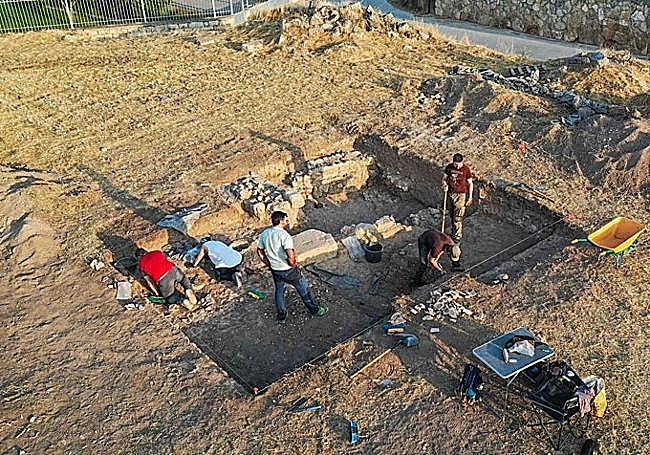
The main aim of the excavation at La Era is to shed light on the origins of Roman Sasamón, but the archaeological work is proceeding with the meticulousness typical of an urban context. Working in reverse order to that in which the layers were deposited, the archaeologists are removing each layer of earth and documenting every preserved structure in order to gather evidence that will enable them to piece together the different phases of the town’s history.
Oral history and early 20th-century photographs still preserve the memory of the era devoted to threshing and mule herds. However, little or nothing was known about the use of this same space as a burial ground during the 19th century. The ten or so graves documented to date conform to Christian rites, but the group is situated away from the historic burial ground, in the cloister of the Church of Santa María, and shows signs of having been hastily constructed.
"The only reliable artefact we have to date these burials is a button from a jacket dating from the reign of Isabel II (1833–1868)," notes Laura Blanco, a researcher at USAL specialising in funerary archaeology. "We may be looking at a cemetery linked to one of the epidemics that ravaged Burgos during the 19th century.”
Further evidence of occupation and plundering can be dated to the modern period (16th-18th centuries), possibly the last time that people lived in this area among the ancient Roman ruins. A simple path led to modest dwellings, of which only a few walls remain, and the hearths where the inhabitants sought warmth and food.
Beneath these levels, some evidence from the medieval period still remains – a time when Sasamón witnessed the construction of its imposing church, but about which we have very little documentation regarding its urban layout. In short, there is still much to be done, as only an area-wide excavation will allow us to study the ground-plan architecture and spatial layout of the various buildings that have been uncovered.
Archaeologists must now study in detail the vast quantity of archaeological materials recovered, ranging from items of personal adornment (bronze pins and earrings, glass and jet bracelets and necklaces) and various tools (iron knives and nails, oil lamps for lighting, and various items of tableware) to waste materials that can provide a great deal of information about the diet of the ancient inhabitants, as is the case with bone remains.
The personal touch of these people can also be seen in the footprints imprinted in the wet clay of some bricks or the words they carved into certain pottery pieces, which we know as graffiti.
A commitment to new technologies
The summer campaign has not been limited to archaeological excavation. At the same time, the research team has used state-of-the-art non-invasive technologies to locate and study the region’s heritage without causing any damage to it.
Aerial remote sensing using drones and geophysical surveys using ground-penetrating radar and magnetometers make it possible to identify archaeological sites and even obtain detailed plans of the structures without the need to disturb the subsoil.
These methodologies have demonstrated their enormous potential in the past, enabling the reconstruction of the urban fabric of Segisamo (Sasamón) itself and leading to spectacular discoveries such as the Roman villa at Santa Olalla (Olmillos de Sasamón), where a possible Visigothic church was identified.
During the 2026 campaign, the team from the Mérida Institute of Archaeology (IAM-CSIC), in close collaboration with the Laboratory of Minimally Invasive Archaeology (MinarqLab), has continued to explore settlement and land use during the Roman period, studying sites such as Los Anillos, where aerial photography and ground-penetrating radar have revealed a small rural settlement, possibly linked to water collection from the moorland; or at La Serna-El Molino, where magnetic surveying has revealed the existence of a prehistoric settlement -perhaps Chalcolithic in date - which extends the region’s chronological sequence by several millennia.
![[]](http://static.vocstatic.com/voc26/latest/assets/images/favicon/surinenglish/apple-touch-icon-57x57.png)