
Politics
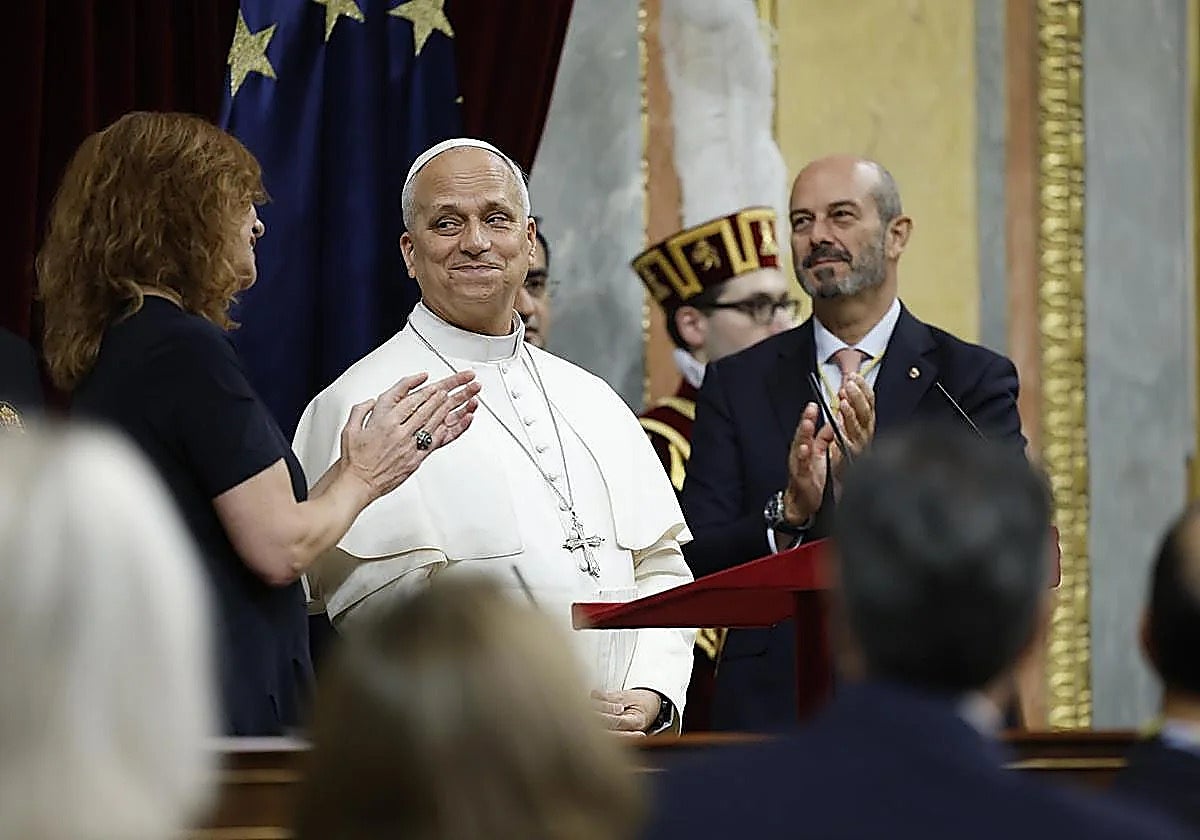
Pope Leo XIV receives seven-minute standing ovation following his speech in the lower house
In his speech in Madrid, the Pope defended "courageous diplomacy" and the welcoming of migrants, while opposing abortion and euthanasia
Paula De las Heras
In the most heated parliamentary session in recent Spanish democratic history, before members of the lower and upper house, who have spent years unable to find common ground, Pope Leo XIV delivered a strong message on Monday : "Firmness does not demand contempt. Disagreement does not entail humiliation."
In any other context, the phrase might have sounded like a platitude, but uttered by the same Pontiff, who days earlier had warned against "identity-based approaches that populate the world with enemies and phantoms", it acquired the weight of a moral challenge with clear targets.
Leo XIV's address was the first by a Pope to the Spanish Parliament. He built it upon an uncompromising diagnosis: that the world is undergoing a profound spiritual and cultural crisis manifested in violence, polarisation and mistrust.
The Pope urged legislators to adopt a public discourse capable of respecting those who think differently, to create institutions that foster dialogue and to cultivate a social life that upholds "civic friendship and mutual respect amidst disagreement".
He warned that rearmament as an "almost inevitable" response to international instability worries him and reiterated that "political pluralism should not degenerate into the permanent denigration of the adversary".
This is the thread that connects Leo XIV's three days in Madrid: the conviction that words can "open paths or close them and that those who hold public office have "a special obligation to safeguard the word".
His speech also rested on the idea that the recognition of the inviolable dignity of the person "precedes any concession by the state and cannot be subordinated to shifting social consensuses or the ebb and flow of majorities at any given moment".
The government of Pedro Sánchez, which is going through one of its worst political moments, beset by corruption cases that have tarnished his party (the PSOE), has interpreted the first days of the Pope's visit as an endorsement of its positions on foreign policy and migration.
The Pope's speech on Monday, however, was more demanding and urgent than the one he gave on Saturday.
Leo XIV called for the safe entry of migrants and condemned mere "flow management" as an insufficient response. He said that all human life must be "recognised and protected from conception to natural death" and rejected the "abortion culture".
"Can a community be truly just if it casts out the unborn child, the elderly, the sick, those who suffer in silence or those who depend entirely on the care of others?" he asked.
The Pope also highlighted that the "primary and inalienable right" of parents to choose their children's education and championed the family as the "first human reality". This message aligns with the right wing's ideology.
At the same time, however, Pope Leo XIV warned that wherever a person is discriminated against because of their national, ethnic, religious or linguistic origin, "the universal principle of the equal dignity of all human beings is gravely violated". This condemnation directly targeted conservative parties' "principle of national priority", which is gaining ground in housing and employment policies.
Modern freedom and Christianity
Pope Prevost also defended the weight of "Christian tradition" in building "modern freedom". "In that inner school, people learnt that law must serve the good, that justice limits force, that power needs legitimacy, that the poor belong fully to the community, that the foreigner must be welcomed according to their dignity and that human life can never be treated as a commodity," he said.
He then warned: "A law does not attain its true greatness merely by virtue of having been formally approved. It attains it when, in addition to being valid in form, it can stand before the dignity of the person and emerge from that examination without shame."
At the end of his speech, Pope Leo XIV received a seven-minute standing ovation from the members of all parties present, despite their political differences and disagreements.
![[]](http://static.vocstatic.com/voc26/latest/assets/images/favicon/surinenglish/apple-touch-icon-57x57.png)