
Immigration
Ceuta receives 191 per cent more migrants, not including the 80,000 who crossed at the end of July
The latest figures from the Interior Ministry reveal that irregular arrivals have risen so far this year at all entry points, with the exception of the Canary Islands

Spanish PM Pedro Sánchez said two weeks ago that the number of migrant arrivals had fallen this year compared with the same period in 2025.
While the overall figures do indeed show this, the truth is that the only point of entry into the country where there have been fewer irregular arrivals is the Canary Islands, which previously had record figures as a result of the migration crisis that prompted emergency measures.
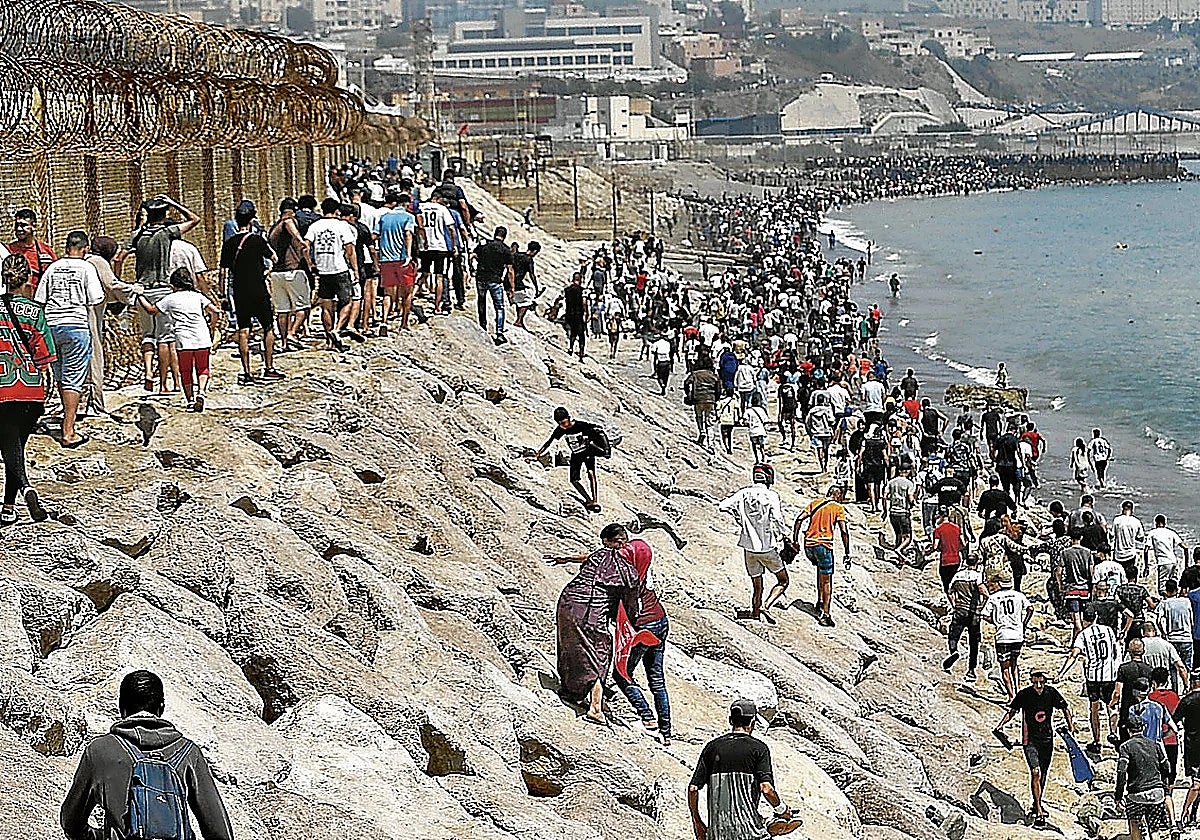
The sharpest increase has been in Ceuta, with a 191 per cent rise in the number of people entering by scaling the fence or swimming across. This is without taking into account the influx on 30 and 31 July. The Interior Ministry considers that this incident requires a specific analysis.
Related story

Spain's government to place buoys at sea to immediately return migrants without breaching Supreme Court ruling the Spanish territory of Ceuta has taken in a total of 5,013 people since the start of the year up to 15 August.
This is almost five times the number of arrivals the Interior Ministry recorded over the same period last year (1,725).
Melilla has also registered an increase in irregular arrivals. Unlike Ceuta, this increase has occurred not only by land, a count that also includes crossings by swimming, which total 548 (382 more than in the same period last year, a 230.1 per cent increase), but also by sea, that is, aboard boats.
The Interior Ministry has recorded a total of 18 arrivals, three more than during the same period, from January 1 to August 15, last year.
The number of arrivals continues to rise on the mainland and in the Balearic Islands as well. Specifically, the archipelago in the Mediterranean has received a total of 236 vessels, compared with 230 in 2025. This represents the irregular arrival of 4,433 migrants, more than 100 more than in the same period a year earlier.
The greatest increase has been along the southern and eastern coasts. Following two years in which migratory pressure shifted towards the Atlantic, the consolidation of routes from Algeria to Almeria, Murcia, Alicante and Valencia has once again driven up the number of arrivals.
The number of boats reaching the mainland coast stands at 295, eleven fewer than in 2025, but the number of people on board has meant that the total number of arrivals has risen by 1,224, from 3,928 a year ago to 5,152 recorded this year.
The Canary Islands, the only exception
The 9.4 per cent fall in arrivals in the Ministry of the Interior's overall figures, from 22,040 to 19,972, is solely due to the decline in the number of arrivals in the Canary Islands. It is the only region in Spain to record a decline.
The figure has fallen from 11,883 to 4,808. This represents 7,075 fewer migrants than in 2025, a figure equivalent to a 59.5 per cent decrease.
This decline along the Atlantic route is largely due to an increase in cooperation and border surveillance agreements with countries of origin and transit such as Mauritania, Senegal and The Gambia.
Despite the drop in arrivals during this period, the region remains on a degree of alert due to the smaller number of unaccompanied migrants who arrived on the islands during the periods of highest migration intensity, although some of them have already been transferred to other regions.
![[]](http://static.vocstatic.com/voc26/latest/assets/images/favicon/surinenglish/apple-touch-icon-57x57.png)