
Society
A hominid skull fossil dating back more than 200,000 years has been discovered in Ciudad Real
The archaeologists who discovered it say their find supports the idea that, during the Middle Pleistocene, populations of hominids with different evolutionary trajectories coexisted in Europe
J.V. Muñoz-Lacuna
Ruidera (Ciudad Real) is a village famous for its lakes, set within a nature reserve, which are very popular in summer as a place to ... cool off or go for a swim. But from now on, it will also be known for the discovery of a skull fragment dating back more than 200,000 years at its palaeontological site.
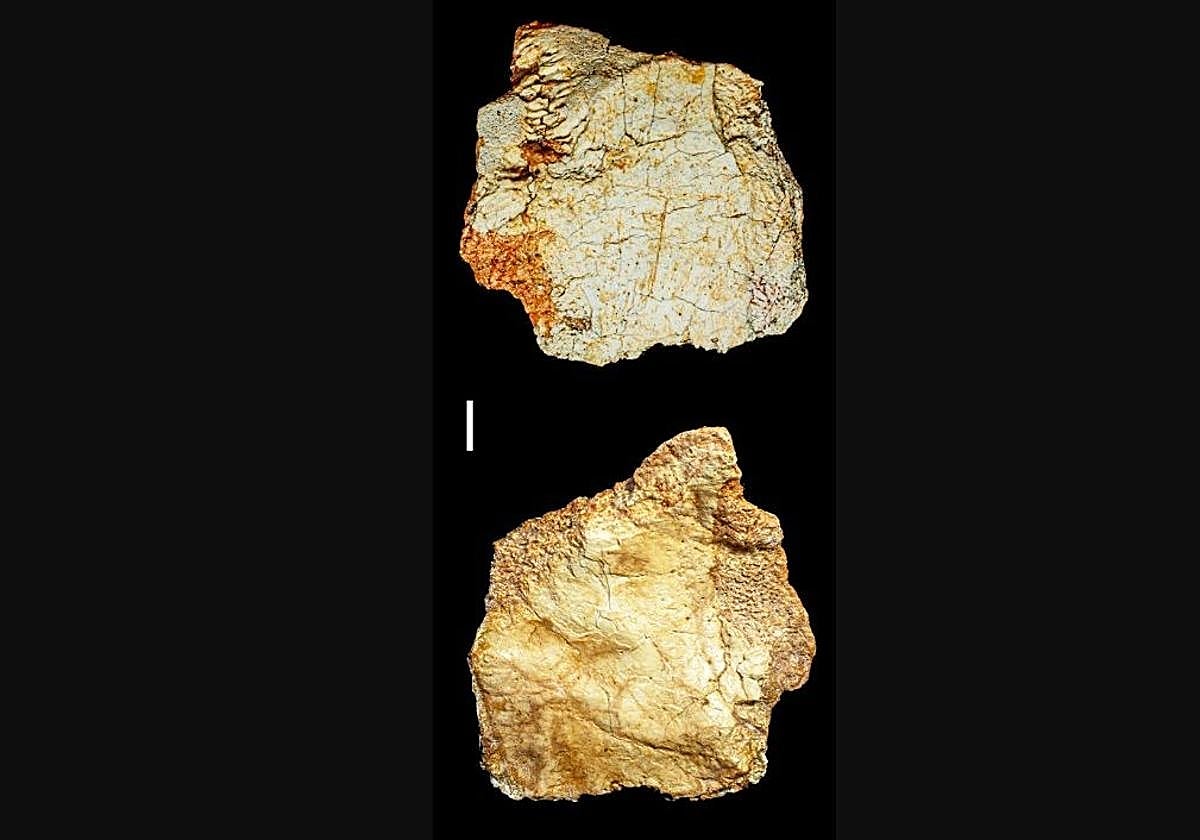
According to its discoverers, it will enable research into human evolution during the Middle Pleistocene (between 126,000 and 780,000 years ago). The fossil found is a fragment of a parietal bone and displays “archaic characteristics that differ from those of remains dated to the same period”, notes Daniel García Martínez, a researcher at the Complutense University of Madrid.
Related story
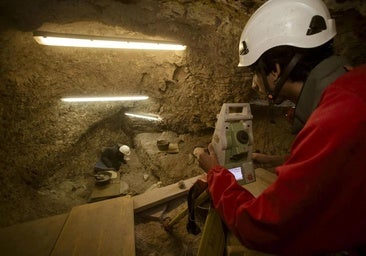
“This discovery provides information about the populations that inhabited the interior of the Iberian Peninsula during that period and places Ruidera in a privileged position on the European map for studying human evolution during the Middle Pleistocene,” adds the palaeontologist.
The discovery, published in the 'Journal of Human Evolution', is the result of work carried out by researchers from the Complutense University of Madrid and the National Museum of Natural Sciences, in collaboration with the National Research Centre on Human Evolution, the Catalan Institute of Human Palaeoecology and Social Evolution, the Autonomous University of Madrid and the University of Cordoba.
The discovery forms part of a project studying the earliest settlers of the Upper Guadiana, and its aim is to reconstruct the biological, cultural and environmental history of the human populations that inhabited the upper Guadiana basin during the Pleistocene.
Hominid with a lineage
To date the fossil, uranium and optically stimulated luminescence techniques have been used, analysing both the fossil itself and the sediments in which it was found.
The results indicate that the skull fossil exhibits "a structure that is rare amongst European fossils of that period due to its morphology and thickness; these are particularly interesting because they retain characteristics considered archaic, also known as plesiomorphic, similar to those of other archaic skulls such as the one from Ceprano, in Italy; or the one from Caune de l’Arago, in the French Pyrenees", explains Daniel García Martínez.
This unique feature, which does not fit the pattern seen in classic Neanderthals, demonstrates that at that time there were still hominid populations on the Iberian Peninsula with characteristics of ancestral lineages dating back hundreds of thousands of years, “which supports the idea that human evolution in Europe was not a linear process but a complex scenario in which different populations with distinct evolutionary histories coexisted,” says Carlos Palancar, a researcher at the National Museum of Natural Sciences.
In the case of the interior of the Iberian Peninsula, there are hardly any palaeoanthropological records, and this skull fragment found at Ruidera will help us understand who the human populations that inhabited southern Europe hundreds of thousands of years ago were and how they evolved.
In recent years, animal fossils, a wealth of stone tools and numerous human remains have also been found at this site.
![[]](http://static.vocstatic.com/voc26/latest/assets/images/favicon/surinenglish/apple-touch-icon-57x57.png)