
Palaeontology
Spanish palaeontologists discover first Diplodocus outside North America in Teruel
The discovery of 14 tail vertebrae at El Castellar shows that this iconic Jurassic herbivorous giant also lived in Europe 150 million years ago
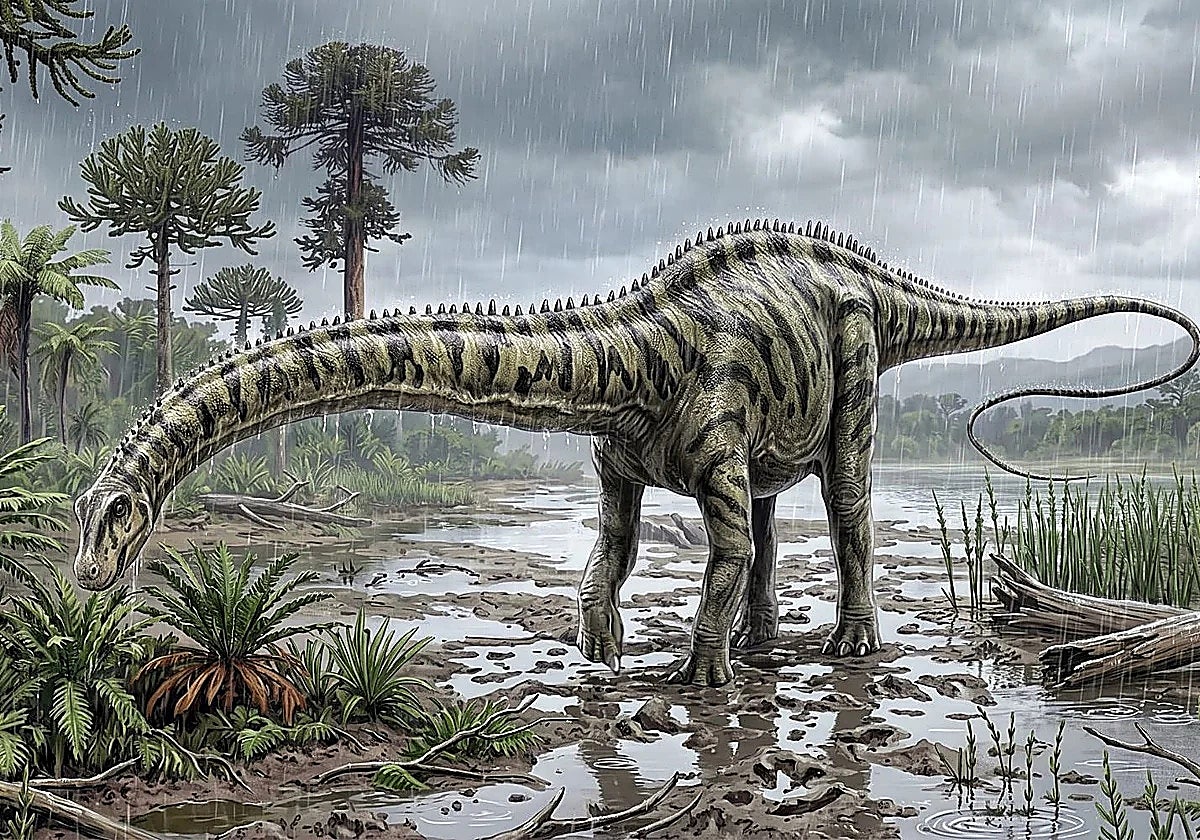

A team of palaeontologists from Fundación Conjunto Paleontológico de Teruel-Dinópolis have discovered at the La Tejería site in the Teruel municipality of El Castellar ... the first fossil remains of the genus Diplodocus to be identified outside North America.
The research, published in Journal of Vertebrate Palaeontology, describes an articulated section of the tail comprising 14 exceptionally well-preserved caudal vertebrae. The specimen has been dated to around 150 million years ago, towards the end of the Late Jurassic period.
The Diplodocus was a herbivorous sauropod dinosaur notable for being one of the longest known land animals, with an estimated length of between 25 and 30 metres. Although it was not the heaviest (its mass was around ten to 16 tonnes, well below that of other giants such as the titanosaurs), its elongated body, with a low torso and hind legs longer than its forelimbs, gave it an unmistakable silhouette.
Its small head, equipped with peg-like teeth only at the front of the jaws, was adapted for stripping leaves and thin branches.
A particularly striking feature of the animal was its extremely long tail, measuring over 14 metres and with very slender terminal vertebrae, which, experts suggest, functioned like a whip capable of reaching supersonic speeds and must have produced an audible crack.
Until now, all confirmed specimens of Diplodocus have formed part of the famous Morrison Formation, situated in the western US. However, the detailed anatomical study and phylogenetic comparisons in Spain placed the Teruel fossil within the genus Diplodocus, establishing its close relationship with the species Diplodocus hallorum.
Sergio Sánchez Fenollosa, a PhD student at Fundación Dinópolis and lead author of the study, says that the anatomical analysis gradually revealed a combination of characteristic features.
"It was an exciting and ongoing process to see how the pieces of the jigsaw puzzle gradually fell into place. From the earliest stages of the osteological study, we noticed strong similarities with various diplodocid sauropods. As we examined the anatomy more closely, we began to identify a combination of characteristics typical of Diplodocus species. Then, as we carried out various evolutionary analyses, these continued to point in the same direction. With each new result, the picture became clearer: we were dealing with a Diplodocus," Sánchez says.
Essentially, this discovery "enables us to better understand the ecosystems of the Iberian Mesozoic and the diversity of sauropod dinosaurs that inhabited the European Jurassic".
25 metres long
Dr Alberto Cobos, managing director of Fundación Dinópolis and co-author of the study, says that the specimen measured approximately 25 metres in total length, "comparable in size to its North American relatives, making it another of the giant sauropods of the Spanish Jurassic, alongside other sauropod dinosaurs from Teruel with characteristics very different from those of the diplodocids, such as Turiasaurus and Losillasaurus, among others".
The discovery provides some of the most robust palaeontological evidence of episodes of faunal dispersal and exchange between North America and Europe across the proto-Atlantic Ocean.
During the Late Jurassic, the Atlantic was a much narrower ocean than it is today and underwent regressive phases during which temporary land bridges emerged. This enabled large groups of dinosaurs to move between the two continents.
Consequently, the Iberian Peninsula shared with North America giant herbivores such as Diplodocus and Stegosaurus, as well as large theropod predators such as Allosaurus, Ceratosaurus and Torvosaurus.
![[]](http://static.vocstatic.com/voc26/latest/assets/images/favicon/surinenglish/apple-touch-icon-57x57.png)