
Artemis II
First crewed mission to the Moon in 53 years takes off
Although the crew of Artemis II will not land on the lunar surface, the mission is crucial for establishing a future lunar base and the subsequent journey to Mars
Jon Garay and Gonzalo de las Heras
Crammed into a space similar to that of a minibus, where they will spend the next ten days, past midnight Spanish time on Thursday astronauts Reid Wiseman, Jeremy Hansen, Christina Koch and Victor Glover began a journey that can undoubtedly be described as historic for several reasons.
First, it has been 53 years since Apollo 17 left the lunar surface to return to Earth. Since that December of 1972, no human being has even come close to Earth's satellite. Second, this will be the longest journey in history. The Artemis II mission will travel 400,000 kilometres from our planet, farther than any of its distant predecessors. A truly epic journey. Third, two of the crew members will remain in history as the first Black woman and Black man to reach the Moon.
"We're going to the Moon. The world has been waiting a long time to do this again. We're really excited," mission commander Wiseman said at the last press conference before going into quarantine with his three colleagues - a standard measure to prevent any setback in the form of infection or illness from derailing meticulously planned operations. "We're winning, in space, on Earth and everywhere," US President Donald Trump said.
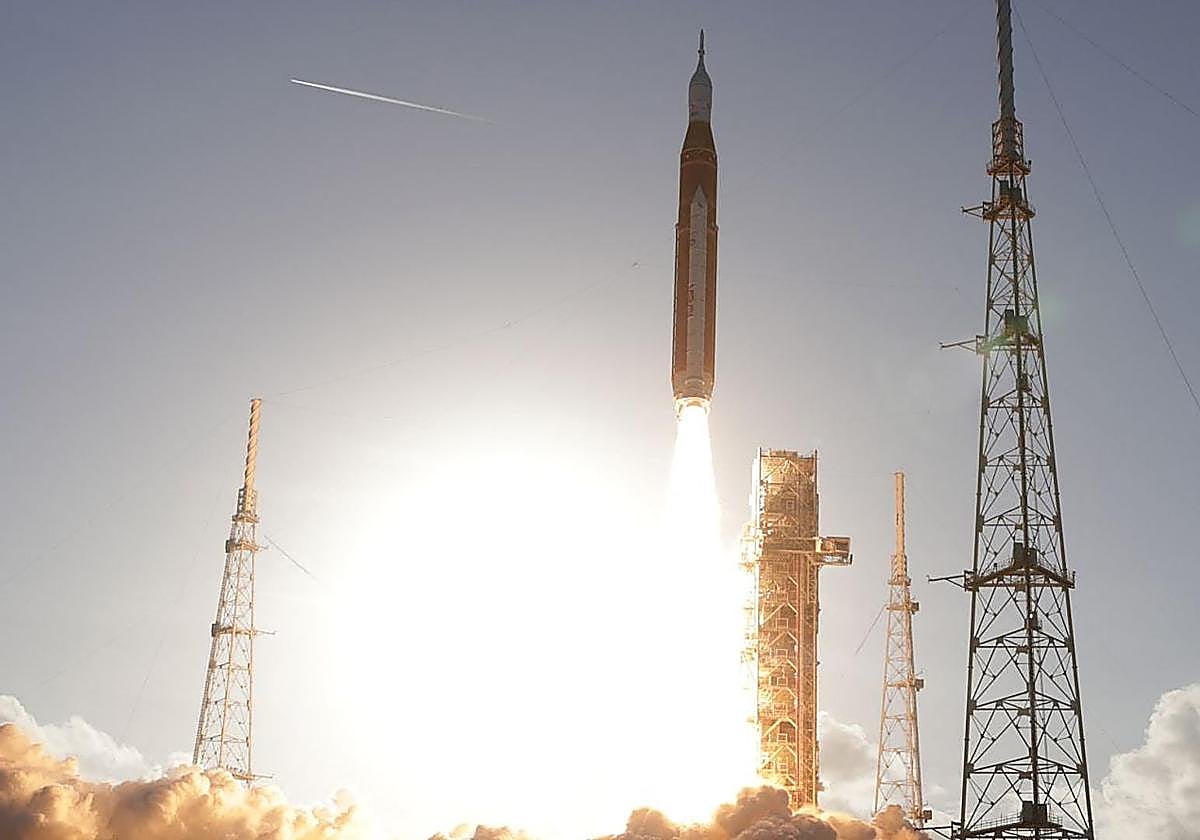
The colossal Space Launch System (SLS) took off at 12.35am after an emergency system issue was resolved. It was first propelled by two solid-fuel rockets attached to its enormous orange body. These provided the initial, energy-intensive boost. Then, the liquid hydrogen and oxygen stored in the central orange part came into play. In their gaseous state, both occupy too much space, so they must be cooled to -200C.
These two boosts are what allow the four RS-25 engines, inherited from the old space shuttles, to lift the 2,000-tonne rocket and reach the 40,000 kilometres per hour necessary to overcome gravity. "It's like standing a frigate upright and expecting it to fly," Guillermo González Gómez of the European Space Agency (ESA) told SUR.
The SLS is a giant, reaching 108 metres in height and boasting a thrust of four million kilograms, allowing it to lift a payload of up to 40 tonnes. These figures make it the largest and most powerful spacecraft ever built by Nasa, second only to Elon Musk's Starship. A direct descendant of the legendary Saturn V rocket of the Apollo missions, designed by Werner von Braun (the engineer who conceived the lethal Nazi V-2 rockets), each flight costs around four billion euros - a colossal sum that hasn't prevented it from becoming one of the Achilles' heels of the programme to return to the Moon. Its main flaw, the continuous hydrogen leaks, are responsible for Thursday's launch not being possible in February or March, when it was originally planned.
The countdown to the launch of the historic mission began this past Monday, some 50 hours before take-off. The weather forecast was favourable, with a 90 per cent chance that neither wind nor storms would interfere with the spacecraft's journey. The pressure was high, as much less favourable conditions were predicted for the following days. After completing each step, fuelling being particularly critical, everything was ready for the long-awaited moment, just after midnight in Spain.
This mission to the Moon will last ten days. On the first day, the Orion capsule, carrying the four crew members and its attached service module, built by the ESA and containing the spacecraft's water, food, oxygen, and propulsion system, will orbit the Earth twice to verify that all the spacecraft's vital systems are functioning correctly. From there, it will take them four days to reach their destination.
It is estimated that they will pass within 7,400 kilometres of Earth's satellite, travelling 400,000 kilometres away from Earth, a distance never before reached by a crewed mission.
They will be able to observe the far side of the Moon for about three hours, something only a handful of astronauts have been able to do throughout history. They will not land on the Moon, a manoeuvre planned for missions IV and V in 2028. The plan has undergone countless alterations. The latest and most significant change is the abandonment of the project to build a space station in lunar orbit in favour of building a permanent base on the Moon.
Nasa has chosen Spanish engineer Carlos García Galán to lead this new plan. The objective is to get ahead of China's lunar plans, which aim to reach the satellite before 2030. From there, the next target will be Mars.
The return trip will be "free". According to Nasa's plans, Orion will take advantage of Earth's gravitational pull for its four-day return journey. It will splash down off the coast of San Diego, California.
![[]](http://static.vocstatic.com/voc26/latest/assets/images/favicon/surinenglish/apple-touch-icon-57x57.png)